
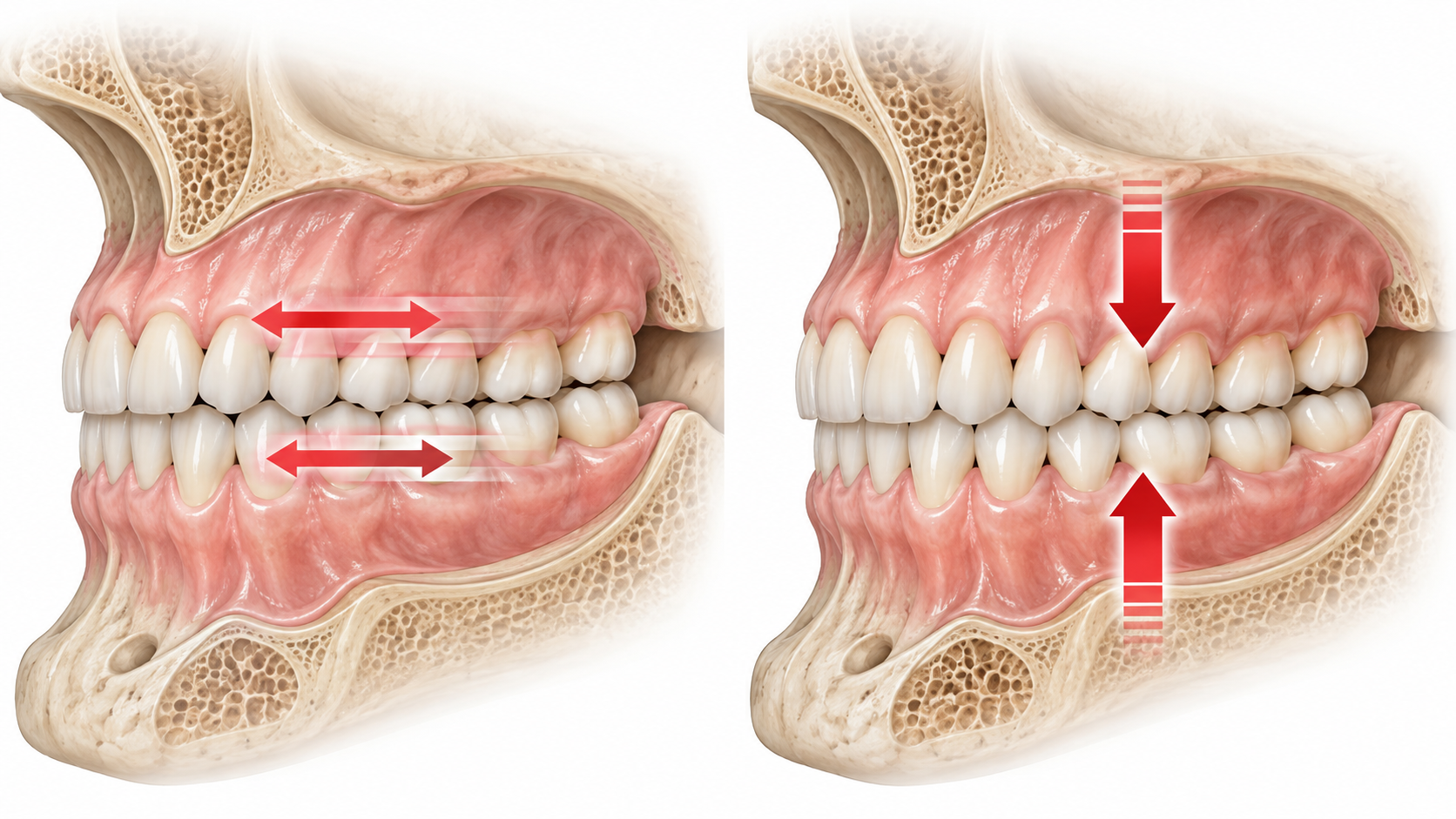
 Teeth grinding (bruxism) treatment aims to manage effects like tooth wear and jaw pain, not to eliminate the habit itself. This page covers causes and symptoms, OTC mouthguards vs. dental splints, and the role of Botox, and explains how treatment is chosen based on your teeth, muscles, and joints.
1. Teeth Grinding Treatment: Can the Grinding Habit Itself Be Fixed?
To date, there is no established treatment that completely eliminates teeth grinding during sleep. However, tooth damage and jaw muscle discomfort can be managed depending on your condition.

Teeth grinding (bruxism) can be divided into sleep bruxism, which occurs during sleep, and clenching or tensing the jaw while awake.
I think of management in three broad directions.
| Management approach | Key points |
|---|---|
| Symptom relief | Considering muscle relaxants, Botox, etc., depending on jaw muscle pain and tension |
| Tooth protection | Managing wear and damage with a splint and any necessary tooth restorations |
| Habit management | Reviewing stress and lifestyle habits, and becoming aware of daytime clenching |
That said, not everyone who grinds their teeth needs treatment.
If symptoms are mild and tooth wear is not obvious, you can start by managing habits while monitoring how things progress.
During the day in particular, it is best to keep your lips gently closed while keeping your upper and lower teeth apart. You can start simply by noticing, often, whether your jaw is tensed.
2. How Can I Tell Whether I Grind My Teeth?
Teeth grinding during sleep is hard to notice on your own. You may also be clenching your teeth even if it makes no sound.
In fact, I myself sometimes clench my teeth without realizing it when I am focused on treating patients, and I also grind my teeth in my sleep. Dr. Kim Kunmin has also mentioned that he grinds his teeth quite heavily and that his canines and molars are worn.
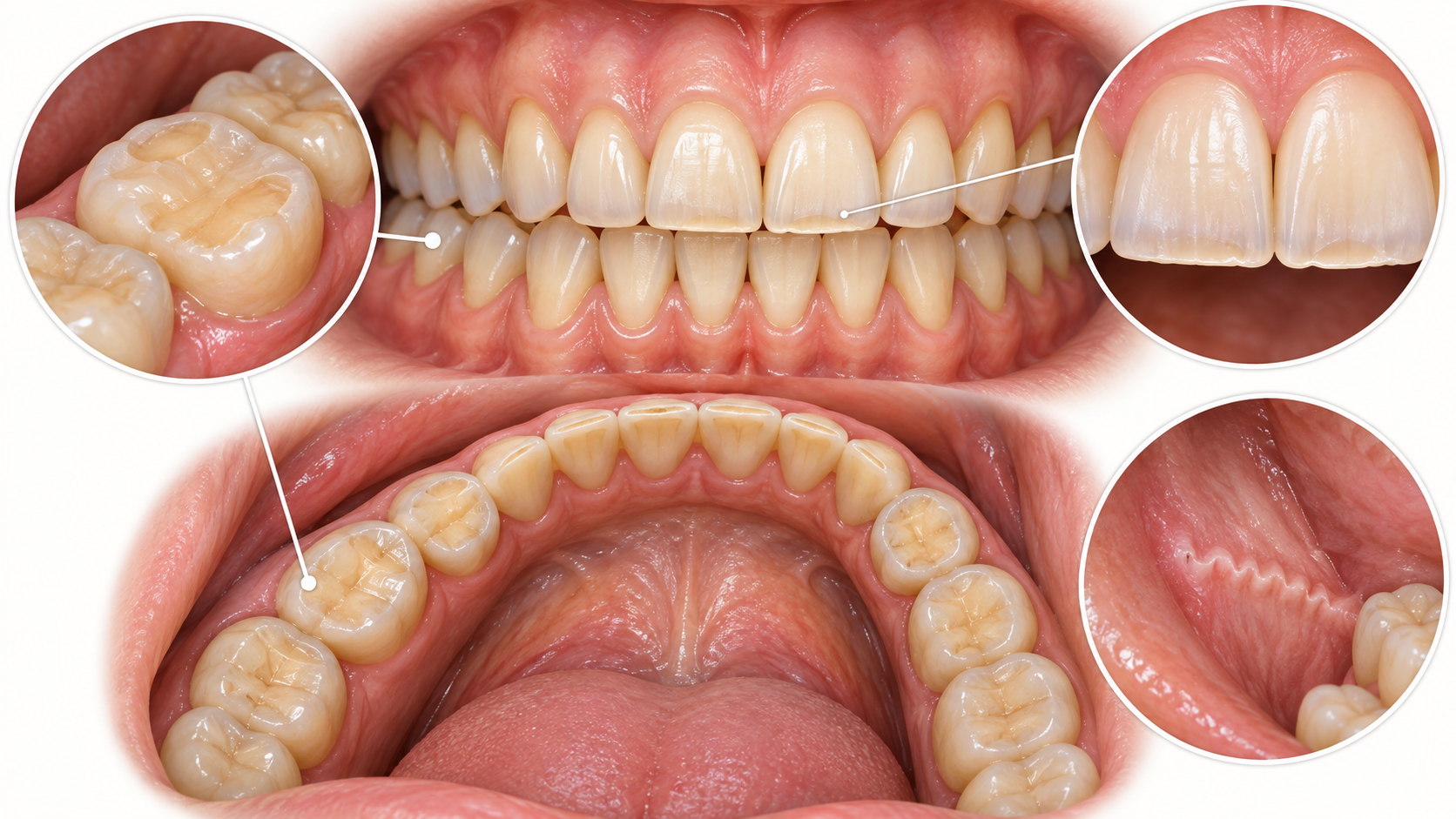
Check whether you notice any of the following changes.
| What to check | Possible changes |
|---|---|
| Jaw in the morning | Stiff jaw or heaviness around the temples |
| Tooth sensitivity | More teeth feel sensitive than before |
| Inner cheeks and sides of the tongue | Visible marks from being pressed against the teeth |
| Molars | Chewing surfaces worn flat |
| Front teeth | Edges become thin and look translucent |
| Right after waking up | Teeth feel sore or sensitive |
Of course, having these symptoms does not always mean they are caused by teeth grinding. Tooth sensitivity and jaw pain can also have other causes.
That is why, rather than judging by symptoms alone, it is important to check tooth wear, the muscles, and jaw movement together.
3. Why Does Teeth Grinding Happen? Is Stress the Cause?
Stress is one of the factors associated with teeth grinding.
However, not all teeth grinding is caused by stress.
Many factors can play a role, including pressure from work or exam preparation, frequent drinking, caffeine intake, sleep conditions, and certain medications.
Sleep bruxism in particular is known to be a behavior related to regulation by the central nervous system, rather than simply a problem of how the teeth fit together. However, exactly how it develops is still being studied.
Therefore, changing how the teeth fit together or reducing stress will not necessarily make teeth grinding go away.
In daily life, it can help to notice the moments when you clench your teeth during the day and practice relaxing your jaw. Regular sleep, stress management, and cutting back on alcohol, caffeine, and smoking can also be considered.
4. Can Severe Teeth Grinding Wear Down or Crack Teeth?
When strong forces from teeth grinding are repeated, teeth can wear down or crack, and fatigue can build up in the jaw muscles.
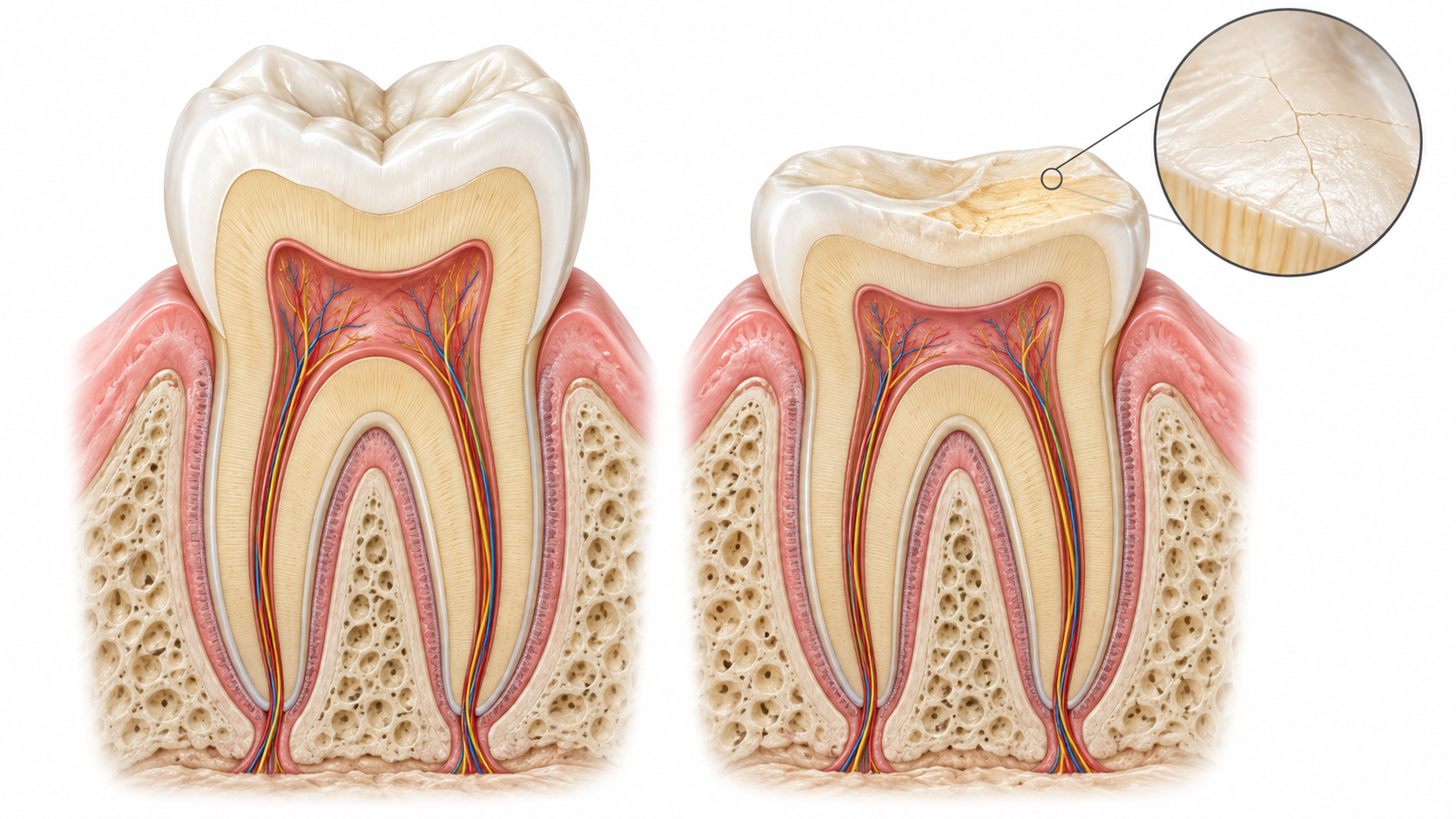
When the enamel on the tooth surface wears away and the dentin underneath is exposed, sensitivity can develop. Repeated forces can also strain teeth that are already cracked.
Restorations such as crowns, inlays, and laminate veneers can be damaged, and implant restorations can also develop problems such as fractures or loosened screws related to repeated forces.
When the jaw muscles are overactive, you may wake up with a stiff jaw or get headaches around the temples.
However, worn teeth do not necessarily mean that you are currently grinding heavily. The wear may have occurred in the past, or acidic foods or other causes may have contributed.
What matters is not only how to restore worn teeth, but also looking at why they wore down.
5. How Is a Mouthguard for Teeth Grinding Different from a Dental Splint?
Both devices can be used to protect the teeth, but they differ in how they are made and how the bite is checked.
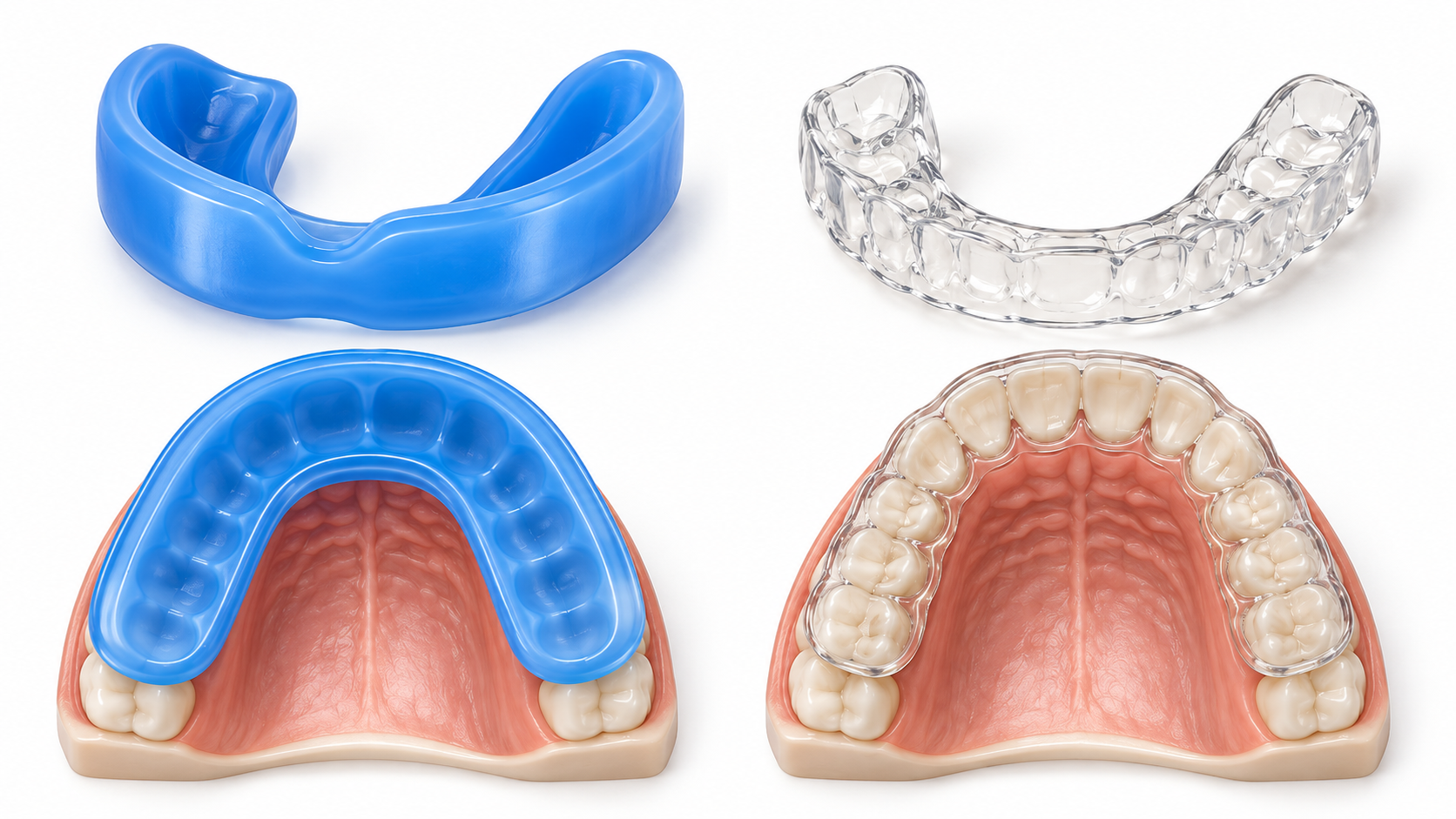
Many over-the-counter mouthguards are ready-made or are shaped by placing them in warm water. They can help reduce tooth wear temporarily, but it is difficult for them to fully reflect your individual bite (occlusion) or jaw joint condition.
| Category | Over-the-counter mouthguard | Custom-made dental splint |
|---|---|---|
| Scope | Mainly tooth protection | Considers teeth, bite, and jaw condition |
| How it is made | Ready-made or heat-molded | Made individually from an intraoral scan or impression |
| Identifying the cause | No separate diagnostic process | Designed after evaluating muscle and joint condition |
| Bite adjustment | Limited fine individual adjustment | Bite checked and adjusted |
| When suitable | For temporary tooth protection | Considered depending on repeated damage or symptoms |
At Yonsei Gunho Dental Clinic, we consider a splint when grinding or clenching habits are clear, when muscle and joint problems are also present, or when symptoms are severe.
When a splint is needed, I examine the jaw structure and joint condition, and Dr. Kim Kunmin, a board-certified prosthodontist, designs and adjusts the bite where the teeth meet.
Even after the device is made, we recheck its condition every month and adjust it as needed. However, the interval and number of adjustments may vary depending on your symptoms and oral condition.
A splint is not a device that eliminates teeth grinding; it is a device for protecting the teeth and managing the strain on them.
Also, while not every over-the-counter product causes problems, a poorly fitting device can actually make the jaw uncomfortable. If your jaw feels more uncomfortable in the morning after wearing a mouthguard, the fit of the device and your bite should be checked.
If there is only mild muscle tension or no obvious tooth damage, I do not recommend a device from the start.
6. When Is Botox for Teeth Grinding Considered?
Botox is one method that can be used to reduce excessive activity of the jaw muscles. It is considered as a supplementary treatment when muscle tension or pain is the main problem.
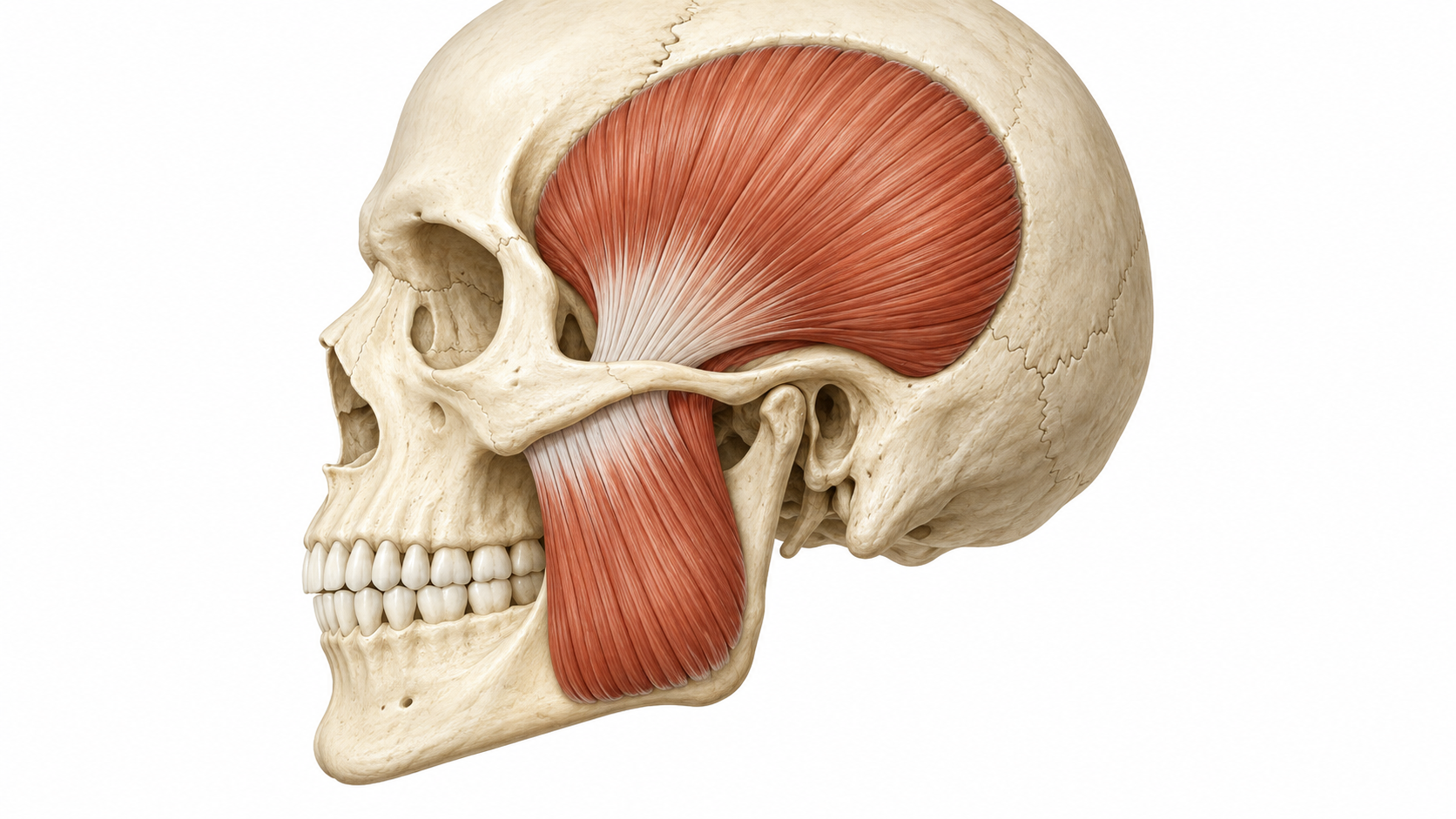
We mainly look at the masseter on the cheek side and the temporalis near the temple. Botulinum toxin temporarily reduces the contractile force of a muscle by inhibiting the signals transmitted from the nerve to the muscle.
Some studies have confirmed a reduction in chewing muscle activity. However, this does not mean it leads to less pain or less frequent teeth grinding for everyone. Evidence on long-term effectiveness and safety is also limited.
The treatment goal differs from cosmetic jaw-slimming (square-jaw) Botox. However, because it acts on the same chewing muscles, chewing force may change or the facial contour may look softer depending on the injection site and dose.
As a director of the Korean Aesthetic Dental Association (KADA), I take part in facial botulinum toxin education. In teeth grinding treatment as well, I try to first judge whether the treatment is needed for the current muscle condition, rather than whether an injection can be given.
When the problem lies in the joint itself rather than the muscles, other approaches, including joint injections such as PDRN, may be considered.
How Botox works and the criteria for choosing treatment are explained in more detail in Does TMJ Botox Work? Treatment Choices Depend on the Cause of Pain.
7. What Examinations Are Done Before Deciding on Teeth Grinding Treatment?
Teeth grinding treatment begins with distinguishing whether it is a muscle problem, a joint problem, or both.
At Yonsei Gunho Dental Clinic, we assess your condition in the following order.
1. Reviewing medical history and lifestyle habits
We ask about your symptoms and lifestyle habits.
2. Observing the muscles and jaw movement
We palpate the jaw muscles and observe how the mouth opens and closes.
3. Imaging
In addition to standard X-rays, we take a TMJ panoramic X-ray to check the jaw joints, and when necessary, a TMJ CT to examine the bone structure of the joint in detail.
4. Checking the teeth and bite
We also look at how worn the teeth are and how the upper and lower teeth meet.
This is because imaging alone cannot determine every muscle or joint problem.
Depending on the results, we may only manage lifestyle habits and monitor progress, or we may consider a splint, muscle treatment, or restoring damaged teeth.
If your jaw makes sounds or feels like it catches, the joint condition should also be examined separately from teeth grinding. This is covered in Clicking Jaw: Does It Need Treatment? Causes and Warning Signs.
For an overview of jaw joint problems, you can also see the TMJ Treatment page.
In Closing
Having teeth grinding does not mean everyone needs to wear a mouthguard or get Botox.
I believe it is important to first distinguish whether you need treatment now or whether it is fine to manage your lifestyle habits and monitor.
What should be considered before which device to use is what kind of strain your teeth and jaw are under right now.
That is why I think first about the treatment that is appropriate, rather than the treatment that is possible.
Reviewed by: Dr. Park Ji-ho, board-certified oral and maxillofacial surgeon
*This content is general medical information; the actual treatment approach may vary depending on individual symptoms and examination results.*
References
- National Institute of Dental and Craniofacial Research (NIDCR). Bruxism.
Causes, symptoms, and diagnosis of teeth grinding; tooth-protective devices and lifestyle management.
https://www.nidcr.nih.gov/health-info/bruxism - Journal of Oral Rehabilitation (2025). Updating the Bruxism Definitions: Report of an International Consensus Meeting.
International expert consensus on the definition and assessment of sleep bruxism and awake bruxism.
https://pubmed.ncbi.nlm.nih.gov/40312776/ - Journal of Dentistry (2021). The efficacy of occlusal splints in the treatment of bruxism: A systematic review.
Effectiveness of occlusal stabilization devices (splints) in managing teeth grinding, and the limits of the evidence.
https://pubmed.ncbi.nlm.nih.gov/33652054/ - Dentistry Journal (2024). Efficacy and Safety of Botulinum Toxin in the Management of Temporomandibular Symptoms Associated with Sleep Bruxism: A Systematic Review.
Effectiveness, safety, and research limitations of botulinum toxin treatment related to sleep bruxism.
https://pmc.ncbi.nlm.nih.gov/articles/PMC11203296/