
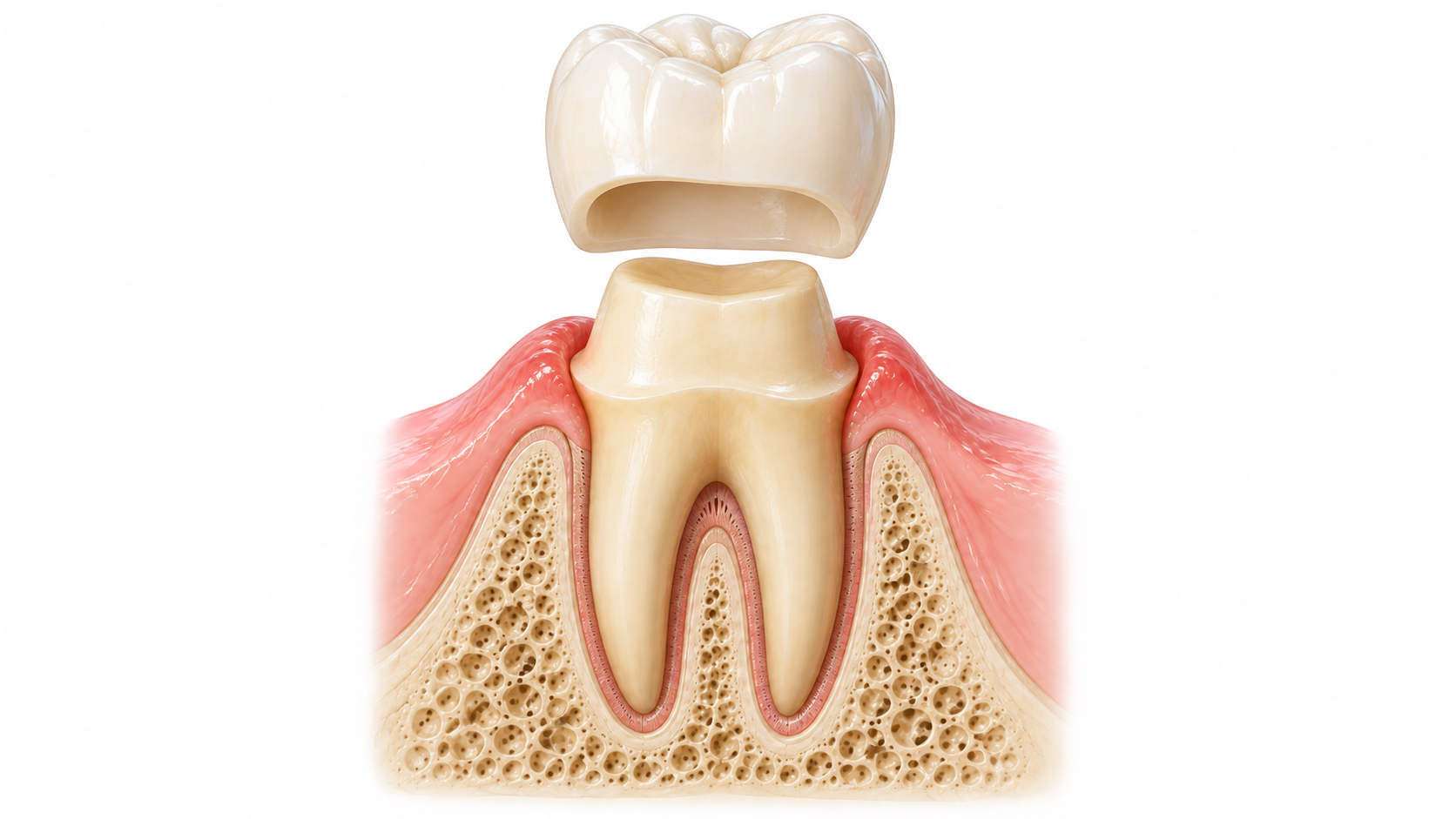
 A crown covers and protects a whole damaged tooth, but not every tooth needs one. Depending on remaining healthy tooth structure, cracks, and chewing forces, an inlay or onlay (overlay) may also be considered. Yonsei Gunho Dental Clinic decides the extent of restoration needed while reducing unnecessary tooth removal.
1. What Is Crown Treatment? When Does a Tooth Need a Crown?
A crown is a prosthetic treatment that covers a damaged tooth entirely to restore its shape and chewing function and to protect the remaining tooth.

It can be considered when decay has spread widely, when a large part of the tooth has broken, or when previous treatment has left the tooth walls very thin.
Molars in particular take heavy forces during chewing. If the raised parts of the chewing surface have become thin or cracked, there is a risk of further breakage under load.
However, a large cavity does not necessarily mean the tooth must have a crown.
If the remaining tooth walls are strong enough and free of cracks, an inlay that restores only the damaged area or an onlay (overlay) that covers the necessary parts can also be considered.
Rather than deciding on a crown from the start, I first look at three things.
- Remaining tooth: how much healthy tooth structure remains
- Area to protect: how far the tooth needs to be protected
- Chewing forces: what chewing forces it will bear going forward
The extent of treatment depends on these criteria.
2. How Do Inlays, Onlays, and Crowns Differ?
The biggest difference is how much of the tooth is covered. Treatment differs depending on whether only the space left after removing decay is filled, the chewing surface is also protected, or the entire tooth is covered.
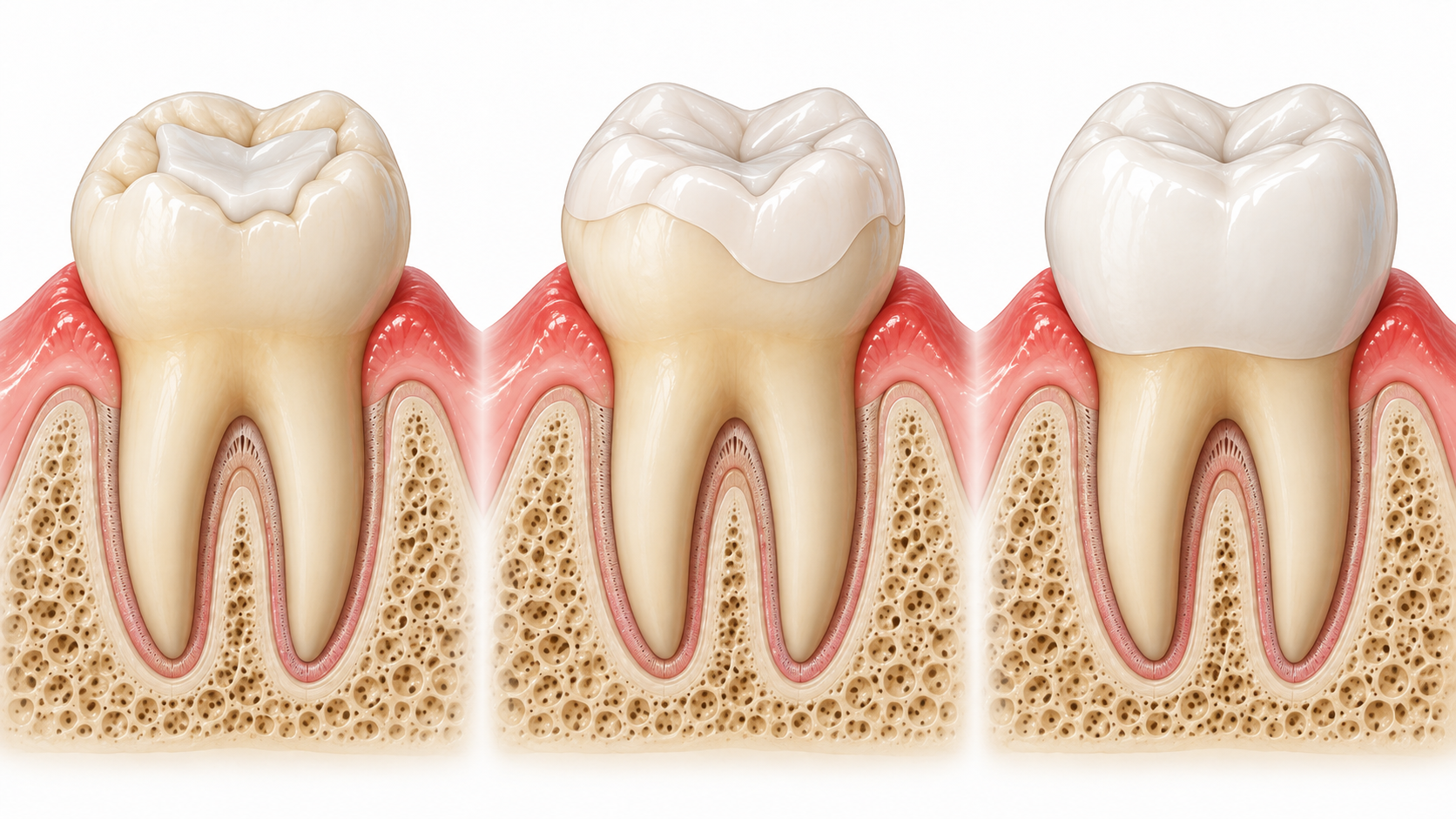
| Category | Inlay | Onlay | Crown |
|---|---|---|---|
| Treatment area | Damaged area inside the tooth | Part or all of the chewing surface and cusps | Entire circumference of the tooth |
| Main purpose | Restoring the damaged area | Protecting weakened chewing areas | Overall protection of a heavily damaged tooth |
| Tooth reduction | Focused on the damaged area | Focused on the necessary parts | Shaping around the whole tooth |
| When considered | When there are enough healthy tooth walls | When cusp protection is needed and bonding conditions are suitable | When damage is extensive and little tooth structure remains |
The advantage of an onlay is that it can cover and protect fragile areas without wrapping the entire tooth.
In some cases, it can preserve more healthy tooth structure than a crown.
But there are conditions.
- There must be enough remaining tooth wall, and the tooth must be in a condition that allows a restoration to be bonded.
- The thickness required by the material must also be secured.
- If cracks are deep, if decay and existing restorations have extensively damaged the whole tooth, or if strong forces are repeated through teeth grinding and clenching, an onlay may not be suitable.
In these situations, insisting on an onlay just to remove less tooth structure carries a risk that the restoration or the remaining tooth will break again.
Preserving plenty of healthy tooth structure matters, but we also have to keep in mind that the preserved tooth must be able to withstand chewing forces.
3. Does a Tooth Always Need a Crown After Root Canal Treatment?
Not every tooth needs a crown just because it has had root canal treatment. The remaining tooth structure and the risk of fracture must be assessed together.
Many people think that removing the nerve makes a tooth weaker.
But what may matter more than the nerve removal itself is that the decay or crack was large enough to require root canal treatment, and that much of the tooth structure was lost through previous treatment.
Molars in particular face a greater risk of breaking under chewing forces if the remaining walls are thin after treatment.
That is why restorations that protect the chewing areas are often considered for molars that have had root canal treatment.
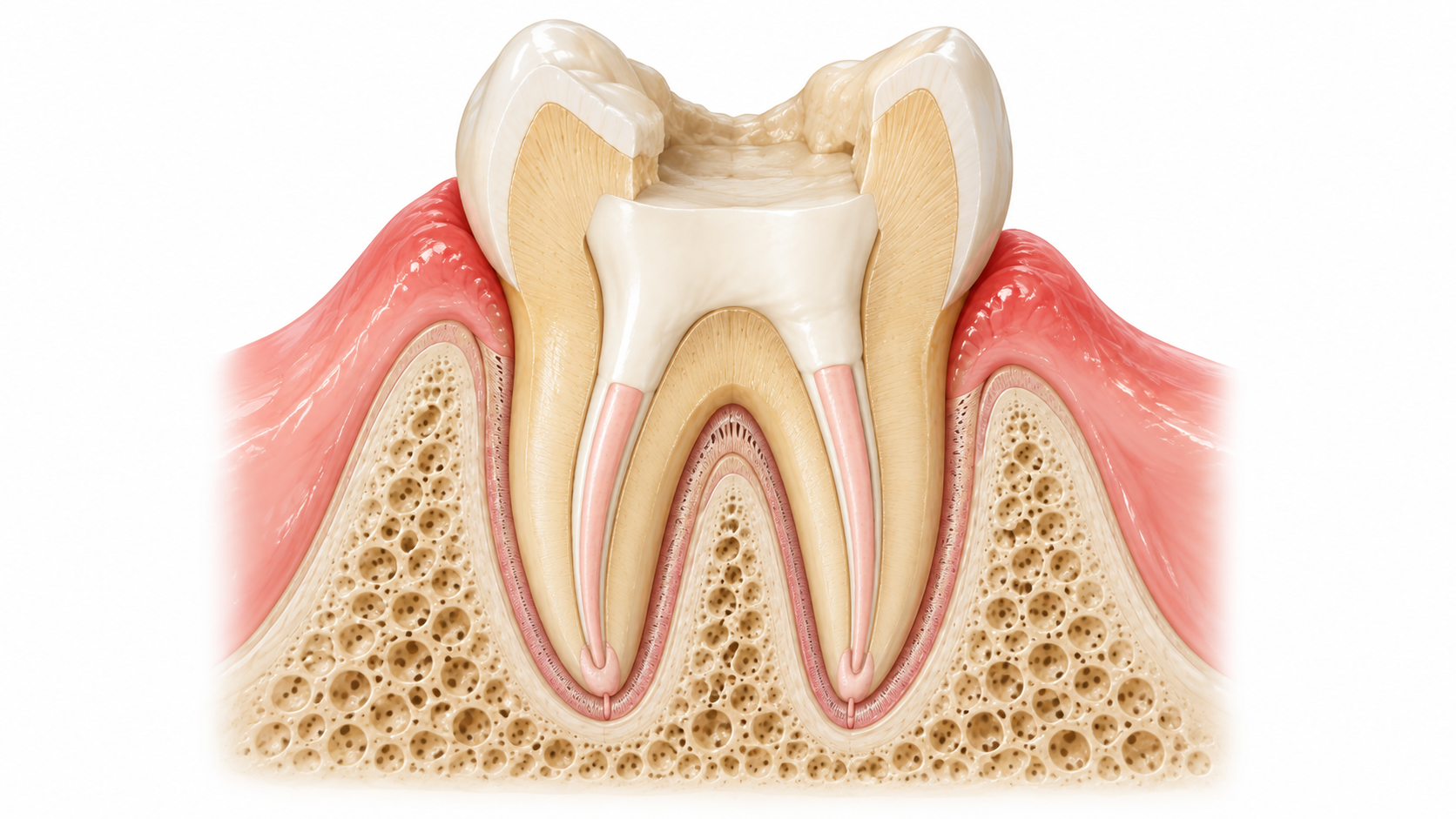
However, that restoration does not necessarily have to be a crown. Depending on the condition of the remaining tooth, a partial restoration such as an onlay may also be considered.
When a tooth is heavily damaged, the inside may be reinforced with resin. A post, used when needed, helps retain the reinforcing material, but it is not a device that makes the tooth root itself stronger.
At Yonsei Gunho Dental Clinic, when root canal treatment, root canal retreatment, or an assessment of whether a cracked tooth can be saved is needed, I check together with Dr. Han Seung-won, a board-certified specialist in conservative dentistry.
Conversely, when the tooth is difficult to save and extraction is needed, such as when the root has split vertically, I review the next course of treatment with Dr. Park Ji-ho, a representative director and board-certified oral and maxillofacial surgeon.
For more details on root canal treatment, see the Microscope Root Canal Treatment · Retreatment page.
4. How Do Zirconia Crowns Differ from Ceramic and Gold Crowns?
Being hard is not the only thing that makes a crown material good. The tooth's position and color, the required thickness, and the chewing forces must all be considered.
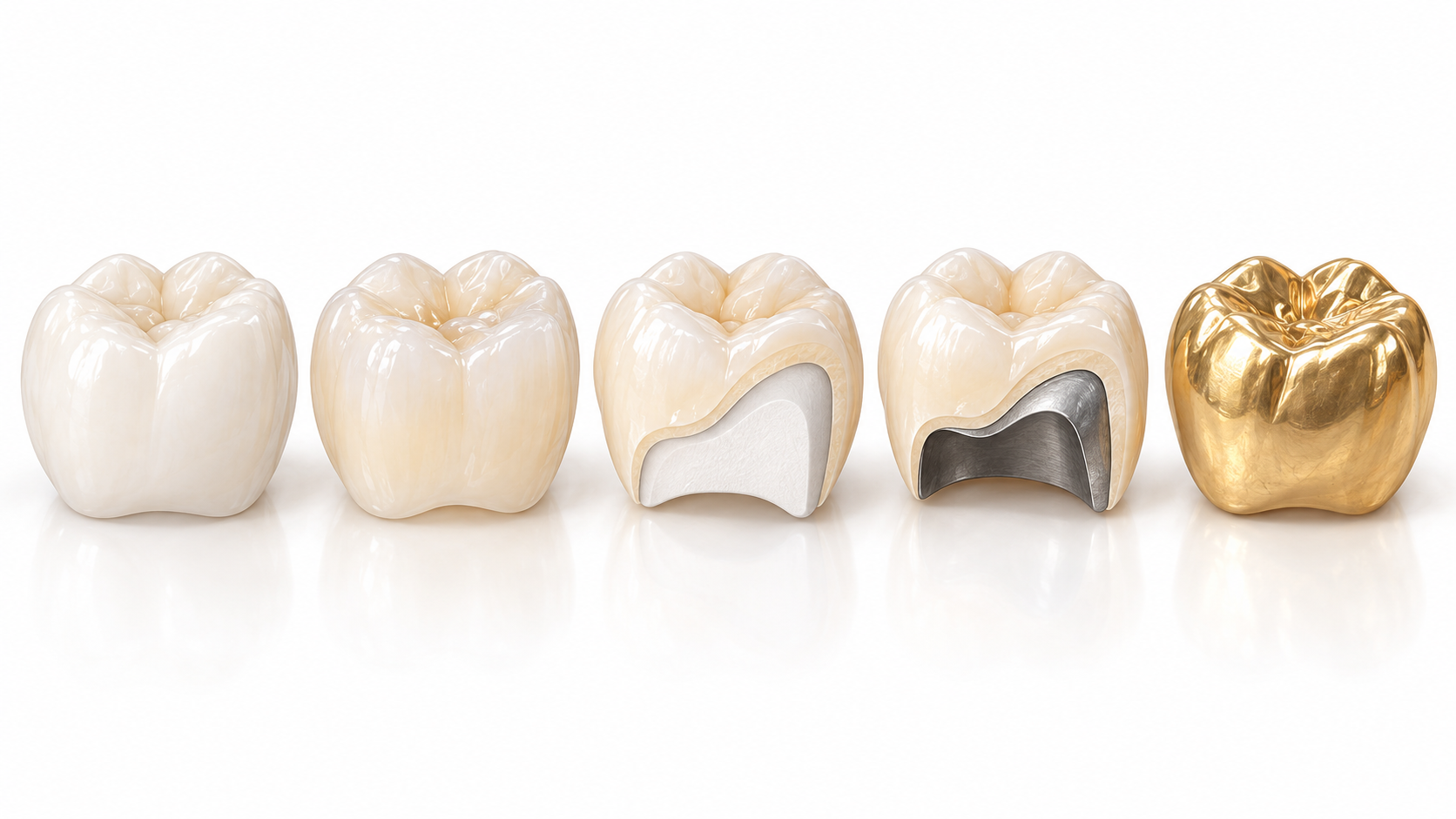
| Material | Main features | Considerations |
|---|---|---|
| Zirconia | High strength; can reproduce tooth color | Translucency by type, thickness, bite |
| Lithium disilicate (e.max, etc.) | Natural light transmission and color reproduction | Thickness, bonding conditions, chewing forces |
| PFZ (porcelain-fused-to-zirconia) | Porcelain layered over zirconia | Esthetics, possibility of the surface porcelain fracturing |
| PFM (porcelain-fused-to-metal) | Porcelain layered over metal | Possibility of metal color showing near the gums |
| Gold alloy | Ductile, workable metal material | Metal color, alloy type, area of use |
For example, zirconia can be considered for molars that take heavy chewing forces.
However, zirconia also varies in strength and translucency by type, and it is not equally suitable for every tooth.
Lithium disilicate can be a good option when natural color reproduction is needed, but the thickness the material requires and the bonding conditions must also be examined.
In the end, what conditions your tooth needs right now comes before which material is best.
For front teeth, color and shape can be more important considerations than for molars. When needed, I record the tooth color with a professional DSLR camera and a polarizing filter and pass it on to the dental lab.
The differences in front tooth treatment are explained separately in Front Tooth Crown vs Laminate Veneer: Which Is Right for My Teeth?
5. How Does Crown Treatment Proceed, and How Much of the Tooth Is Removed?
Crown treatment proceeds by checking the tooth's condition, shaping only the necessary area, and then fabricating and placing a restoration that fits the tooth.
The typical process is as follows.
1. Checking the tooth's condition
Decay, cracks, gum condition, and chewing forces are examined.
2. Shaping the tooth
The damaged parts are cleaned up, and the space and shape needed for the restoration are created.
3. Recording the tooth shape
The shape of the tooth is recorded with an intraoral scan or impression material.
4. Fabricating the restoration
A temporary crown is used if needed while the final restoration is fabricated.
5. Placement and checking
We check that it fits the tooth well and that the contacts with neighboring teeth and the bite height are appropriate.
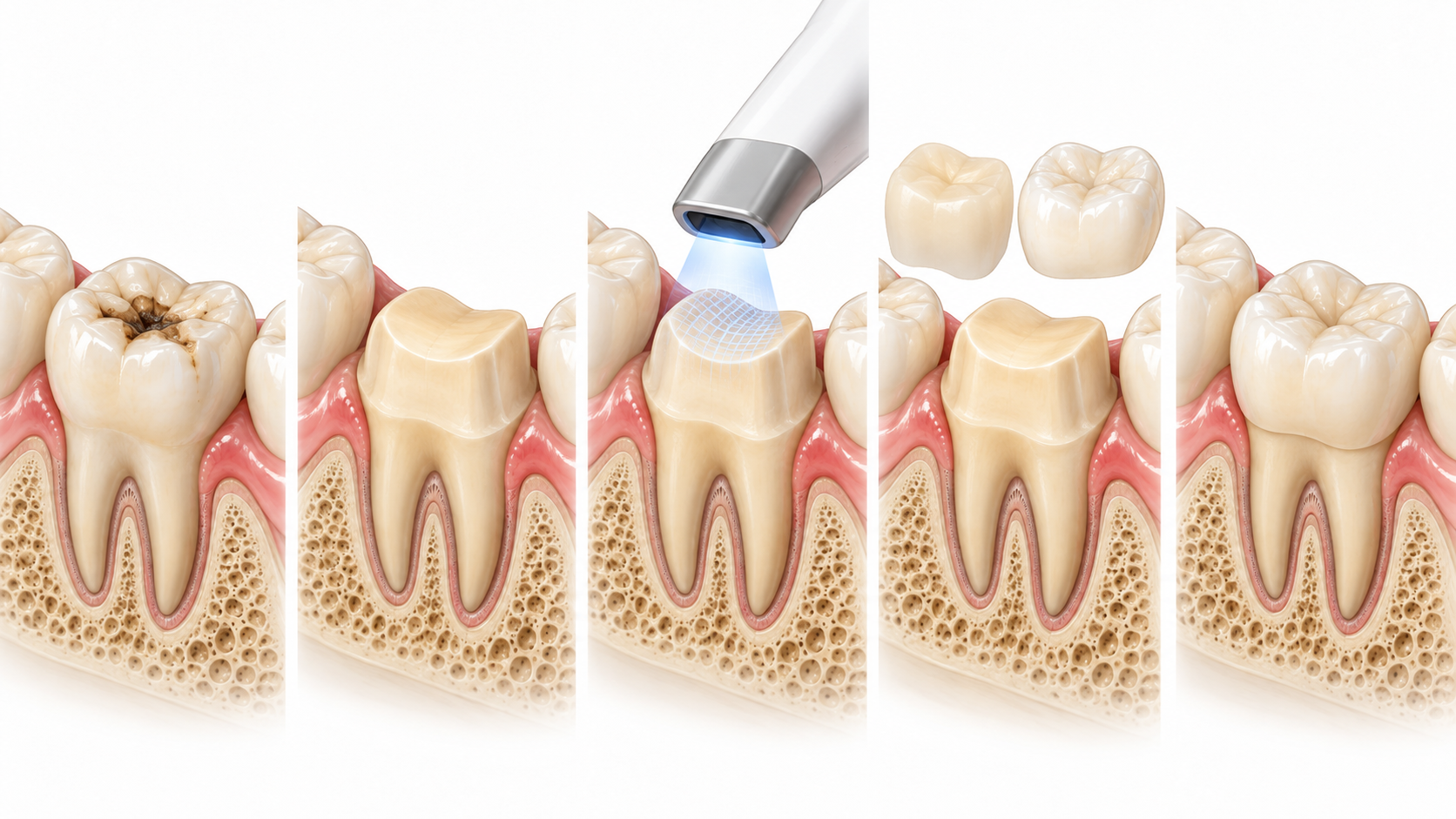
At Yonsei Gunho Dental Clinic, we record the tooth shape with a 3Shape TRIOS 5 intraoral scanner. We also use in-house equipment related to restoration fabrication, such as a 3D printer and a furnace.
So how much of the tooth needs to be removed?
There is no fixed amount. It depends on the extent already damaged by decay, the shape of the remaining tooth, and the material to be used.
Removing as little as possible is not always the answer either. The thickness the restoration requires must be secured while reducing unnecessary removal of healthy tooth structure.
Local anesthesia is used during treatment as needed, and the treatment period and number of visits vary depending on the tooth's condition and the fabrication process.
After the crown is placed, it is important to follow the precautions for the bonding material used and the anesthesia. While the anesthesia has not worn off, take care not to bite your lips or cheeks.
6. If a Crowned Tooth Hurts or Smells, Does It Need to Be Treated Again?
Pain or odor from a crowned tooth does not always mean the crown has to be remade. The first step is to identify what is causing the discomfort.
After a new crown is placed, the tooth may temporarily feel sensitive or feel odd when chewing.
However, if a certain spot seems to touch first or pain recurs every time you chew, the crown's height and how the teeth meet need to be checked.
With an older crown, there are a few more things to examine.
The crown margin may have lifted or the bond may have changed, or decay may have developed again underneath.
Gum inflammation, food getting trapped, nerve problems, and tooth cracks can also be causes.
In these cases, I examine things in the following order.
1. First, I check the condition of the gums.
2. I check whether food is getting trapped.
3. I check whether the contacts between teeth are appropriate.
4. I check for problems at the crown margin.
5. If needed, I also examine the tooth under the crown and the area around the root with X-rays.
However, X-rays alone cannot reveal every problem.
If the bite is the cause, bite adjustment (occlusal adjustment) may reduce the discomfort. On the other hand, if there is decay inside or a nerve problem, additional treatment may be needed.
What matters is distinguishing whether the existing crown can be kept, whether the tooth underneath needs treatment, and, if the crown is remade, which cause needs to be addressed.
7. How Long Does a Crown Last, and What Matters for Using It Longer?
How long a crown can be used depends not only on the material but also on the condition of the remaining tooth, chewing forces, and care habits.
Even if the crown itself looks fine, decay can develop at the margin, and the condition of the gums can change over time.
That is why care remains important even after crown treatment is finished.
- Keep the area around the crown and between the teeth clean by brushing, flossing, and similar care.
- It is a good idea to have the restoration margins and gum condition checked through regular dental checkups.
- It is also worth checking whether repeated forces are being applied through teeth grinding or clenching.
I myself have experienced significant tooth wear from severe grinding, so when planning restorations I tend to pay close attention to the forces the teeth receive and how they meet.
Repeated grinding or clenching can put strain on crowns and the surrounding teeth.
This is explained in detail on the Bruxism (Teeth Grinding) Treatment page.
8. What Factors Affect the Cost of Crown Treatment?
The cost of crown treatment can vary depending not only on the type of material but also on the degree of tooth damage, additional procedures, and the restoration fabrication process.
Even with the same zirconia crown, the treatment needed can differ depending on the tooth's condition.
Factors that can affect the cost include the following.
- Material: the type of crown material used
- Existing treatment: whether an existing crown needs to be removed
- Inside the tooth: whether there is decay or a nerve problem
- Additional procedures: whether the remaining tooth needs to be reinforced
- Fabrication process: the process of making and adjusting the restoration
So when trying to understand crown treatment, rather than looking only at material names, it is important to also consider what treatment process a tooth in a given condition needs.
In Closing
Crowns, inlays, and onlays are not competing treatments. They are options chosen to suit each situation in order to restore and protect a damaged tooth.
Before deciding how far a tooth needs to be covered, I first consider how much healthy tooth structure can be preserved.
I also examine whether the preserved tooth can continue to withstand chewing forces.
Treatment that conserves, rather than treatment that does more.
This is the principle I value when planning crowns, inlays, and onlays.
Reviewed by: Dr. Kim Kunmin, board-certified prosthodontist
References
- American Dental Association (ADA) MouthHealthy. Crowns.
Definition and purpose of crowns.
https://www.mouthhealthy.org/all-topics-a-z/crowns/ - American Dental Association (ADA). Materials for Indirect Restorations.
Characteristics of inlay, onlay, and crown materials.
https://www.ada.org/resources/ada-library/oral-health-topics/materials-for-indirect-restorations - European Society of Endodontology (ESE), International Endodontic Journal (2021). The restoration of root filled teeth.
Criteria for restoring teeth after root canal treatment.
https://doi.org/10.1111/iej.13607 - Journal of Esthetic and Restorative Dentistry (2024). Do onlays and crowns offer similar outcomes to posterior teeth with mesial-occlusal-distal preparations? A systematic review.
Comparison of clinical outcomes of onlays and crowns in molars.
https://pubmed.ncbi.nlm.nih.gov/37497796/