
 Dentures (complete, partial, implant overdentures) vary with the remaining teeth and jawbone. At Yonsei Gunho Dental Clinic, a prosthodontist's bite and prosthetic design and an oral and maxillofacial surgeon's evaluation guide treatment scope. Covers types, choosing, cost factors, insurance at 65+, making, and care.
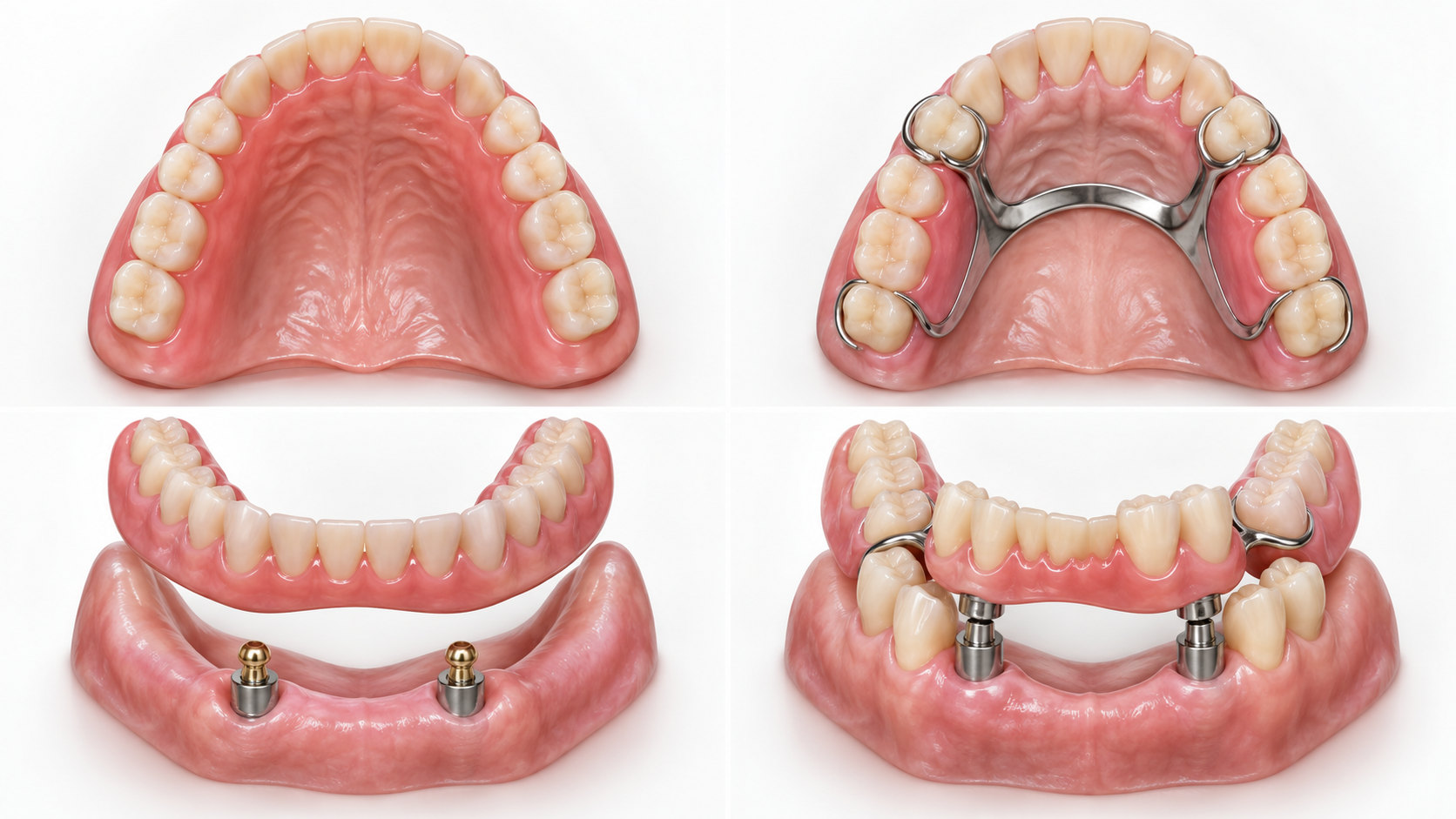
1. How Do Denture Types Differ? Complete Dentures, Partial Dentures, and Implant Overdentures
Dentures differ by type depending on what they rely on for retention. Some dentures are supported by the gums, while others make use of remaining natural teeth or implants.

| Type | When it is considered | Features and limitations |
|---|---|---|
| Complete denture | When no teeth remain in the upper or lower jaw | Retained by fitting closely against the gums; stability varies with the condition of the jawbone |
| Partial denture | When natural teeth that can provide support remain | Connected to teeth with clasps or similar parts; care of the remaining teeth is important |
| Implant overdenture | When denture retention is insufficient and implant placement is possible | Implants supplement retention, but surgery and maintenance of the attachments are required |
| Implant-assisted partial denture | When there are not enough natural teeth to support a partial denture | Uses implants as additional supports; implant position and prosthetic design are important |
Complete Dentures — When No Natural Teeth Remain
A complete denture is also called a full denture. It is a prosthesis used when all natural teeth are missing in the upper or lower jaw.
Because the denture is retained by fitting closely against the gums and surrounding tissues, the height and shape of the jawbone are important.
If the jawbone has shrunk considerably, the denture may move easily or feel uncomfortable when chewing. In the lower jaw in particular, tongue movement and other factors also play a role, so retention and stability must be considered together.
Partial Dentures — When Remaining Natural Teeth Can Be Used
A partial denture is considered when usable natural teeth remain.
The denture is supported by connecting clasps or similar parts to the remaining teeth. A key feature is that it fills in the areas where teeth are missing while making use of your existing natural teeth.
However, not every remaining tooth can support a denture.
If any teeth are loose, X-rays are needed to check the roots and the condition of the jawbone. It is also important to design the denture together with the chewing forces so that the supporting teeth are not overloaded.
Implant Overdentures — When Implants Supplement Retention
An implant overdenture is connected to implants placed in the jawbone to supplement retention.
It uses attachments such as ones that snap together like buttons, and it may help reduce movement compared with a conventional gum-supported denture.
However, there must be enough jawbone to place implants, and general health and the burden of surgery must also be considered.
In addition, the attachments can wear or change in retention with use, so they require maintenance.
Implant-Assisted Partial Dentures — When There Are Not Enough Teeth for Clasps
Sometimes a partial denture is desired, but there are not enough natural teeth suitable for clasps.
In this case, an implant-assisted removable partial denture, which uses implants as additional supports, can be considered. The denture is supported by a connecting structure on top of the implants.
What matters here is where the implants are placed, the shape of the connecting components, and how the remaining natural teeth and the denture share the load.
This is why the implant placement plan and the final denture design need to be considered together from the start.
2. Which Denture Is Right for You? Implant Overdentures Are Not Always the Answer
Implant overdentures are not suitable for everyone. Above all, the remaining teeth, the jawbone, and general health must be examined first.
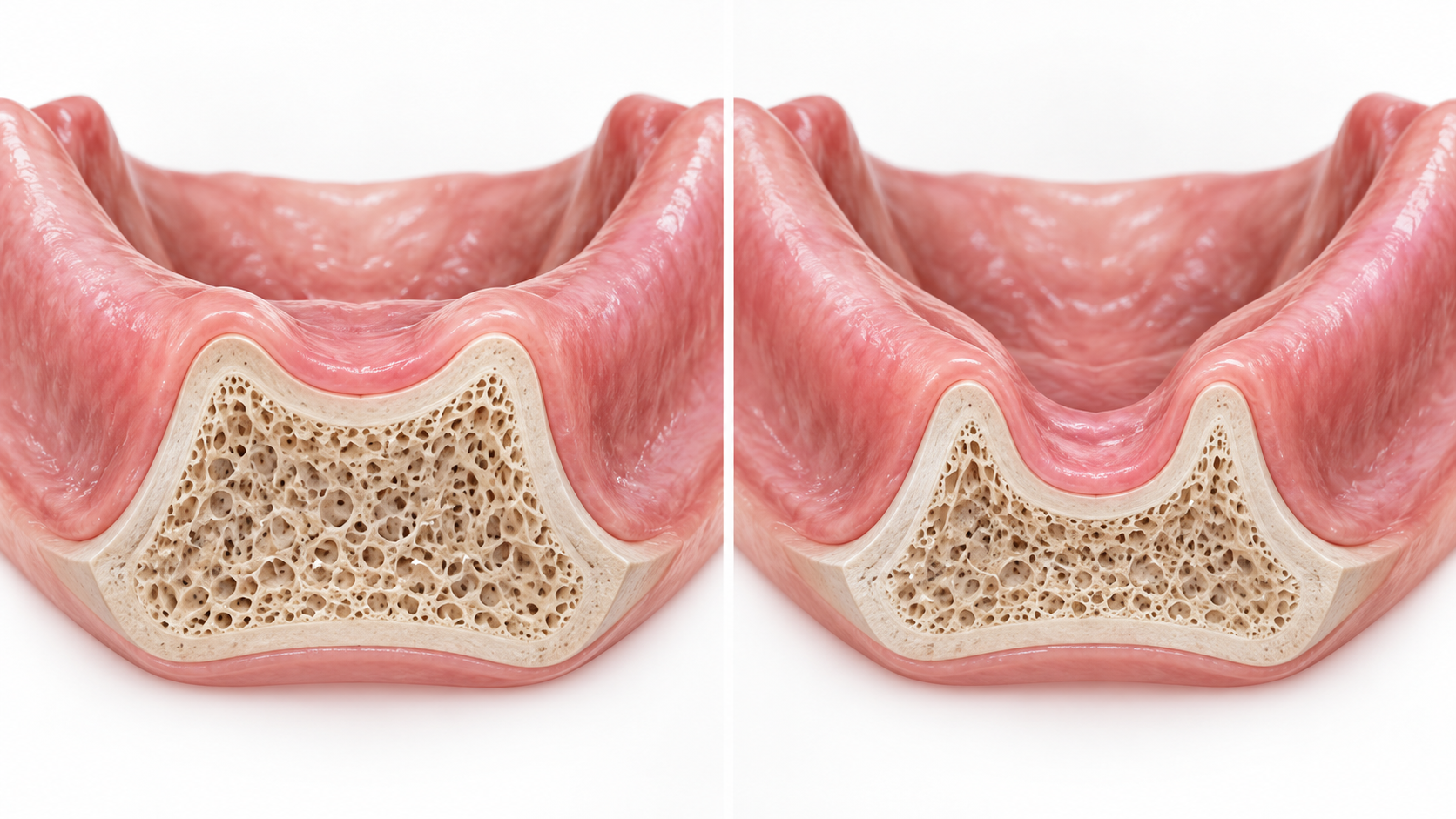
Where a tooth has been lost, the jawbone tends to shrink gradually over time. If the bone shrinks considerably, keeping a denture in place can become difficult, and implant placement also becomes limited.
That said, we do not recommend bone grafting or implants to everyone whose jawbone is insufficient.
At Yonsei Gunho Dental Clinic, Dr. Park Ji-ho, a director and board-certified oral and maxillofacial surgeon, assesses whether extraction is needed and whether the jawbone is in a condition to support implants.
As a board-certified prosthodontist, I design around the remaining teeth and the bite, and plan the shape and support structure of the denture.
In this way, we consider both the feasibility of surgery and the conditions under which the prosthesis will actually be used.
When planning denture treatment, I also pay close attention to the following five points.
1. The type of denture currently in use and how long it has been used
2. The condition of the remaining natural teeth and any loose teeth
3. Whether there is pain when chewing and whether the denture feels loose
4. Systemic conditions such as diabetes or high blood pressure, and current medications
5. Whether comfortable eating is the priority, or whether a natural appearance also matters
Only by considering all of these conditions together can the necessary scope of treatment be determined.
What I value is "treatment that conserves rather than treatment that does more."
If the remaining teeth can be used, I look at that possibility first, and if implants are not suitable, I also consider dentures that do not require surgery.
For more on preserving natural teeth, see 4 Tooth-Preserving Treatments to Check Before Extraction.
3. What Determines the Price and Cost of Dentures?
The cost of dentures varies depending on whether it is a complete or partial denture and whether implants are used as well.
However, the type alone does not determine the entire cost.
The main factors that determine cost are as follows.
- Denture type and materials: complete denture, partial denture, and whether it connects to implants
- Prosthetic design: the materials and attachments used
- Condition of the remaining teeth: differences in design depending on how the natural teeth will be used
- Scope of preliminary treatment: whether gum treatment or extractions are needed
Partial dentures in particular can differ in design depending on how the remaining natural teeth will be used.
So rather than simply comparing denture types, it is important to look at what treatment your current oral condition requires.
4. How Does Korean National Health Insurance Cover Dentures for People Aged 65 and Over?
Korean National Health Insurance subscribers or dependents aged 65 and over may receive health insurance coverage for complete and partial dentures, subject to set requirements.
| Category | Health insurance coverage criteria |
|---|---|
| Eligibility | Korean National Health Insurance subscribers or dependents aged 65 and over |
| Complete dentures | Resin-base and metal-base complete dentures |
| Partial dentures | Clasp-retained metal-base partial dentures |
| Standard coverage cycle | Once every 7 years for each of the upper and lower jaws |
| Exceptions for remaking | Cases that meet set requirements, such as a serious change in oral condition |
Dentures connected to implants and partial dentures that use special attachments need to be distinguished from the standard dentures eligible for coverage.
In principle, the insurance coverage cycle for dentures is once every 7 years for each of the upper and lower jaws.
However, exceptions may be granted under set criteria, for example when there is a medical opinion that a new denture is unavoidable because the oral condition has changed seriously.
That is why, from the very first denture, it is important to plan with careful attention to the remaining teeth, the condition of the jawbone, and chewing forces.
5. What Are the Denture-Making Process and Timeline?
Making a typical denture begins with checking your current oral condition.
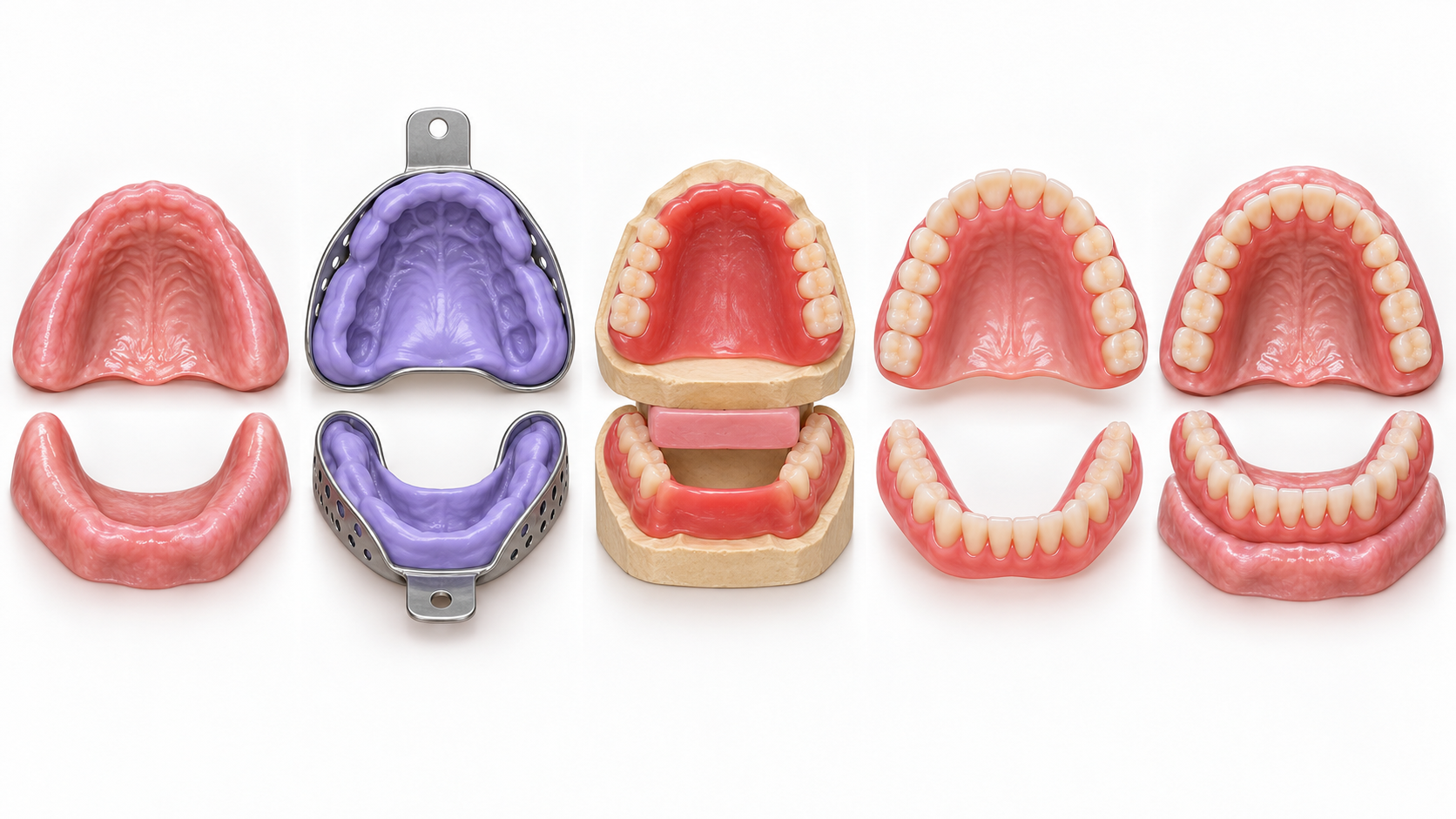
1. Oral examination and treatment plan
The remaining teeth and gums are examined, and the necessary treatment is decided.
2. Impressions
Impressions of the shape of the mouth are taken to prepare for making the denture.
3. Checking the bite and tooth arrangement
The relationship between the upper and lower jaws when they meet and the arrangement of the teeth are checked.
4. Denture fabrication and fitting
The finished denture is adjusted to the mouth and fitted.
5. Adjustments after fitting
The areas that contact the gums and the chewing height can be adjusted.
During this process, I pay close attention to whether chewing forces are excessively concentrated on one side.
This is because a denture must not only be made to fit the shape of the gums, but must also take into account how it behaves as it moves in the mouth and when chewing food.
The time needed and the number of visits vary with the type of denture, the condition of the remaining teeth, and whether extractions and gum healing are needed. How much additional adjustment is needed after fitting also differs from person to person.
6. Does It Hurt When You First Wear Dentures? Adjustment Period and Pain
When you first use new dentures, they may feel like a foreign object, or your speech may sound awkward.
Certain areas of the gums may hurt from pressure, or the denture may feel like it moves when you chew food.
In general, the following can help you adjust at first.
- Eat soft foods cut into small pieces
- Practice chewing slowly on both sides
- Read aloud to get used to speaking
However, the time needed to adjust differs from person to person.
If sores keep forming on the gums or pain persists, simply putting up with it is not the solution. The pressure where the denture contacts the gums, the chewing height, or other factors may need to be adjusted.
7. Do Loose Dentures Need to Be Remade? Criteria for Adjustment and Repair
A denture that has become loose does not necessarily need to be remade.
After teeth are lost, the shape of the jawbone and gums changes gradually. Even a denture that fit well at first may become loose over time.
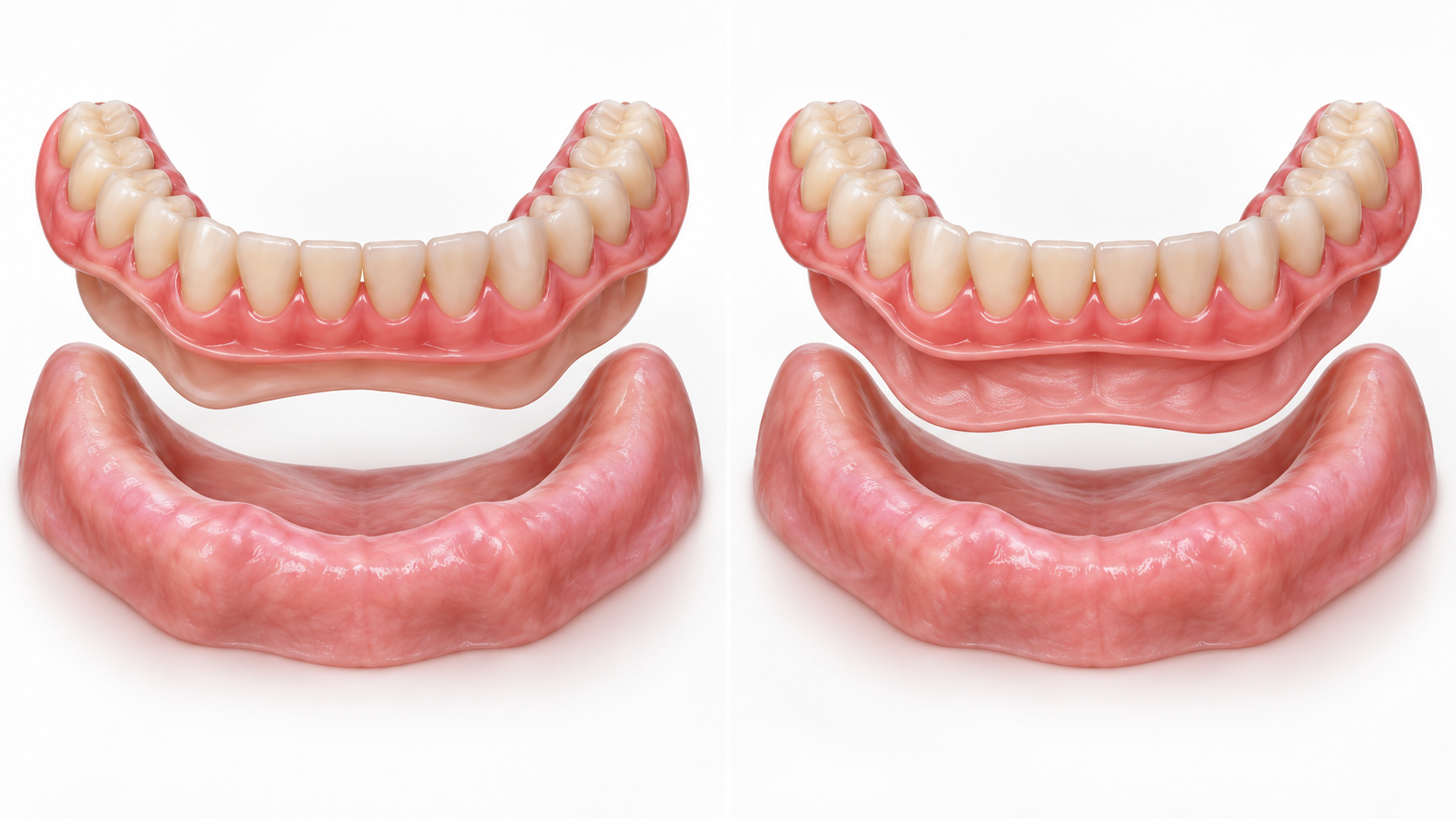
| Observed condition | Options to consider |
|---|---|
| The inside of the denture no longer fits because the gum shape has changed | Improve the fit with relining |
| Chewing forces are not distributed properly | Bite adjustment |
| Part of the denture is broken | Assess whether repair is possible based on the extent of the damage |
| The denture is severely worn or structurally ill-fitting | Consider whether to remake it |
If the existing denture is structurally sound, the fit can sometimes be improved by relining, which refills the inside to match the current shape of the gums.
If chewing forces are not balanced, a bite adjustment may also be considered.
On the other hand, if the denture itself is severely worn or broken and proper function is hard to achieve through adjustment alone, it may need to be remade.
I believe it is important to first check whether the existing denture can be used again.
Before making a new one, the first step is to find out what problem has developed with the denture you are using now.
8. How Should Dentures Be Cared For? Cleaning, Storage, and Regular Checkups
A denture is not a prosthesis that is made once and then forgotten. Because the condition of the mouth keeps changing, it is a device that must be maintained as it is used.
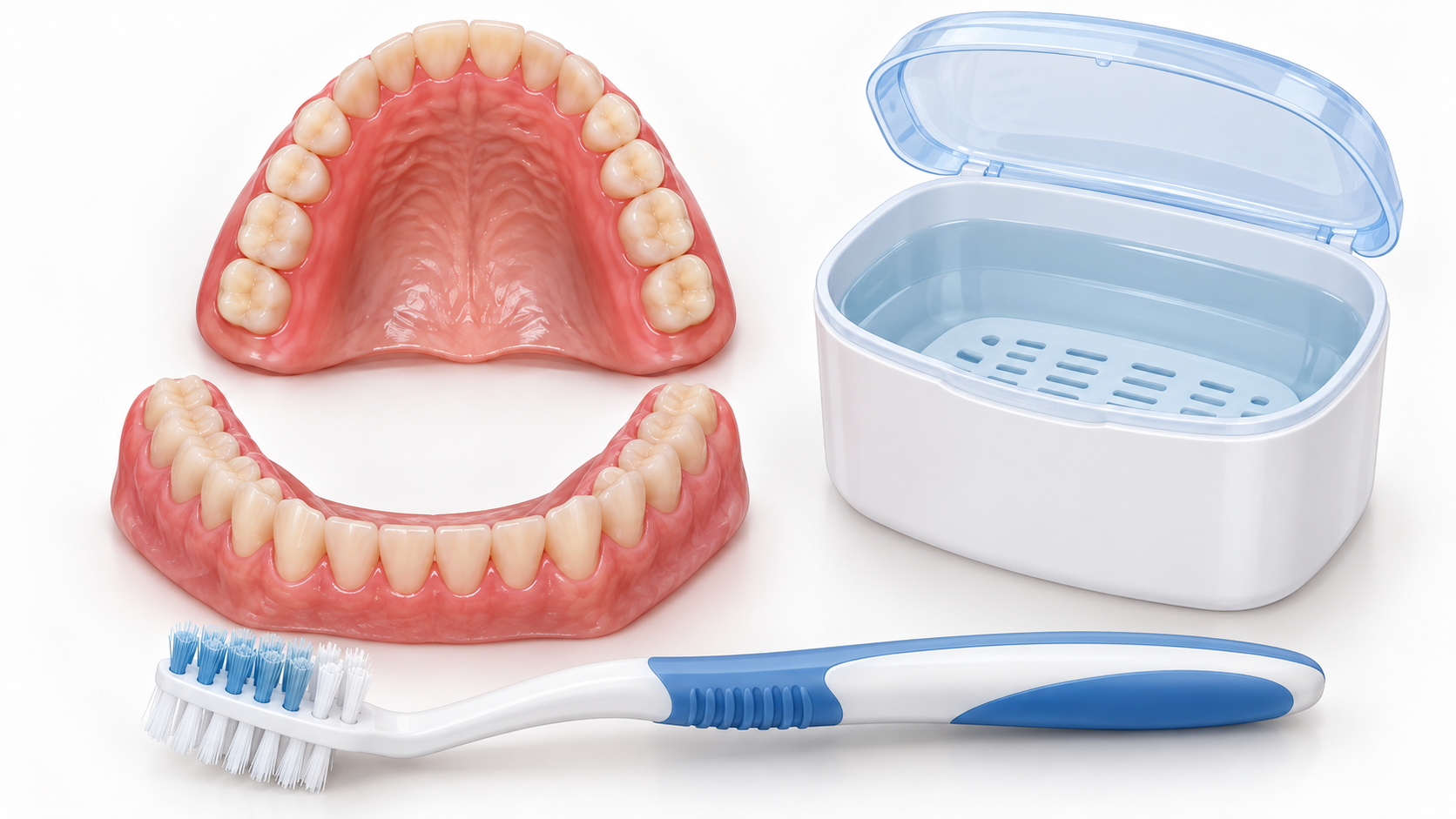
It helps to keep the following in mind when caring for dentures.
- Cleaning: After meals, remove food debris and clean with a soft brush.
- Cleaning method: Use a method suitable for dentures, and be careful with abrasive products or hot water.
- Storage: Generally, remove dentures at bedtime and store them in a way suited to their material.
- Oral hygiene: Also care for your remaining natural teeth, gums, and tongue.
- Regular checkups: Check that the denture fits the gums well and that chewing forces are not concentrated on one side.
With implant overdentures, you need to care not only for the denture but also for the gums around the implants and the condition of the connecting components.
The structure of implants and the treatment process are explained in detail in What Is a Dental Implant? From the Treatment Process to Cost and Insurance Coverage.
In Closing
Watching my maternal grandmother, who wore dentures for many years, what weighed on me most was her everyday meals.
Easing, even a little, the inconvenience of having to avoid hard foods and eat only porridge or soup, and helping patients comfortably enjoy the foods they used to love again. That is the goal I pursue in denture care.
Rather than asking what more needs to be done, I will start by thinking about how to conserve the teeth and gums that remain now.
Reviewed by: Dr. Kim Kunmin, board-certified prosthodontist
References
- National Health Insurance Service (Korea). Denture coverage for older adults.
Eligibility and coverage criteria for Korean National Health Insurance denture coverage for people aged 65 and over.
https://www.nhis.or.kr/static/html/wbma/c/wbmac0217.html - Health Insurance Review & Assessment Service (Korea). Denture coverage criteria.
Scope and cycle of coverage for complete and partial dentures.
https://www.hira.or.kr/bbsDummy.do?brdBltNo=47749&brdScnBltNo=4&pgmid=HIRAA010006011200 - UK National Health Service (NHS). Dentures (false teeth).
Types of dentures, adjusting to them, and how to care for them.
https://www.nhs.uk/tests-and-treatments/dentures/