
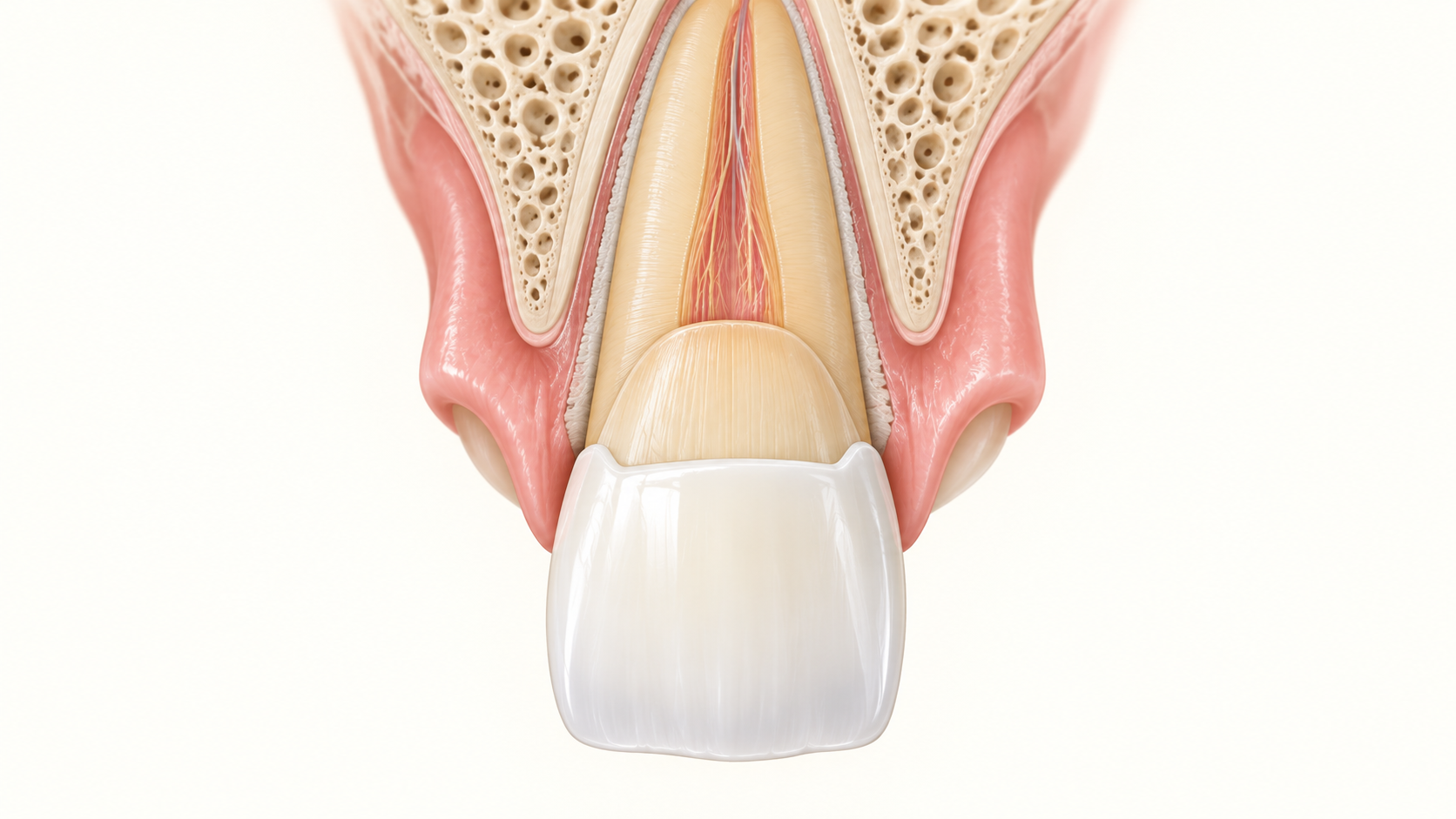
 A front tooth crown covers a badly damaged or weakened tooth to restore its shape and function. The need depends on root canal history, remaining tooth structure, and material traits (zirconia, E-max, PFZ). Covers why crowns turn dark, replacement criteria, tooth reduction, shade, and lifespan and cost factors.
1. When Is a Front Tooth Crown Needed?
A front tooth crown is a treatment considered when a tooth is severely damaged or when the remaining tooth alone cannot withstand enough force.

Examples include extensive decay, a badly fractured front tooth, or a large existing restoration that has left the remaining tooth weakened.
On the other hand, if only a small part of the tooth has chipped, it may be restored with resin. If the main goal is to improve color or shape, a laminate veneer may also be considered, depending on the condition of the tooth.
What matters here is not only how large the damage looks from the outside. We also need to check how much healthy tooth remains after the decay is removed, and whether there are any cracks or problems with bite force.
Because a crown covers the entire tooth, a certain amount of tooth reduction is required. So rather than deciding on a crown from the start, I tend to first check whether the tooth can be adequately restored in another way.
Small fractures are explained in more detail on the Front Tooth Resin page, and the differences between treatment options on the Front Tooth Crown vs Laminate page.
2. Does a Front Tooth Treated with a Root Canal Always Need a Crown?
Having had root canal treatment does not by itself mean a front tooth must receive a crown. If enough tooth remains, it may be finished with resin or a similar material.
However, a tooth whose decay was deep enough to require root canal treatment may already have lost a large part of its structure.
Even if a good amount of tooth seems to remain from the outside, less healthy tooth than expected may be left once the decay is removed.
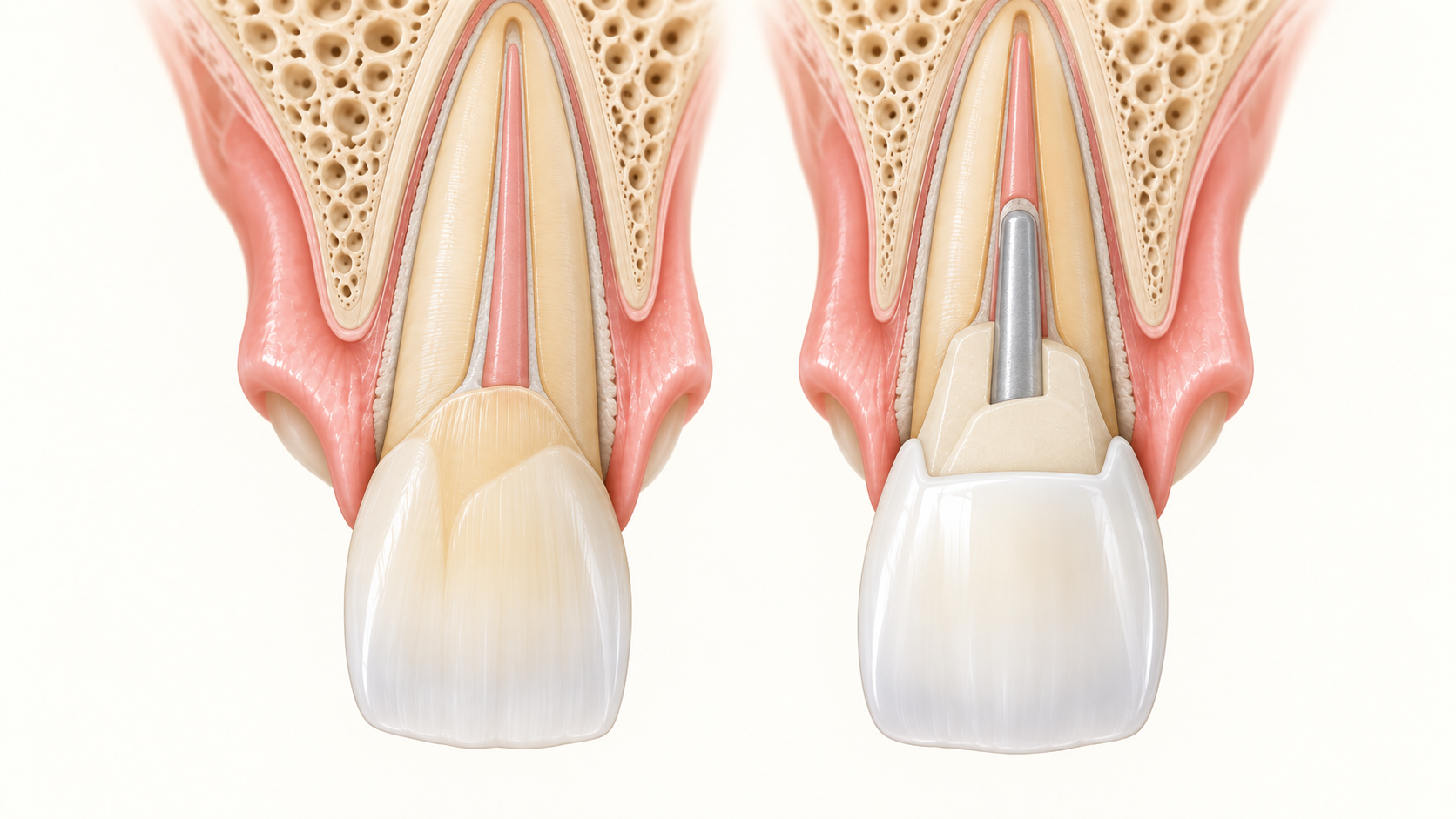
In such cases, I consider reinforcing the inside with resin and then covering and protecting the tooth with a crown. When needed, a supporting pillar called a post may also be used.
A post is not a device that automatically makes the tooth itself stronger. It is used to retain the internal core build-up when too little tooth remains, and the decision should be made after examining the condition of the root as well.
Some people think a tooth becomes like dry wood after root canal treatment. However, the tooth structure already lost to decay or fracture is a more important factor in the decision than the root canal treatment itself.
At Yonsei Gunho Dental Clinic, root canal treatment can be carried out in collaboration with Dr. Han Seung-won, a board-certified specialist in conservative dentistry, when needed.
The root canal treatment process and situations that call for retreatment are explained on the Microscope Root Canal Treatment and Retreatment page.
3. Types of Front Tooth Crowns: How to Choose Between Zirconia, E-max, and PFZ
For a front tooth crown, a harder material is not automatically better. The color and translucency of the surrounding teeth, the color of the underlying tooth, and bite force all need to be considered together.
The characteristics of the main materials are as follows.
| Material | Characteristics | Considerations when choosing |
|---|---|---|
| Lithium disilicate (e.g., E-max) | Used to reproduce translucency and color similar to natural teeth | When esthetics are important and bite conditions are suitable |
| Zirconia | High strength, with products available in a range of opacity and translucency | When the tooth bears heavy force or the color of the underlying tooth needs to be masked |
| PFZ (porcelain-fused-to-zirconia) | Porcelain layered over zirconia to express color and shape | Weigh esthetics and strength together, while checking the possibility of the surface porcelain fracturing |
For example, if the underlying tooth has darkened after root canal treatment, that color may show through when a translucent material is used.
Conversely, if the edges of the surrounding natural teeth look clear and translucent, how to reproduce that look also becomes important.
Materials with a porcelain outer layer, such as PFZ, can express color in fine detail, but the possibility of the surface porcelain chipping or coming off must also be considered.
Each material has different strengths and limitations. Rather than deciding by the material's name alone, I believe it is important to look at the tooth's condition, the desired color, and bite force together.
4. Should a Front Tooth Crown That Has Turned Dark Be Replaced?
A front tooth crown looking dark does not automatically mean it has to be redone.
Even if crowns look similarly dark from the outside, the causes can differ. It may be due to the material of the restoration, or it may be a problem with the gums or the natural tooth underneath.
Main Causes of a Dark-Looking Front Tooth Crown
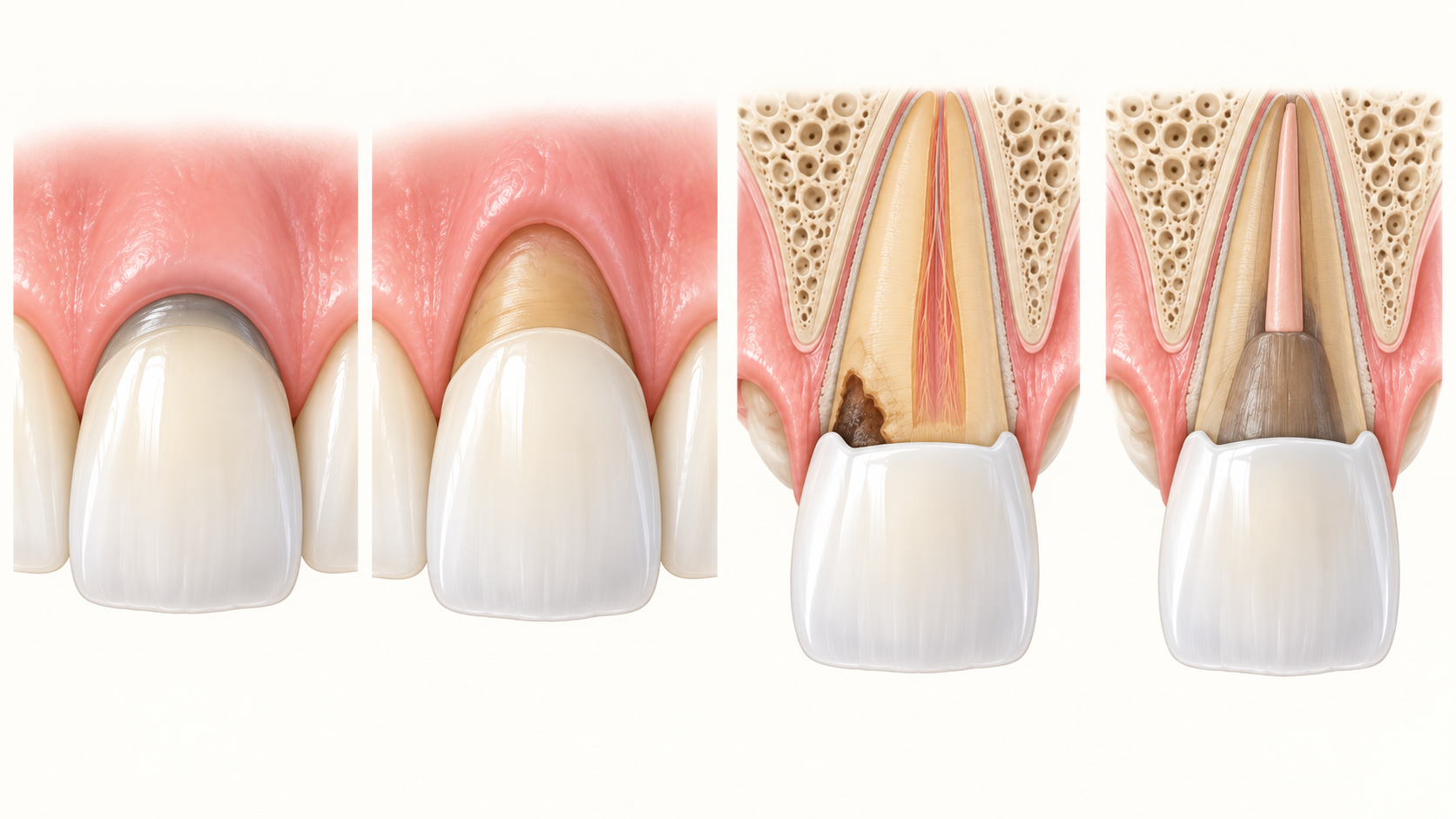
| Cause | Why it looks dark | What to check |
|---|---|---|
| PFM metal margin | The metal inside the restoration shows through darkly at the gumline | The restoration margin and the condition of the underlying tooth |
| Gum recession | The gums recede, exposing a dark tooth root or the restoration margin | Gum condition and the exposed margin |
| Secondary decay | Decay develops in the natural tooth under the crown | Extent of the decay and remaining tooth structure |
| Discoloration after root canal treatment | The inside of the tooth darkens and affects the color of the restoration | Color of the underlying tooth and condition of the existing restoration |
There is one thing worth knowing here.
The crown itself cannot decay, but the natural tooth remaining underneath it can.
In particular, problems at the margin where the crown meets the tooth may not be easily visible from the outside.
When Replacement Is Needed and When It Is Not
If the metal margin of a PFM crown is showing through, it does not necessarily mean there is a problem with the restoration or the underlying tooth.
If the underlying tooth is healthy and the crown is holding well, it may be kept as is. If the color bothers you, remaking it with a material such as zirconia, PFZ, or lithium disilicate can be considered.
If the gums have receded and exposed the margin, the gum condition should be examined first. If needed, the margin position of the new crown should also be planned so as not to strain the surrounding tissues.
If, on the other hand, decay has developed underneath, the decay is removed, and whether to remake the crown is decided after checking how much of the remaining tooth can be preserved.
If the tooth has darkened after root canal treatment, internal bleaching of the root-canal-treated tooth may be considered. However, bleaching does not change the color of the existing crown itself, so whether to remake it should be judged after checking the change in tooth color and the condition of the restoration.
That is why, when a crown looks dark, I first check what is making the color darker.
If the cause remains, a similar problem can occur even with a new crown.
5. How Much of the Tooth Needs to Be Reduced for a Front Tooth Crown?
Because a crown must cover the entire tooth, a certain amount of reduction is required. However, how much needs to be shaped depends on the condition of the tooth and the material used.
If there is decay, the damaged part is removed first, and I check how much healthy tooth remains. Where needed, missing parts are built up with resin or a similar material.
The tooth is then shaped to create space for the crown.
The goal cannot simply be to remove as little as possible. It is important to give the restoration the thickness it needs so that it stays well in place, while preserving as much healthy tooth as possible.
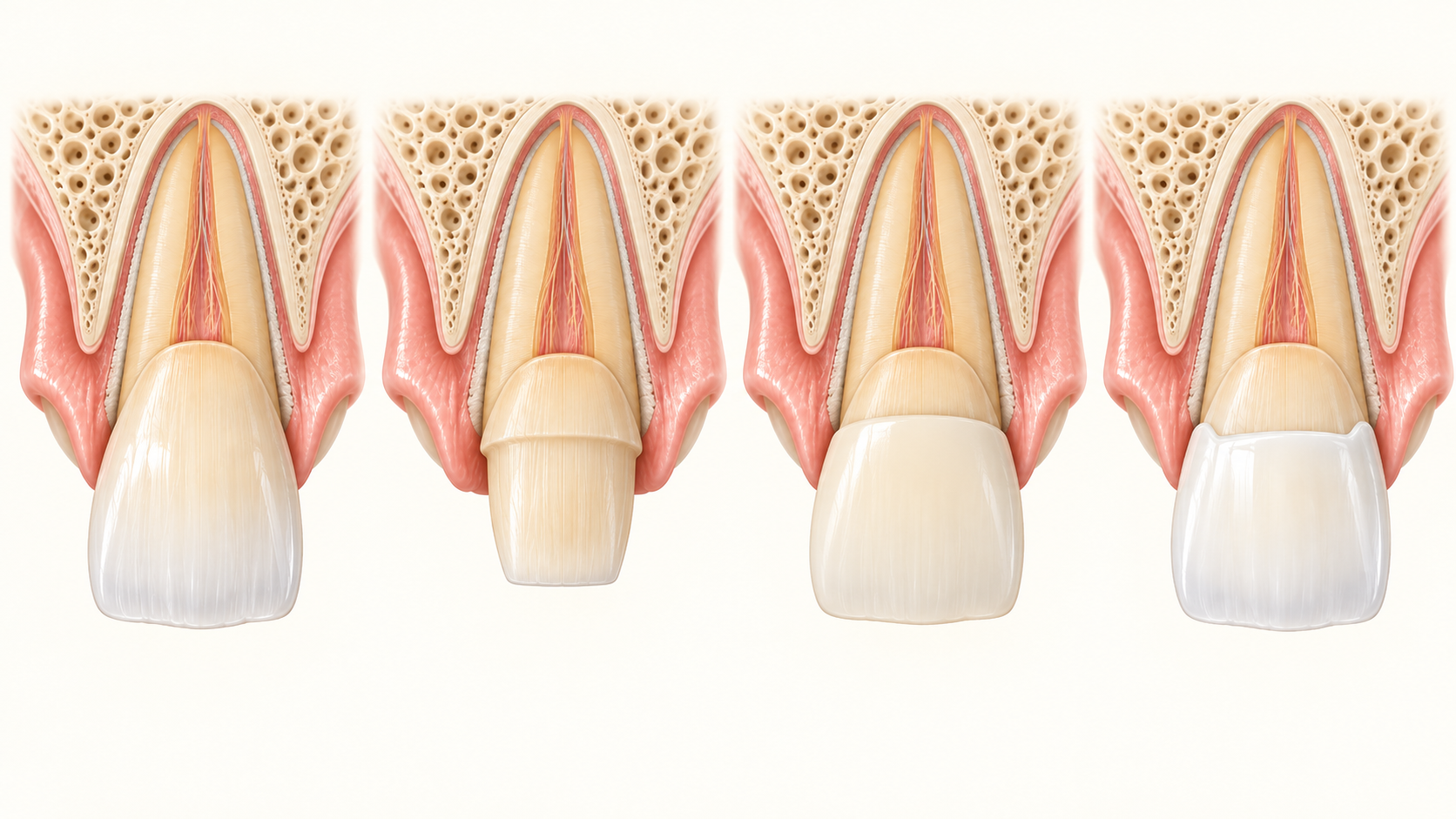
After the tooth is shaped, its form is recorded with an intraoral scan or impression, and the crown is fabricated. Yonsei Gunho Dental Clinic has a 3Shape TRIOS 5 intraoral scanner and an in-house 3D printer.
A temporary crown is used as needed until the final restoration is completed.
A front temporary crown does more than simply cover the gap. It protects the tooth in daily life and also helps in checking shape, pronunciation, and the relationship with neighboring teeth.
When the final crown is placed, not only the color but also the shape of the tooth and how the teeth bite together are checked.
The treatment process and duration vary with each person's situation, such as the extent of tooth damage, gum condition, and whether additional treatment is needed.
6. Can the Color Match the Neighboring Teeth When Only One Front Tooth Gets a Crown?
When only one front tooth receives a crown, its harmony with the surrounding natural teeth must be examined carefully.
That is because teeth are not made of a single shade of white.
The area near the gums can be slightly darker in color, while the edge may look clear or translucent. The color can also look different depending on the direction of the light.
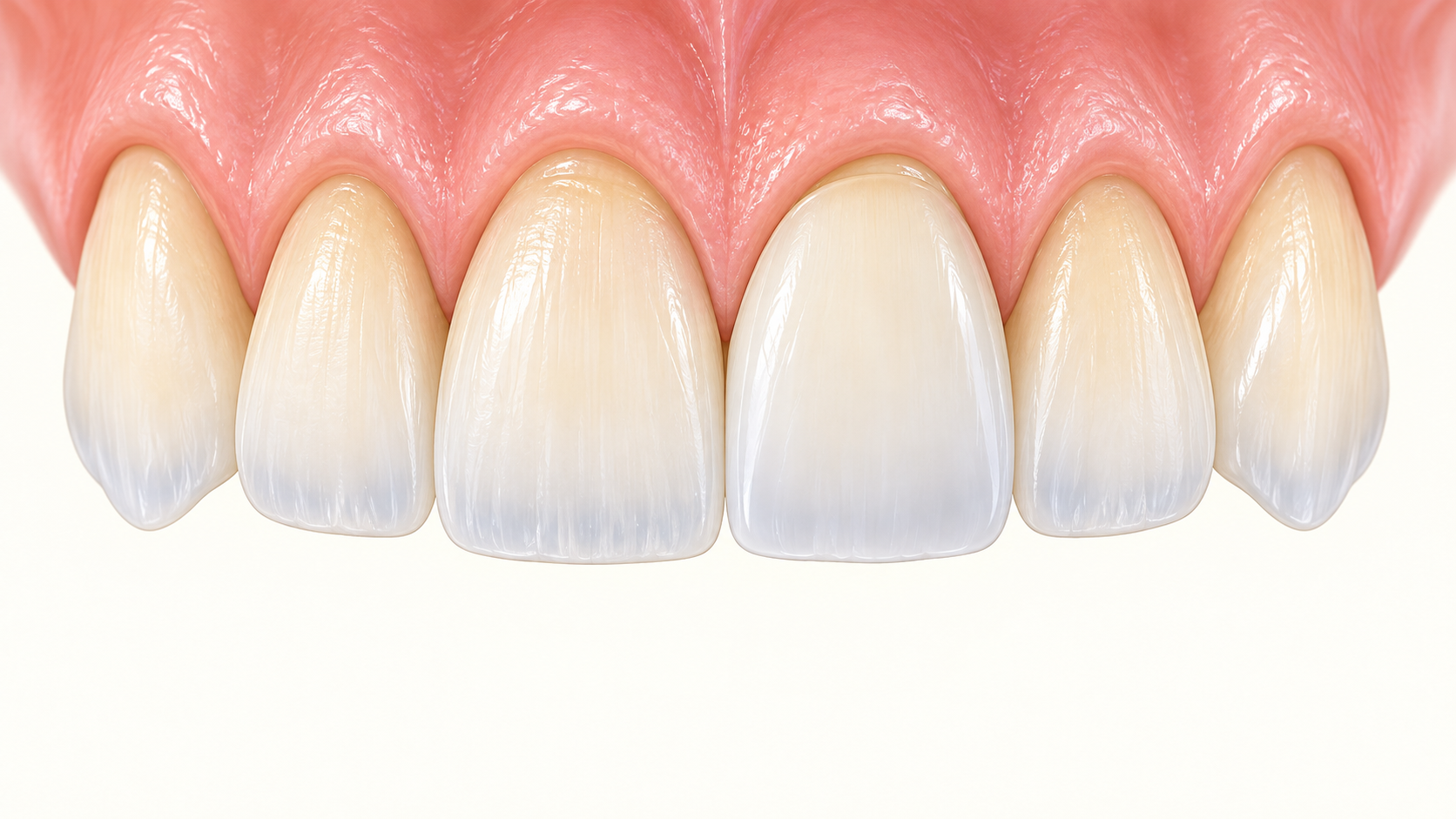
So when checking the color of a front tooth crown, I use a professional DSLR camera, lighting, and a polarizing filter.
I pass on to the dental technician not only the color I see with my eyes but also the subtle differences captured in the photos. When needed, I also take part in the lab work myself.
Of course, no material can guarantee a color completely identical to the surrounding natural teeth.
In particular, when the underlying tooth is dark or the surrounding teeth are highly translucent, the properties of the material and the range it can reproduce must be considered together.
What I consider important is not simply making a whiter tooth.
I look at whether the color and shape blend naturally when seen alongside the neighboring teeth, and whether the crown can be used comfortably in daily life.
7. What Does the Lifespan of a Front Tooth Crown Depend On?
How long a front tooth crown can be used is not determined by the material alone.
The condition of the remaining natural tooth, the shape of the restoration, bite force, grinding or clenching habits, and gum care all have an effect.
Long-term use has been reported for several materials, including zirconia and lithium disilicate, but the pattern of fractures and other complications can differ depending on the material and fabrication method.
It is therefore difficult to say that any one material will always last longer.
Over time, a crown can break or come off, and gaps or secondary decay can develop at the margin where the crown meets the natural tooth.
If the crown felt fine at first but now feels high or uncomfortable when chewing, the way the teeth meet and the fit of the restoration need to be checked.
In particular, if a crown becomes loose or comes off, it should be checked whether it can be re-cemented and whether any problem has developed in the underlying tooth or the restoration.
The natural tooth under the crown also needs ongoing care. It is important to clean the gumline with a toothbrush and floss and to have the surrounding teeth and gums checked regularly.
Placing a new crown is not the end of treatment. How the natural tooth underneath is cared for also affects how long it lasts.
8. What Factors Affect the Cost of a Front Tooth Crown?
The cost of a front tooth crown depends not only on the type of material but also on the current condition of the tooth and the treatment steps required.
The main determining factors are as follows.
- Restoration material and fabrication method: the choice of zirconia, lithium disilicate, PFZ, or other options
- Condition of the existing crown: whether it needs to be removed and remade
- Extent of tooth damage: whether decay treatment and core build-up are needed
- Additional treatment: whether root canal treatment is needed
Esthetic front tooth crowns are generally not covered by Korean National Health Insurance, but whether insurance actually applies may vary depending on the treatment provided.
So when trying to understand the cost, it is better to look not only at the material but also at what treatment the tooth actually needs.
In Closing
A front tooth crown is a treatment that restores the shape and color of a tooth, but not every front tooth needs one.
Likewise, an existing crown does not have to be replaced just because its color looks different. The cause needs to be identified first.
Rather than doing more treatment, I place importance on protecting the natural tooth that remains while treating precisely as much as is needed.
Reviewed by: Dr. Kim Kunmin, board-certified prosthodontist
References
- American Dental Association (ADA). Materials for Indirect Restorations.
Types and properties of indirect restoration materials such as crowns.
https://www.ada.org/resources/ada-library/oral-health-topics/materials-for-indirect-restorations - American Association of Endodontists (AAE). Root Canal Explained.
The root canal treatment process and restoring the tooth after treatment.
https://www.aae.org/patients/root-canal-treatment/what-is-a-root-canal/root-canal-explained/ - NHS (UK National Health Service). Dental treatments.
What a crown is and the treatment process.
https://www.nhs.uk/live-well/healthy-teeth-and-gums/dental-treatments/ - American Association of Endodontists (AAE). Root Canal Myths vs. Facts.
Misconceptions and facts about root canal treatment.
https://www.aae.org/patients/root-canal-treatment/myths-root-canals/