
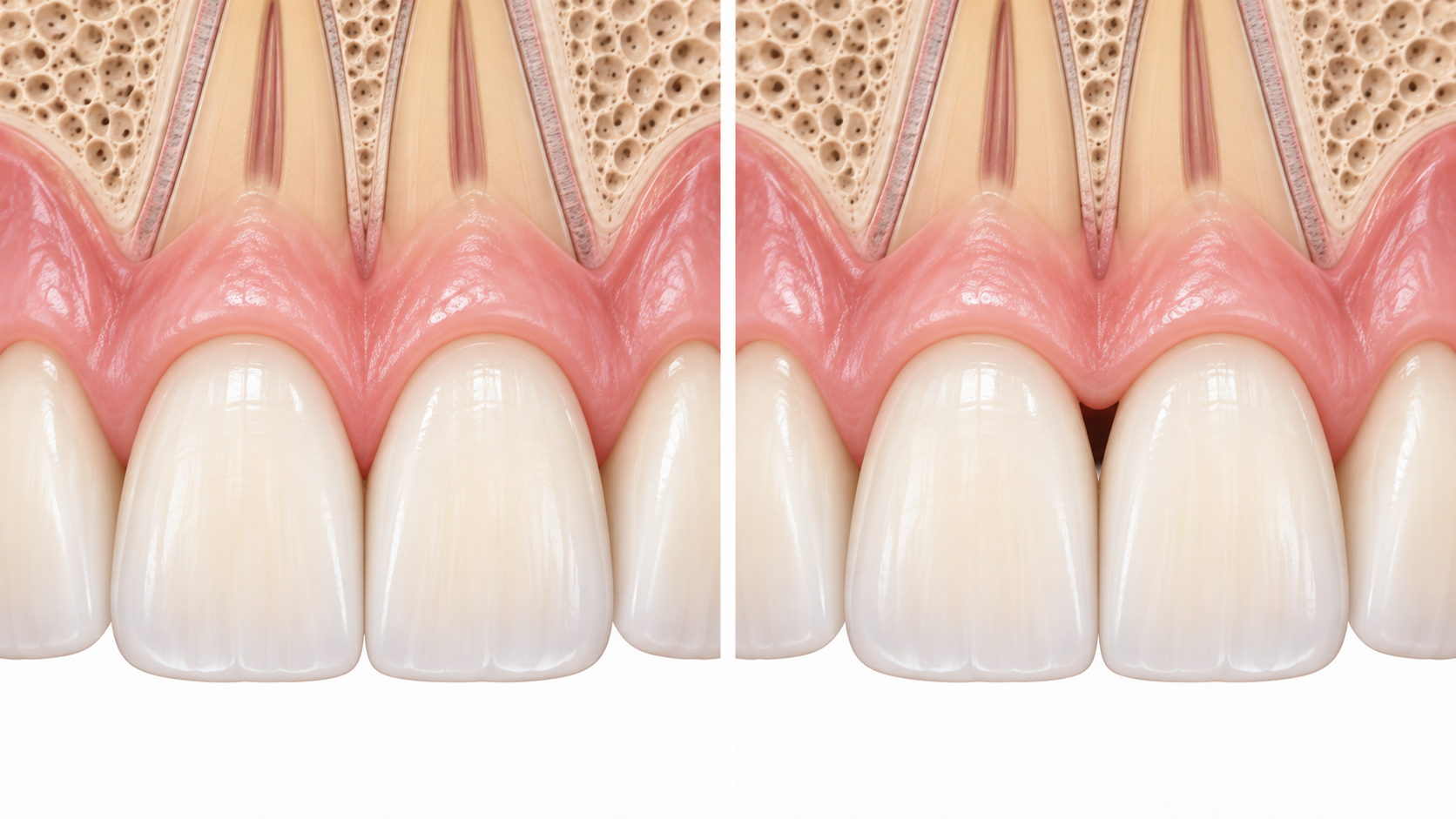
 A black triangle is a dark triangular space between the front teeth near the gums. Treatment depends on the cause, such as jawbone loss, tooth shape, or contact point position. A prosthodontist explains the chances of natural recovery and gum regeneration, choosing composite resin or laminate veneers, and aftercare.
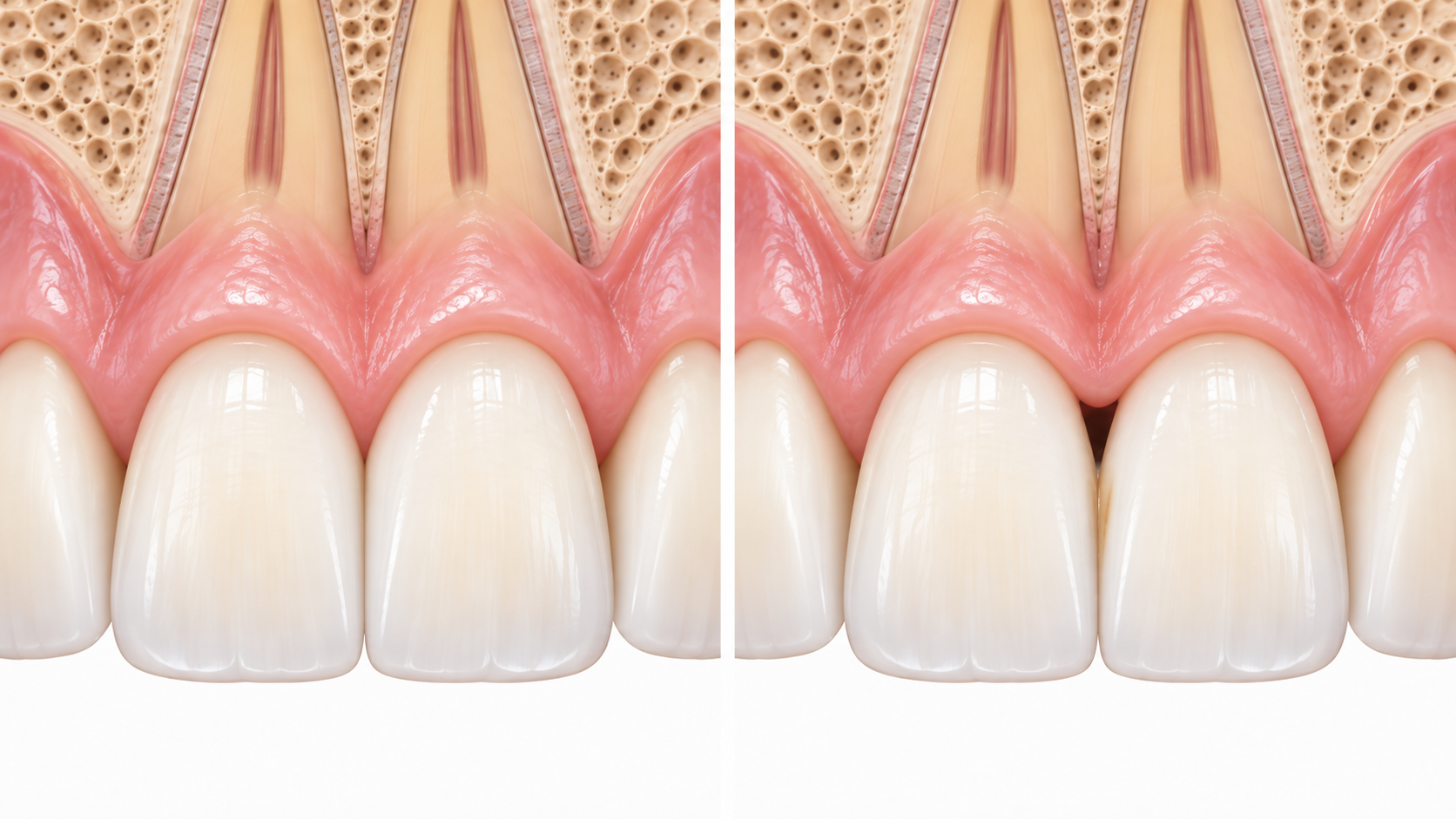
1. What Is a Black Triangle? Why a Dark Triangular Space Appears Between the Front Teeth
The space between teeth is normally filled with gum. This gum is called the "interdental papilla," and when it does not fully fill the space between the teeth, it looks like a dark triangle.

The important point here is that black triangles are not caused only by receding gums.
| Cause | Why the dark space appears |
|---|---|
| Periodontitis and jawbone loss | As the bone supporting the gum between the teeth decreases, the space may become exposed |
| Tooth shape | If the teeth are closer to a triangular shape, the space near the gums may be relatively wider |
| Contact point | If the point where the teeth touch is far from the gums, the space may be hard to fill |
| Changes after orthodontic treatment | As tooth positions change, a space that was previously hidden may become visible |
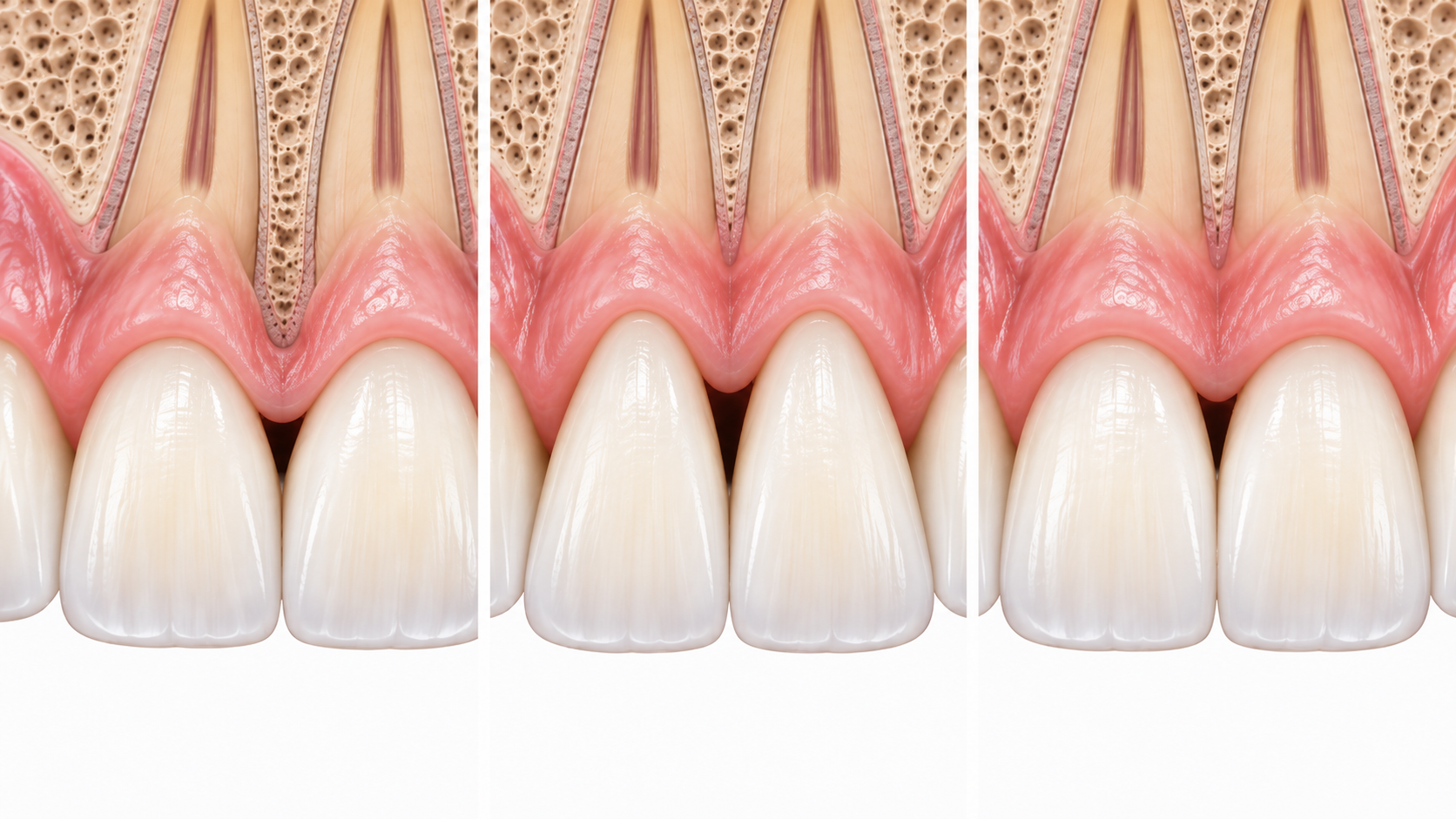
After gum inflammation is treated and the swelling goes down, a gap that was not easily seen before may also become visible.
A straight gap between the two front teeth should also be distinguished from a black triangle. The two can also appear together.
That is why, rather than looking at the space itself, I first check whether the jawbone has decreased or whether the tooth shape or contact position is the cause.
2. Can a Black Triangle Go Away on Its Own, or Can the Gum Fill Back In?
It depends on the cause, but the space does not fill back in on its own just because time passes.
In particular, a space caused by jawbone loss or by tooth shape may be difficult to restore naturally to its original appearance.
As gum inflammation subsides, the shape of the tissue may change. However, this does not mean that lost jawbone or interdental papilla has been rebuilt.
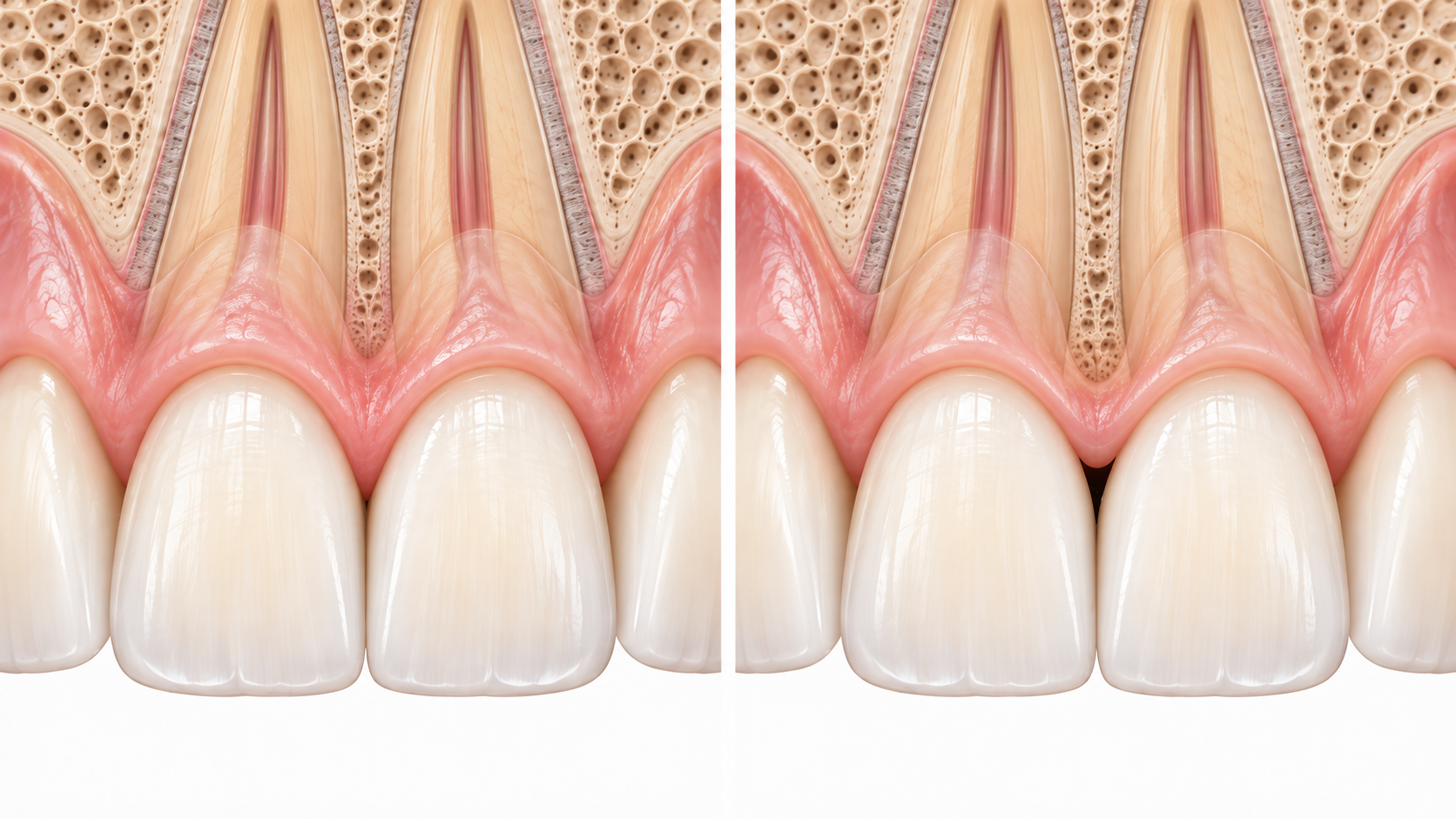
Treatments to restore the interdental papilla are also being studied, but results vary depending on the condition of the jawbone and the degree of tissue damage. Regeneration cannot yet be predicted for every black triangle.
In particular, if periodontitis is the cause, managing gum inflammation and stabilizing the periodontal tissues comes before filling the dark space.
The relationship between jawbone loss and periodontal disease is explained in detail on the Gum Treatment (Periodontal Treatment) page.
3. How Are Black Triangles Treated? Choosing Between Composite Resin and Laminate Veneers
A black triangle can be reduced by reshaping the teeth with composite resin or laminate veneers. However, filling the space first is not appropriate in every case.
Whether the gums are stable, how much the teeth need to be altered, and what the biting forces are like must all be assessed together.
| Treatment | When it is considered | Points to note |
|---|---|---|
| Composite resin treatment | When the space can be reduced by reshaping the teeth and the gums are stable | Possible staining or chipping; keeping the area between the teeth clean |
| Laminate veneers | When the color and shape of the front teeth also need to be adjusted | Depending on the tooth condition, tooth reduction and fabrication steps are needed |
| Gum-related treatment | When there are periodontal tissue problems such as periodontitis or jawbone loss | Treating the gums does not mean the dark space will be completely filled |
| Orthodontic evaluation | When the alignment of the teeth itself needs to be adjusted | The relationship between tooth position and the space needs to be evaluated first |
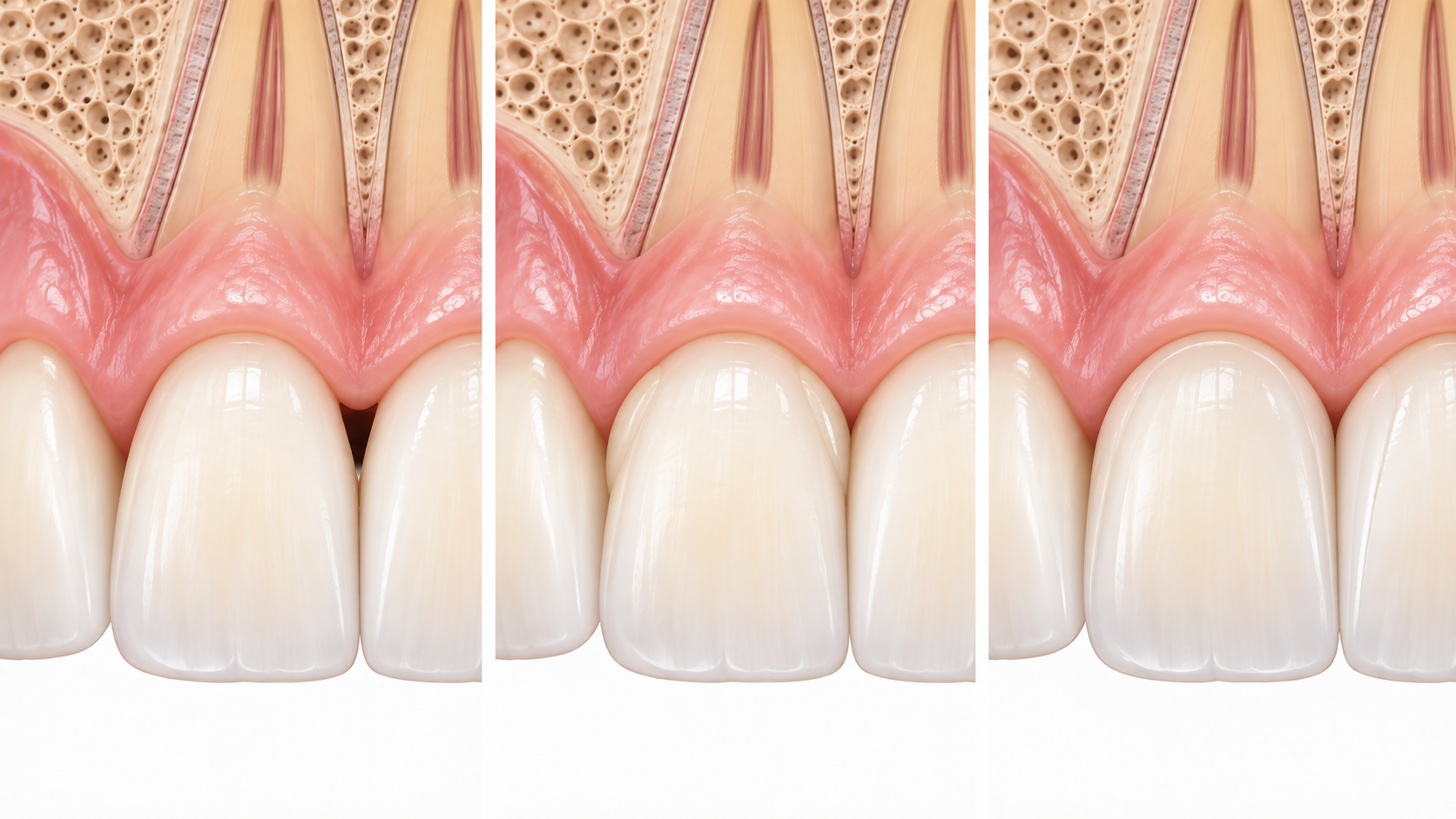
Among composite resin techniques, there is also Bioclear, which uses dedicated clear matrices to shape the area between the teeth. It is a way to adjust the space while reducing tooth reduction, but the actual extent of reduction and whether it can be used depend on the condition of the teeth.
A crown, on the other hand, covers the entire tooth, so relatively more tooth structure is removed. It is not a first-line option for addressing a black triangle alone.
Yonsei Gunho Dental Clinic does not provide orthodontic treatment. When jawbone loss or periodontitis is suspected, the gum condition is checked together, as needed, with Dr. Park Ji-ho, board-certified oral and maxillofacial surgeon.
For front teeth, color and shape also matter. When reducing the space, I also check that the teeth do not look too wide and that they blend naturally with the color of the neighboring teeth and the gum line.
Ways to adjust both the color and shape of the front teeth are covered in detail on the Laminate Veneers page.
4. Why Can the Dark Space Become Visible Again After Black Triangle Treatment?
If a dark space becomes visible again after treatment, it does not necessarily mean the composite resin has come off.
Common causes include the following.
- Gum changes: As the gums continue to recede, a new space may become exposed.
- Resin staining: Staining at the resin margin can make the area look dark.
- Resin damage: Chipping or detachment can change the shape.
There is one more thing I consider important here: the forces placed on the teeth.
I grind my own teeth too, so in front tooth treatment I check how the upper and lower teeth fit together just as closely as color and shape.
If there is teeth grinding or clenching, or if the back-tooth bite has lowered so that force concentrates on the front teeth, the restorations may be placed under repeated stress.
This is why it is not enough to think only about filling the space; we also need to judge whether the conditions allow the treated result to be maintained.
5. How Should You Care for Your Teeth After Black Triangle Treatment?
After treatment, it is important to keep the gums healthy, keep the spaces between the teeth clean, and avoid placing excessive force on the restorations.
The following points can be checked during care.
- Cleaning between the teeth: If food gets caught often or floss catches excessively, the contact between the teeth and the shape of the restoration need to be checked.
- Avoiding gum irritation: It is best to avoid habits such as forcing floss in too hard or repeatedly irritating the gums.
- Caring for restorations: Over time, composite resin margins may stain or the surface may wear. Depending on the condition, polishing or partial repair may be needed, and how well it holds up varies from person to person.
- Managing the bite: If there is teeth grinding or clenching, the overall bite should be considered, not just the front teeth.
This is explained in more detail on the Teeth Grinding Treatment page.
6. What Does the Cost of Black Triangle Treatment Depend On?
Esthetic composite resin restoration for black triangles is generally not covered by Korean National Health Insurance, and the cost varies depending on the treatment method and scope.
The main factors are as follows.
- Number of teeth treated
- Size and shape of the space
- Materials used
- Difficulty of reshaping the teeth
There is one thing that is helpful to know here.
Seeing one dark triangle between the front teeth does not necessarily mean only one tooth will be treated.
This is because in some cases the shapes of the teeth on both sides need to be adjusted together to create a natural appearance.
Therefore, it is difficult to judge the actual scope of treatment or the cost from the number of visible spaces alone.
In Closing
A black triangle is not simply a matter of filling the dark space between the front teeth.
We need to look together at whether the gums have receded, whether tooth shape is the cause, and whether the result can withstand biting forces after treatment.
What I value is treatment that conserves rather than treatment that does more. For black triangles too, I believe the basics are to identify the cause first, preserve the natural teeth as much as possible, and treat only as much as needed.
Reviewed by: Dr. Kim Kunmin, board-certified prosthodontist
References
- Journal of Esthetic and Restorative Dentistry (2010). Esthetic considerations in interdental papilla: remediation and regeneration.
Causes of interdental papilla loss and methods for its recovery and regeneration.
https://pubmed.ncbi.nlm.nih.gov/20136942/ - Clinical Oral Investigations (2024). Interdental papilla reconstruction: a systematic review.
A systematic review of interdental papilla reconstruction and the limitations of the evidence.
https://pubmed.ncbi.nlm.nih.gov/38231354/ - Frontiers in Dental Medicine (2025). Interdental papilla recession and reconstruction of the lost triangle: a review of the current literature.
Factors behind black triangles and treatment approaches.
https://pmc.ncbi.nlm.nih.gov/articles/PMC11797962/