
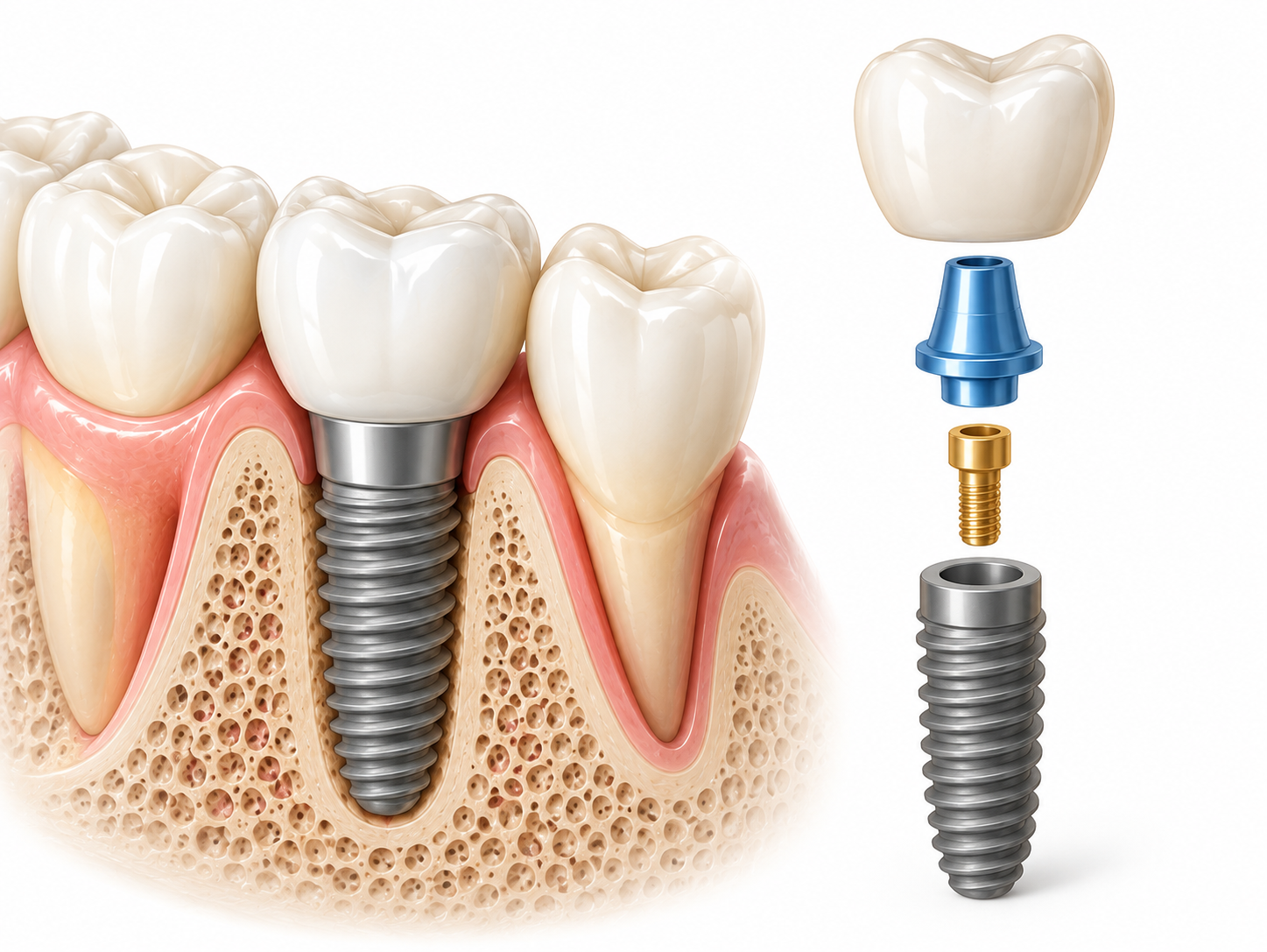
 A loose or inflamed implant does not always need removal and re-placement. Treatment depends on the cause: screw loosening, prosthesis damage, peri-implantitis, or failed osseointegration. We check if it can be kept; if removal is needed, we explain re-placement method and timing, pain, recovery, cost, and insurance.
1. If an implant becomes loose or falls out, does it always need revision surgery?
A loose implant does not always have to be removed or placed again. First, we need to distinguish whether the crown on top is loose or the implant body placed in the bone is itself loose.
An implant consists mainly of the fixture placed in the bone, the abutment that connects it to the prosthesis, and the crown that does the chewing. The treatment depends on which part is loose or has come off.
For example, if only the abutment screw has loosened, retightening the screw and adjusting the bite can sometimes solve the problem. On the other hand, if the implant body has fractured or its bond with the bone is not maintained, removal must be considered.
When deciding on revision surgery, I first look at what is loose, and then find out why it became loose. Implants placed at other dental clinics are evaluated by the same criteria.

In particular, an implant itself has no nerve like a natural tooth, so you may not feel pain even when a structural problem occurs. Even if it does not hurt, it is a good idea to have the cause of any looseness checked.
2. What causes the need for implant revision surgery?
There are four main causes that lead us to consider implant revision surgery. However, even when causes look the same, the actual treatment depends on the remaining bone and the condition of the implant.
- Fracture of connecting components: The screw or abutment has broken. We check whether the broken component can be removed and the prosthesis remade.
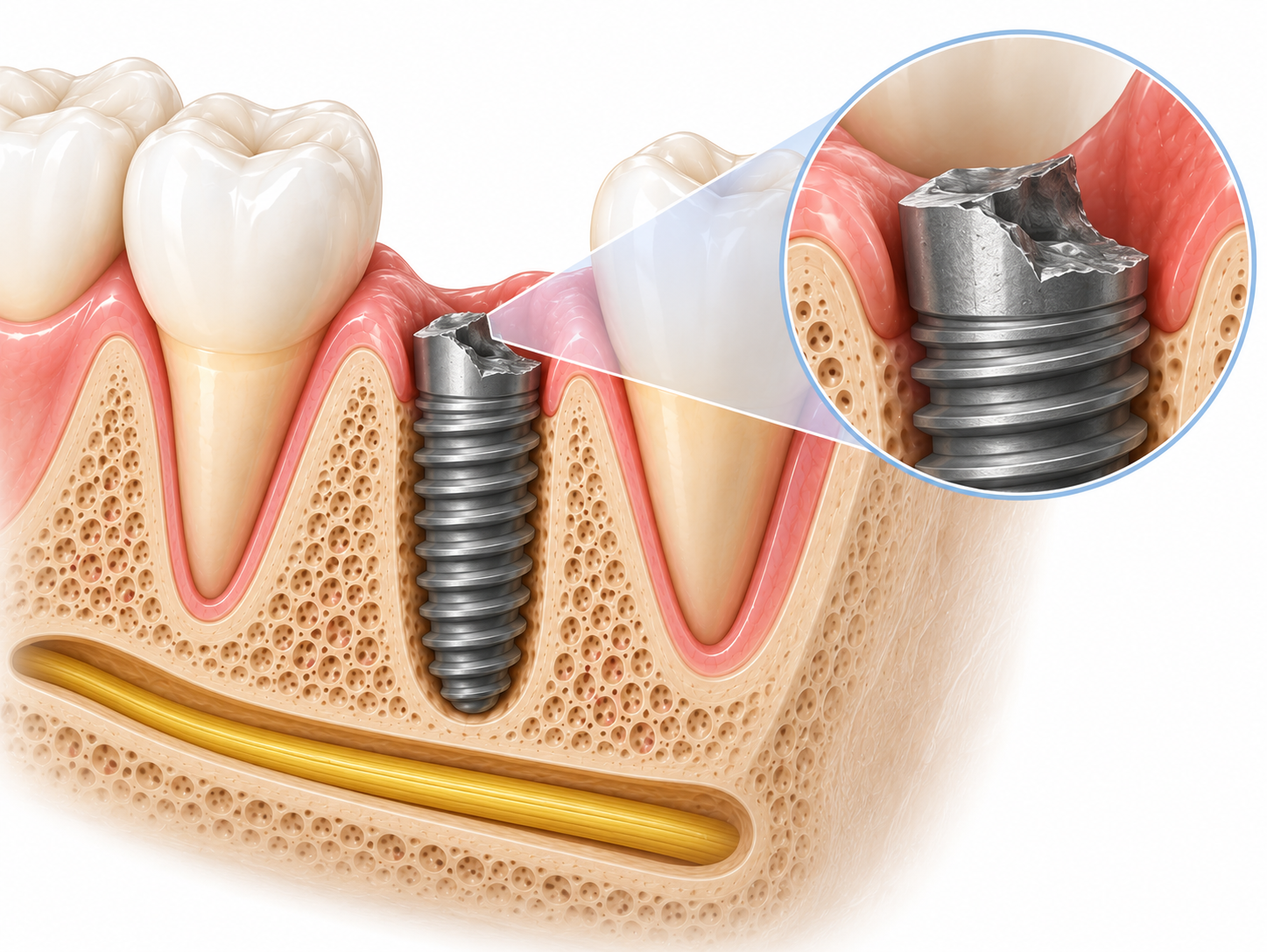
- Fracture of the implant body (fixture): The body placed in the bone has itself broken. The removal method and the possibility of damage to surrounding tissue must be considered.
- Failed osseointegration: The necessary bond between the implant and the jawbone did not form or was not maintained. If the body itself moves, removal may be needed.
- Peri-implantitis: A condition in which gum inflammation is accompanied by loss of the bone supporting the implant. It is distinguished from peri-implant mucositis, in which only the gum is inflamed.
Typical symptoms include gum bleeding, swelling, pus, and pain. However, symptoms may not be obvious in the early stages.
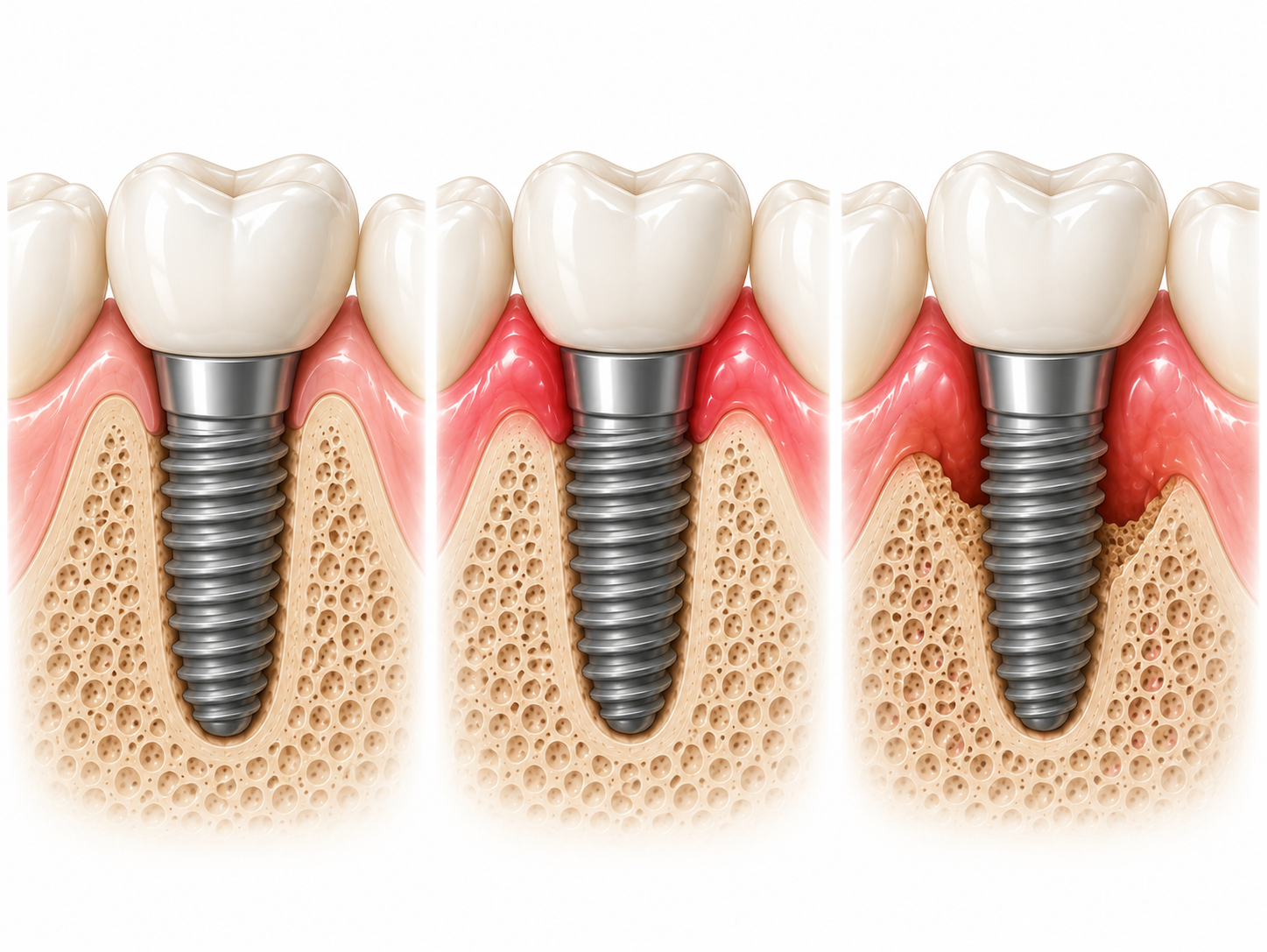
This is also why I try to distinguish inflammation from fracture when examining a loose implant. Even if the symptoms look similar on the outside, whether the existing implant can be kept depends on the cause.
3. What examinations are used to decide on revision surgery?
Implant revision surgery is not decided by looseness alone. We check the connection of the prosthesis, the bite, and the condition of the surrounding gums and bone, and, if needed, examine the mandibular canal and implant position with CT.
The items we check are as follows.
- Loose part: We distinguish whether it is the prosthesis, a connecting component, or the implant body in the bone.
- Gum condition: We look for signs of inflammation such as bleeding or pus.
- Surrounding bone: X-rays show the amount of remaining bone and areas of suspected fracture or bone loss.
- Mandibular canal position: If needed, CT is used to examine the positional relationship between the inferior alveolar nerve and the implant.
- Bite: We check whether excessive force is concentrated on the prosthesis.
However, it is difficult to identify every structural problem with standard X-rays alone.
At Yonsei Gunho Dental Clinic, CT is used when surgical planning is needed. In the lower molar area in particular, the inferior alveolar nerve, which is responsible for sensation, runs close by, so the positional relationship between the mandibular canal and the implant must be examined.
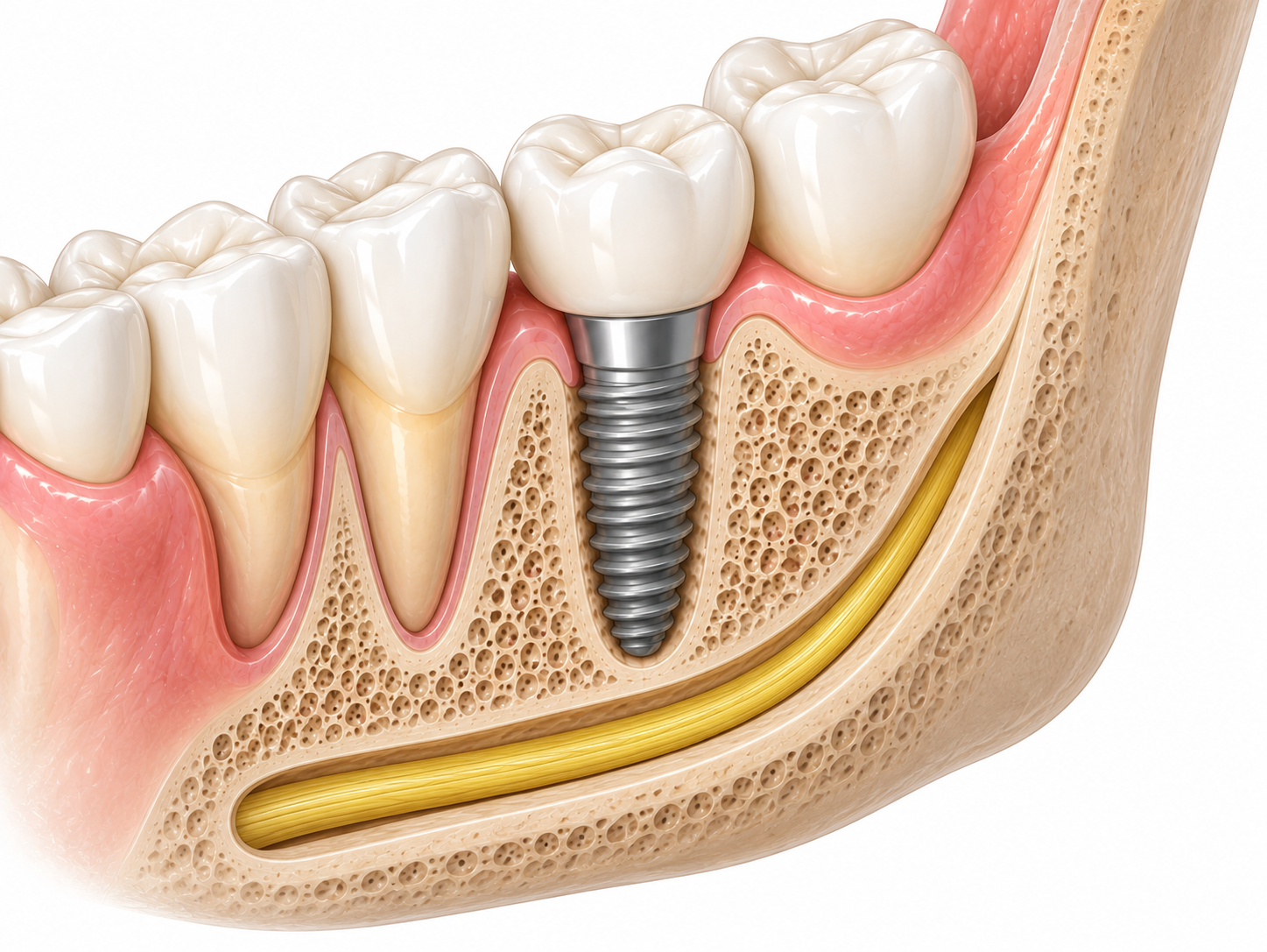
In addition, when needed, I check the prosthesis, screws, and how the upper and lower teeth meet together with Dr. Kim Kunmin, a board-certified prosthodontist. This is to look not only at problems with the implant body and surrounding bone but also at the causes of repeated force.
4. How do we choose between peri-implantitis treatment and removal/re-placement?
Not every implant with a problem is removed. We first check whether the existing implant can be kept, and then choose the necessary treatment according to the extent of damage and the state of inflammation.
| Identified problem | Treatment considered | Decision criteria |
|---|---|---|
| Screw loosening | Screw retightening, bite adjustment | Condition of the fixture and connecting components |
| Screw/abutment fracture | Removal of the fractured component, remaking the prosthesis | Whether the component can be removed and whether the fixture is damaged |
| Peri-implantitis | Non-surgical treatment, surgical treatment if needed | Extent of inflammation, bone loss, possibility of keeping the implant |
| Failed osseointegration | Fixture removal, then consideration of re-placement | Implant mobility and condition of the surrounding bone |
| Fixture fracture | Removal or consideration of a different placement position | Fracture location and risk of damage to surrounding tissue |
For peri-implantitis, the cause of the inflammation is generally managed first, and the condition is re-evaluated after non-surgical treatment. If the inflammation persists, surgical treatment may be considered, and removal is considered when the implant is judged difficult to keep.
However, bone that has already been damaged does not return to its original state in every case. Even if the existing implant is kept, follow-up observation is needed afterward.
I think first about the treatment that should be done, rather than the treatment that can be done. Rather than deciding on surgery right away simply because removal is possible, I weigh the benefits and risks of keeping the existing implant against those of removing it.
5. Can a new implant be placed right after removal? What are the revision process and timeline?
Placing a new implant immediately in the site where an implant was removed is possible under certain conditions. Immediate or delayed re-placement is decided based on whether enough bone remains and whether the new implant can be stabilized.
Revision surgery generally follows these steps.
Step 1. Evaluating the existing implant and the possibility of re-placement
We check where the implant is damaged and the condition of the surrounding bone and inflammation. CT is also used to examine where the new implant will be placed and its relationship to surrounding structures such as the mandibular canal.
Step 2. Removal of the existing fixture if needed
If the existing implant is difficult to keep, it is removed. For a fractured implant firmly attached to the bone, damage to the surrounding bone must be considered during removal.
Step 3. Immediate re-placement, or recovery after a bone graft
If the remaining bone is in suitable condition after removal, immediate re-placement is considered. If bone is insufficient or initial stability is difficult to achieve, a bone graft and recovery period may come first.
At Yonsei Gunho Dental Clinic, our principle is to confirm the extent of bone grafting needed and apply it only where it is needed. For details, see the Implant Bone Graft page.
Step 4. Confirming osseointegration and the final prosthesis
After confirming that the new implant has bonded stably with the bone, the prosthesis is made. The treatment period follows clinic guidelines and varies by individual, depending on the difficulty of removal, whether a bone graft is done, and the recovery.
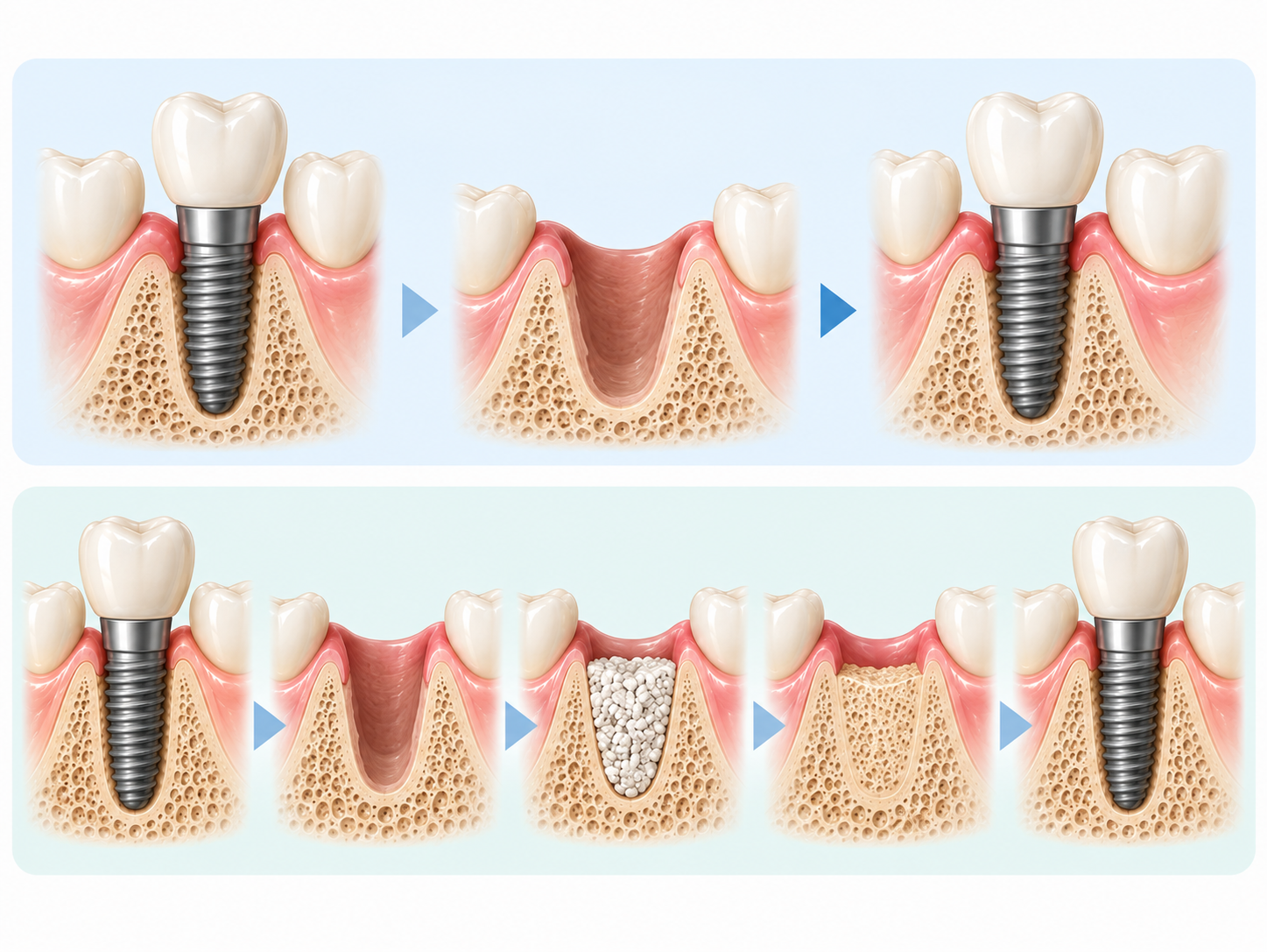
I do not believe a new implant must be placed on the same day the old one is removed. Preserving the surrounding tissue and creating the conditions for the new implant to last comes first.
6. How painful is implant revision surgery, and what should I be careful about during recovery?
Implant revision surgery is performed under local anesthesia, and pain and swelling after surgery differ from person to person. Recovery also varies depending on how firmly the existing implant is attached and whether a bone graft is needed during removal.
In particular, if a fractured fixture is firmly bonded to the bone, the removal process can become complex. In such cases, the approach takes into account anatomical structures such as the surrounding bone and nerves.
At Yonsei Gunho Dental Clinic, we evaluate your condition before surgery and, depending on your condition, consider conscious sedation when needed. Sedation methods and the conditions for its use are explained on the Conscious Sedation page.
After surgery, please keep the following in mind.
- Do not repeatedly touch the surgical site with your tongue or fingers.
- If there is bleeding, apply pressure as instructed; if bleeding continues, it needs to be checked.
- Smoking and drinking can affect wound healing, so it is best to avoid them.
- If pain or swelling gradually worsens, or pus or fever appears, you should be checked for infection.
At Yonsei Gunho Dental Clinic, we recommend avoiding alcohol for about two weeks after implant surgery. This is our clinic guideline, and instructions may vary depending on the extent of surgery and your individual condition.
7. When is implant revision surgery difficult or in need of special care?
If much of the surrounding bone has been lost or the site is close to an important nerve, revision planning can become complex. Risks such as bone loss or nerve damage must also be considered when removing the existing implant.
In particular, if part of an implant body firmly attached to the bone has fractured, removal may not be easy. This is because there are situations in which a lot of surrounding bone would have to be damaged to take out the broken piece.
In such cases, I compare the benefits of removal with the risk of damaging surrounding tissue. Depending on conditions, I may consider leaving the existing piece in place and placing an implant in a different position, but this does not apply to every patient.
Also, even when revision surgery is performed, complications such as infection, bleeding, nerve damage, and failed osseointegration are possible. Smoking, diabetes, and oral hygiene can also affect recovery and long-term maintenance.
If you have teeth grinding, clenching, or a habit of chewing only on one side, the repeated force must also be checked. Related management is covered on the Bruxism Treatment page.
Regular care is needed even after revision surgery. Yonsei Gunho Dental Clinic generally recommends check-ups every 6 months to 1 year, but this is a typical clinic guideline and varies by individual. The check-up interval is set differently depending on your history of inflammation and the condition of the prosthesis.
8. Why does the cost of implant revision surgery vary, and is it covered by health insurance?
The cost of implant revision surgery depends on what treatment is needed.
Whether health insurance applies can also be determined only after checking the insurance history of the existing implant and the reason for the repeat procedure.
Simply retightening an abutment screw and removing an existing fixture to place a new one involve different scopes of treatment.
The main factors that determine the cost of revision surgery are whether existing components can be kept, the difficulty of removal, whether a bone graft is needed, the extent of re-placement, and whether the final prosthesis must be remade.
The dental implant coverage criteria of the Health Insurance Review & Assessment Service (HIRA) include a separate criterion for removing the fixture and placing a new implant when an insured implant has failed to osseointegrate.
However, this criterion does not apply to every implant revision surgery. It needs to be checked based on the insurance history and the reason for the repeat procedure. If treatment or surgery is performed for gum disease around the implant after a certain period following placement of the prosthesis, it can be billed under the corresponding covered item, while prosthesis-related maintenance is not covered by Korean National Health Insurance.
The general scope of health insurance coverage for implants can be found on the Dental Implants page.
I believe that before discussing cost or the scope of surgery, it is right to first see whether there is a way to keep the existing implant. Even with the same looseness, the treatment actually needed can differ.
In Closing
In implant revision surgery, the first thing to check is not whether a new implant can be placed, but whether the existing implant can be kept. Only by distinguishing the cause of looseness and inflammation can the necessary scope of treatment be determined. My treatment principle is to choose the treatment that should be done rather than the treatment that can be done, and not to rush into excessive surgery.
This was Dr. Park Ji-ho, board-certified oral and maxillofacial surgeon at Yonsei Gunho Dental Clinic in Jamsilsaenae.
Reviewed by: Dr. Park Ji-ho, board-certified oral and maxillofacial surgeon
References
- American Academy of Periodontology. Peri-Implant Diseases.
Academy material explaining the differences between peri-implant mucositis and peri-implantitis, their symptoms, and risk factors.
https://www.perio.org/for-patients/periodontal-treatments-and-procedures/dental-implant-procedures/peri-implant-diseases/ - European Federation of Periodontology. Prevention and treatment of peri-implant diseases: The EFP S3 level clinical practice guideline.
Clinical practice guideline setting out stepwise treatment and maintenance criteria for peri-implantitis.
https://pubmed.ncbi.nlm.nih.gov/37271498/ - American Academy of Periodontology / Academy of Osseointegration. AO/AAP Consensus on Prevention and Management of Peri-Implant Diseases and Conditions: Summary Report.
Expert consensus covering risk factors for peri-implantitis, non-surgical and surgical treatment, and maintenance.
https://pubmed.ncbi.nlm.nih.gov/40501397/ - Health Insurance Review & Assessment Service (HIRA). Chan-11 Dental Implants (per tooth): Coverage Criteria.
Official document specifying the health insurance coverage criteria for revision surgery due to failed osseointegration and for maintenance.
https://www.hira.or.kr/rc/insu/insuadtcrtr/InsuAdtCrtrPopup.do?mtgHmeDd=20250201&mtgMtrRegSno=3&sno=5