
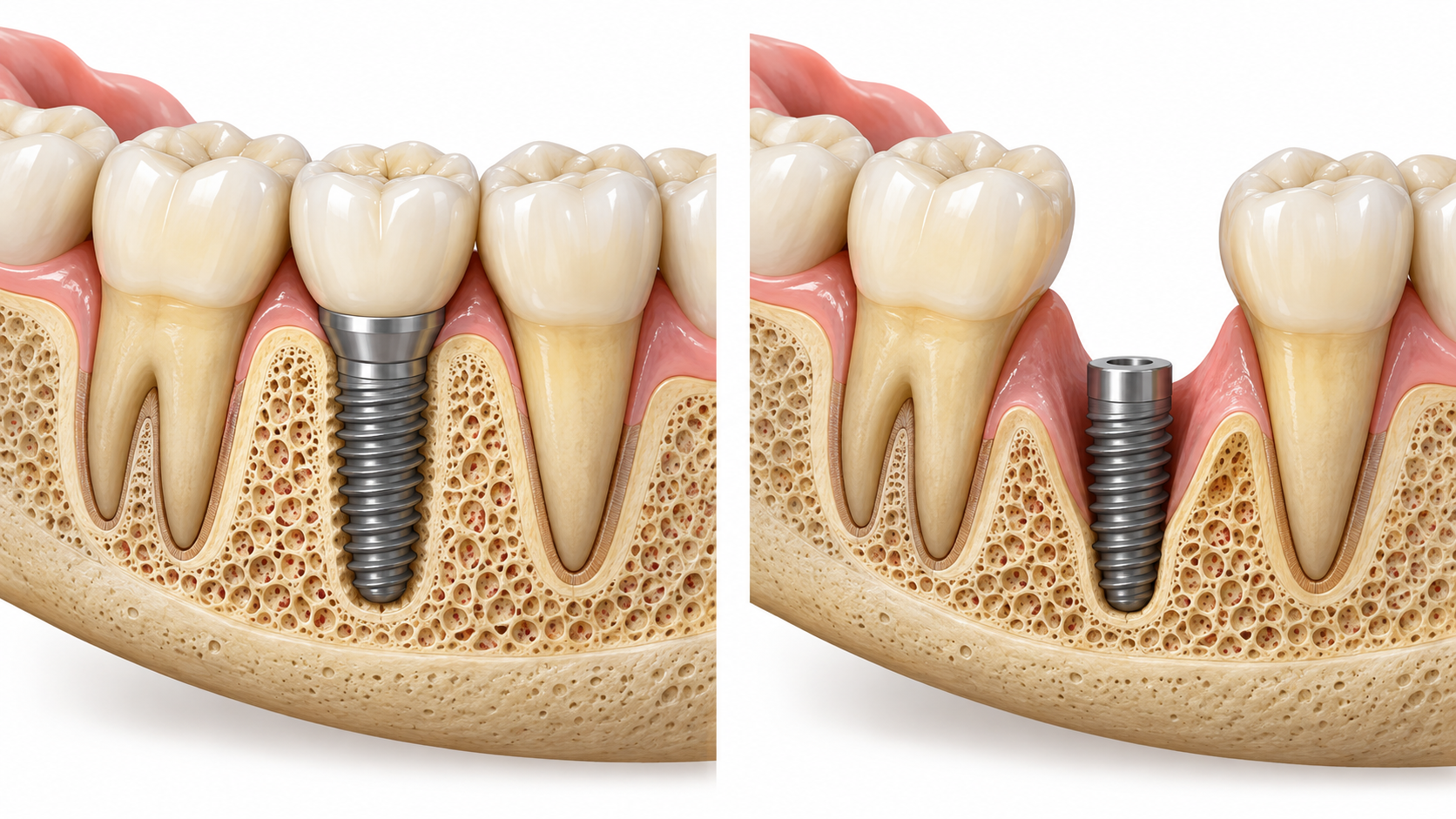
 Implant bone grafting reinforces insufficient jawbone, but not every implant needs it. CT is used to check bone height, thickness, and nerve position and to decide whether to graft at the same time as implant placement. Covers the grafting process, pain, recovery time, aftercare, and cost factors.
1. Why Is Bone Grafting Needed for Implants?
An implant is an artificial tooth root anchored in the jawbone, so it needs to be supported by enough bone.
I often compare a tooth to a tree and the jawbone to the ground the tree stands on.
Just as a tree has trouble standing firmly in narrow or sunken ground, it can be difficult to place an implant in the desired position where the jawbone has shrunk significantly.

There are many reasons the jawbone can become insufficient.
- The jawbone in the area naturally resorbs after a tooth is extracted
- Bone is lost due to periodontal disease or inflammation around the tooth root
- A missing tooth is left untreated for a long time, so the bone shrinks and neighboring teeth tilt
Bone grafting creates an environment in which bone can form in these deficient areas and helps the implant be placed in the right position.
However, the first step is deciding whether extraction is needed at all, because the possibility of preserving the remaining tooth must also be considered.
You can find related information in Treatment Options That Can Save a Tooth Before Extraction and Gum Treatment (Periodontal Treatment).
2. Is a Bone Graft Always Necessary for Implants?
My principle is to graft bone only where it is needed, and only as much as is needed.
If the remaining bone alone allows the implant to be placed in the right position and stably anchored, a bone graft may not be necessary.
On the other hand, if the bone is insufficient so that the implant surface would be exposed or it is difficult to place the implant in the desired position, grafting is considered as well.
Adding more bone graft material does not mean all of it turns into new bone. Healing also differs depending on the material and the condition of the graft site.
That is why it is important to identify the areas that actually need reinforcement rather than unnecessarily widening the graft area.
Checking Jawbone Height, Thickness, and Nerve Position with CT
CT is an important test when deciding whether a bone graft is needed.
A panoramic X-ray is good for an overall view of the teeth and jaws, but because it is a flat image, it is difficult to directly assess bone thickness.
CT allows the height and thickness of the jawbone and the surrounding anatomical structures to be viewed in three dimensions.
| What Is Checked | Consider Immediate Placement | Consider Bone Grafting as Well |
|---|---|---|
| Bone thickness | When there is ample margin for the planned implant diameter | When part of the implant surface may be exposed outside the bone |
| Bone height | When sufficient distance from the nerve or maxillary sinus can be secured | When it is difficult to secure a safe placement position and depth |
| Timing of extraction | When the extraction site has healed and the bone is stable | When supporting structures are insufficient due to inflammation or bone loss |
This table is an example to help you understand the decision criteria. Whether a bone graft is actually needed is decided by considering not only CT findings but also gum condition, implant position, the likelihood of primary stability, and other factors together.
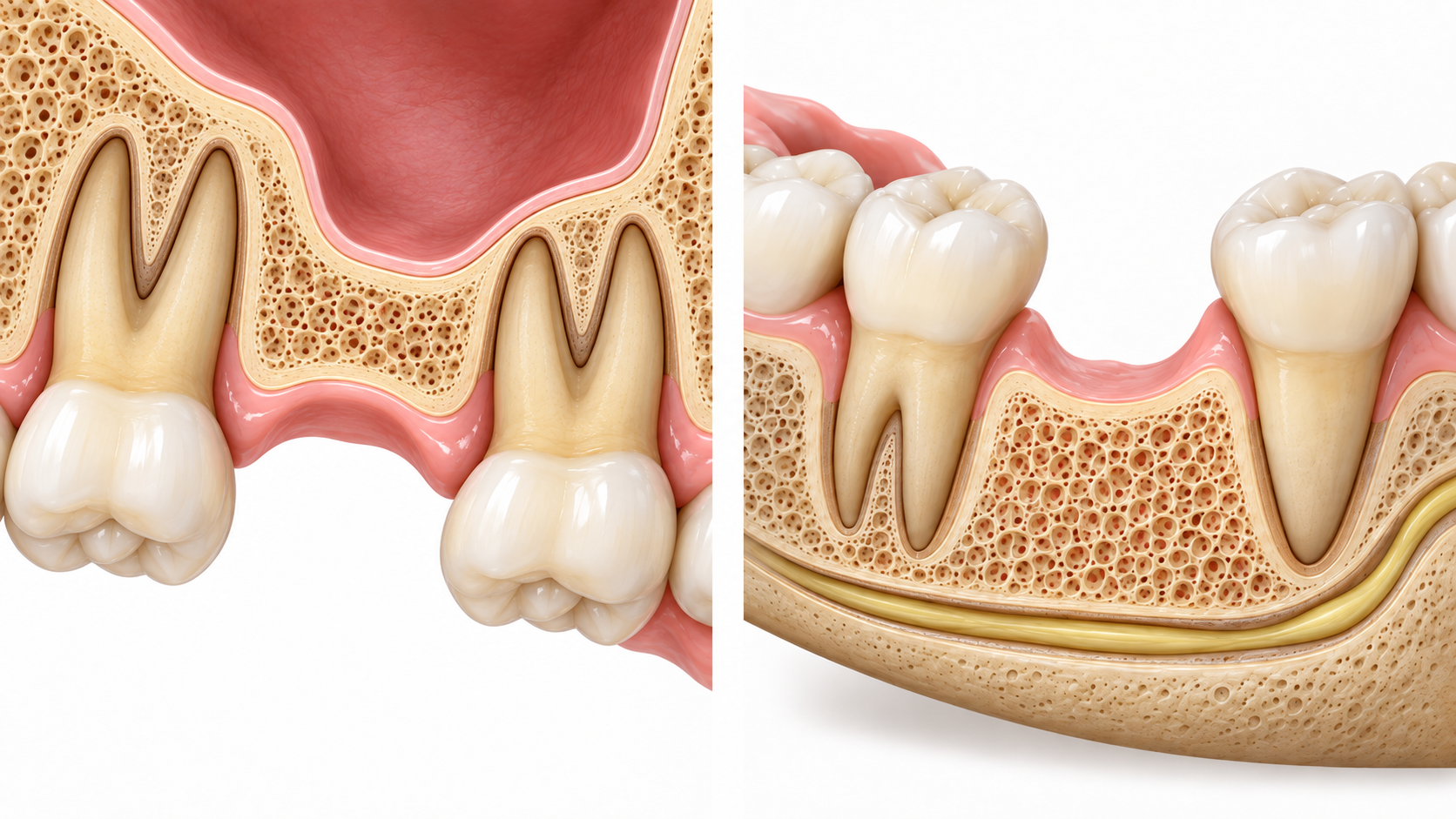
In particular, the inferior alveolar nerve, which is involved in sensation of the lower lip and chin, runs through the lower jaw. In the upper molar region, the maxillary sinus is located close by.
If the distance from these structures is not sufficiently considered, nerve damage or sinus-related complications can occur.
When I explain a surgical plan, I tend to discuss not only the possible treatment options but also these risks and limitations.
Can a Short or Narrow Implant Replace a Bone Graft?
In some situations, choosing a short or small-diameter implant can reduce or avoid the extent of bone grafting.
However, a short implant is not automatically safe.
We need to look at how stably the remaining bone can hold the implant, what kind of tooth ultimately needs to be made, and in which direction the biting forces act.
In the end, the goal is not to avoid bone grafting itself; what matters is distinguishing which treatment is needed.
3. Can Implant Placement and Bone Grafting Be Done at the Same Time?
Yes, it is possible. However, an important criterion is whether sufficient primary stability can be achieved when the implant is placed.
Primary stability refers to the state in which the surrounding bone mechanically holds the implant stable immediately after placement.
If this stability is achievable, simultaneous bone grafting can be considered; if not, the bone graft may be done first.
| Category | Simultaneous Approach | Staged Approach |
|---|---|---|
| Treatment method | Implant placement and bone grafting performed together | Implant placed after bone grafting and waiting for healing |
| When it is considered | When primary stability can be secured with the remaining bone | When the bone defect is large or primary stability is difficult |
| Characteristics | Can reduce the number of treatment stages | Healing of the graft site can be checked first |
| Deciding factors | Bone shape and likelihood of primary stability | Extent of the bone defect and healing status |
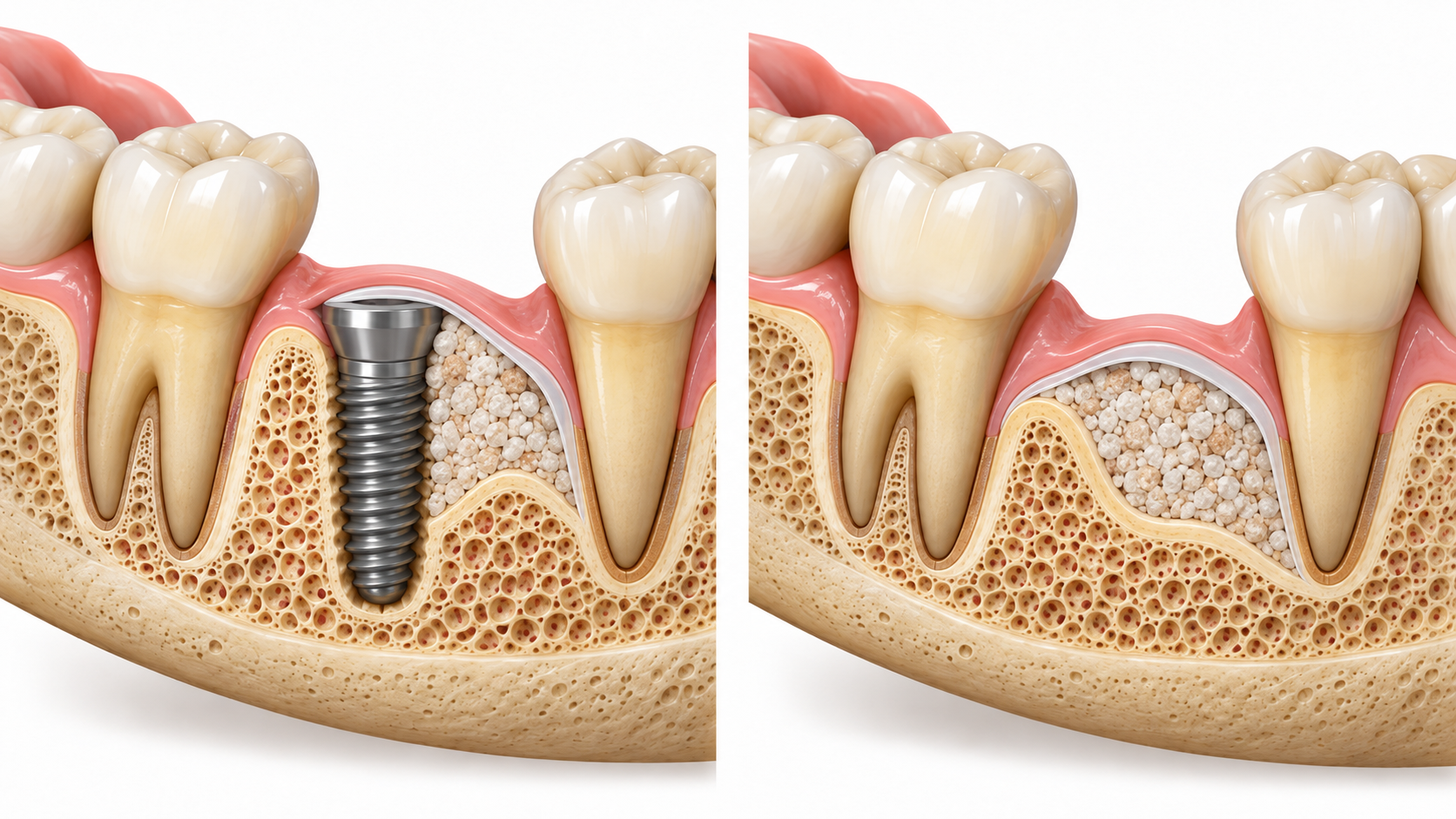
When Implant Placement and Bone Grafting Are Done Together
Even if some bone is lacking, if the implant can be stably anchored in the planned position, bone grafting can be performed at the same time in the deficient surrounding area.
However, if the area needing a graft is too large or stable anchoring is difficult, a different plan is needed.
When the Bone Graft Is Done First and the Implant Placed Later
If too little bone remains or the supporting structures have been lost due to inflammation, bone grafting is considered first.
Whether an implant can be placed right after extraction is evaluated by the same criteria.
Depending on the degree of inflammation, the remaining bone, and the likelihood of primary stability, the implant may be placed immediately or after the extraction site has healed.
Neither approach applies the same way to everyone.
4. What Is the Process of Implant Bone Grafting?
Implant bone grafting does not end with simply placing graft material where bone is lacking.
It is important to first plan where the implant will go and then check whether the necessary bone is present at that position.
At Yonsei Gunho Dental Clinic, we consider the implant surgical plan and the prosthetic plan together.
I examine bone thickness and height, nerve position, and surgical difficulty, while Dr. Kim Kunmin, a board-certified prosthodontist and co-director, checks where the final prosthesis will sit and the bite.
This is because the place where there is enough bone and the place where the tooth actually needs to go do not always match.
The two dentists review the CT images together to perform a digital virtual surgery and, when needed, produce a navigation surgical guide with our in-house 3D printer.
During this process, we also check in advance whether part of the implant surface could be exposed because the bone is thin when the implant is placed in the planned position.
The general flow of bone graft treatment is as follows.
1. Examination and Planning
We check the CT and oral condition and plan the implant position and the extent of the bone graft.
2. Bone Grafting
Graft material is applied to the necessary areas according to the plan.
3. Protecting the Graft Site
The graft site is protected and sutured if necessary.
4. Checking Recovery
We check the healing of the gums and changes at the graft site.
The actual surgical method varies depending on the shape and extent of the bone defect.
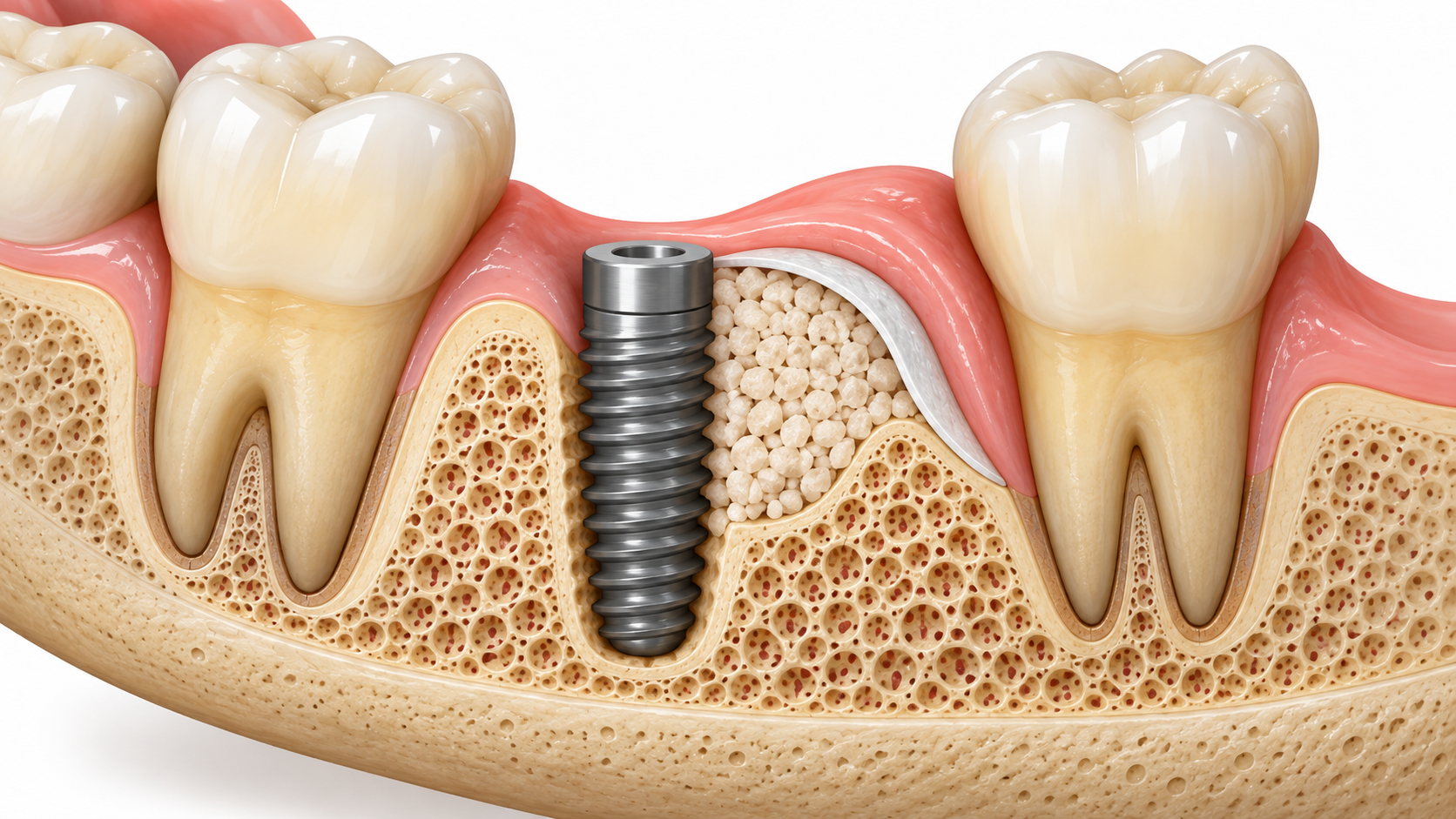
What Methods and Materials Are Used for Bone Grafting?
Representative methods include guided bone regeneration (GBR) and socket preservation.
Guided bone regeneration (GBR) is a treatment that uses graft material, a barrier membrane, and other materials in a bone-deficient area to create and maintain space for bone to form.
Socket preservation is a method of applying graft material or similar materials to the site where a tooth was extracted to reduce changes in the shape of the jawbone after extraction.
There are also several types of bone graft materials.
| Type | Characteristics |
|---|---|
| Autograft | Material using your own bone |
| Allograft | Processed material derived from another person |
| Xenograft | Material made by processing animal-derived components |
| Synthetic bone substitute | Artificially manufactured bone substitute |
Each graft material differs in how it supports bone formation and how it changes in the body. Therefore, it is hard to say that any one material is always better.
Tooth-derived bone graft material, made by processing material obtained from teeth, can also be considered under certain conditions.
Meanwhile, in the upper molars, bone height below the maxillary sinus is sometimes insufficient. In such cases, a sinus lift, which reinforces the bone at the floor of the maxillary sinus, may be considered.
5. How Long Does Implant Bone Grafting Take?
The bone grafting period depends on how stably the grafted bone heals.
There is something to distinguish here.
The fact that the gum wound has closed does not mean the bone beneath it has fully matured.
Generally, healing of the graft site and bone remodeling can take several months. However, this varies with the extent of the graft, the material, general health, and individual healing speed.
After the implant is placed, the process of osseointegration, in which the implant surface bonds with the surrounding bone, must also be considered.
The timing for connecting the final prosthesis is decided by considering primary stability, bone density, whether a bone graft was done, the length and width of the implant, and other factors together.
Therefore, having a bone graft alone does not set a fixed treatment period.
6. How Much Pain and Swelling Are There with Implant Bone Grafting?
Bone grafting can generally be performed under local anesthesia.
Anesthesia reduces pain during surgery, but after it wears off, pain, swelling, bruising, or minor bleeding may occur.
Discomfort varies depending on the extent of surgery and the individual's recovery.
Generally, swelling may increase at first and then gradually subside, but the same recovery speed cannot be applied to everyone.
At Yonsei Gunho Dental Clinic, we monitor recovery by checking swelling, bleeding, mouth opening, and other signs the day after surgery. The actual follow-up schedule may vary depending on the surgery performed.
What matters is not only how swollen you are right after surgery, but also how the discomfort changes afterward.
7. How Should I Manage Eating, Smoking, and Care After a Bone Graft?
After a bone graft, it is important to protect the surgical site and care for it so the wound can heal.
Precautions When Eating and Brushing
Eat after the anesthesia has fully worn off, and in the early period it is better to choose soft, non-irritating foods.
Be careful, because chewing hard or tough foods can put pressure on the surgical site.
If possible, chew on the side that was not operated on, and it is also best to avoid hot or spicy foods early on.
Brushing is important for maintaining oral hygiene, but you should avoid scrubbing the sutured area hard with a toothbrush or rinsing your mouth forcefully.
The specific way to clean the surgical site and when to resume normal brushing depend on the sutures and the extent of surgery.
How Smoking and Drinking Affect Recovery
Smoking can adversely affect wound healing.
Nicotine and various harmful substances in cigarettes affect blood flow and tissue recovery and can also work against the healing of bone grafts and implants.
Drinking alcohol can also affect bleeding and recovery after surgery, so it is best avoided during the early recovery period.
The specific period for avoiding smoking and alcohol may vary depending on individual health and the surgical method.
8. What Symptoms Should I Watch for After a Bone Graft?
Swelling or pain after surgery alone does not mean the bone graft has failed.
This is because some pain, swelling, and bleeding can occur right after surgery.
However, if pain that was improving becomes worse again or swelling keeps increasing, the possibility of infection or other complications should be checked.
The following changes in particular require attention.
- Pain or swelling that gets worse over time
- Pus or an unpleasant odor from the surgical site
- Fever or persistent bleeding
- The sutured area opening up or the graft material appearing to be exposed
- Persistent reduced sensation in the lower lip or chin after lower jaw surgery
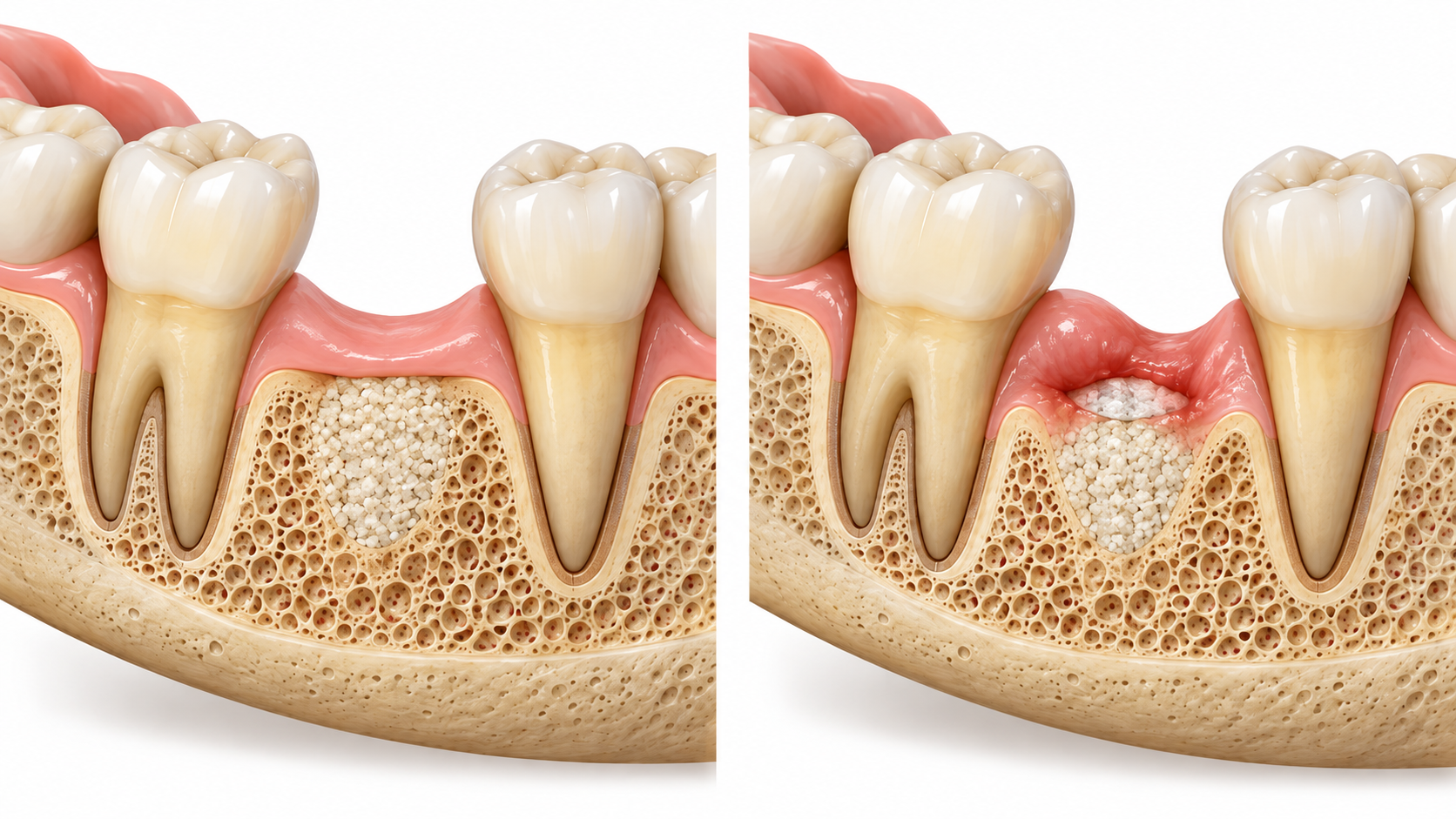
Having these symptoms does not necessarily mean the bone graft has failed, because the cause may differ, such as infection or wound opening.
If abnormal symptoms appear, an evaluation by the dental team is needed, and if bleeding is severe or breathing or swallowing becomes difficult, immediate emergency evaluation is necessary.
9. How Is the Cost of Implant Bone Grafting Determined?
The cost of implant bone grafting is not determined by the type of graft material alone.
It depends on where and how much bone is needed and what surgical method is planned.
The main factors affecting cost are as follows.
- Whether a bone graft is needed and the extent of the graft
- The type of bone graft material used
- Whether sinus surgery is also needed in the upper jaw
- Whether a navigation surgical guide is made
- Whether the patient's own blood is collected or the patient's own teeth are used
Whether Korean National Health Insurance covers additional procedures such as bone grafting may also vary depending on the actual treatment provided.
Even when looking at costs, I think it is important to understand what treatments are included and why they are needed.
In the end, the treatment plan comes first, and the cost varies according to that plan.
The overall implant treatment plan and the roles of oral and maxillofacial surgery and prosthodontics are explained in detail in Guide to Collaborative Implant Care.
In Closing
With implant bone grafting, doing more is not necessarily better, and avoiding it at all costs is not necessarily better either.
It is important to check the condition of the remaining bone, decide where the implant should be placed, and then plan a bone graft for the areas that truly need it.
My standard for treatment is simple.
Consider the treatment that should be done before the treatment that can be done, and graft bone only where it is needed, and only as much as is needed.
Reviewed by: Dr. Park Ji-ho, board-certified oral and maxillofacial surgeon
References
- International Team for Implantology (ITI). Horizontal Ridge Augmentation in the Anterior Maxilla. Consensus Statement.
Criteria for choosing bone augmentation when jawbone width is insufficient.
https://academy.iti.org/academy/consensus-database/consensus-statement/-/consensus/horizontal-ridge-augmentation-in-the-anterior-maxilla/1215 - International Team for Implantology (ITI). Bone Augmentation Procedures in Extended Alveolar Ridge Defects. Consensus Statement.
Bone grafting methods for extensive jawbone defects.
https://network.iti.org/academy/consensus-database/consensus-statement/-/consensus/bone-augmentation-procedures-in-extended-alveolar-ridge-defects/1211 - Guy's and St Thomas' NHS Foundation Trust. Bone grafting for dental implants – Minor bone grafting.
Minor bone grafting for implants and recovery.
https://www.guysandstthomas.nhs.uk/health-information/bone-grafting-dental-implants/minor-bone-grafting - Newcastle Hospitals NHS Foundation Trust. Aftercare information for patients undergoing oral surgical procedures.
Guidance on care after oral surgery.
https://www.newcastle-hospitals.nhs.uk/resources/aftercare-information-for-patientsundergoing-oral-surgical-procedures/