
If a molar has broken or you suddenly feel a sharp twinge when chewing food, you are probably worried that the tooth may have cracked.
Hello. I am Dr. Kim Kunmin, a board-certified prosthodontist at Yonsei Gunho Dental Clinic in Jamsilsaenae.
A tooth fracture does not automatically mean you need a crown or root canal treatment. The treatment depends on how far the crack has progressed and how much healthy tooth structure remains.
1. How can you tell if a tooth is cracked?
If a molar gives a sharp twinge when you bite in a certain direction, or hurts when you release the bite, a cracked tooth may be suspected. However, pain alone is not enough to conclude that a tooth is cracked.
When a tooth is cracked, the cracked area can flex slightly under biting force and irritate the nerve inside the tooth.
In some cases the tooth is sensitive when you drink cold water, or it feels fine most of the time and hurts only when you chew certain foods.
The problem is that even when a tooth has a crack, it may be hard to see with the naked eye and may not show up on an X-ray.
So when a crack is suspected, we examine the tooth under magnification or shine light through it (transillumination). We also have you bite on each raised point of the chewing surface separately to see whether the pain is reproduced (bite test).
If there is a large existing filling, it may be removed when needed to check the condition underneath.
When I look at a tooth like this, I first assess whether it is at a stage where we can watch it or a stage where it needs treatment now.
That is because the actual depth of the crack and the condition of the tooth, rather than the visible crack line, are what determine the treatment.
If the sharp twinge when chewing keeps coming back, it is better not to put it off for long and to have the cause checked.
2. What is the difference between craze lines, cracks and fractures?
Not every visible line on a tooth means the same thing. From fine lines limited to the surface to fractures that extend inside the tooth or into the root, the treatment approach depends on the extent of the damage.
The American Association of Endodontists (AAE) classifies cracked teeth according to the type and extent of the crack.
| Type | Typical symptoms | Treatment approach |
|---|---|---|
| Craze lines | Usually no symptoms | Monitoring |
| Fractured cusp | A corner of the chewing surface breaks off, or discomfort when chewing | Restoring the damaged area and protecting the cusps if needed |
| Cracked tooth | Sharp twinge when chewing, sensitivity to cold and heat | Restoration and cusp protection depending on the extent of the crack |
| Split tooth | The tooth is actually separated | Evaluating which parts can be saved, considering extraction |
| Vertical root fracture | Few early symptoms, or gum inflammation | Considering extraction or removal of part of the root depending on the extent of the fracture |
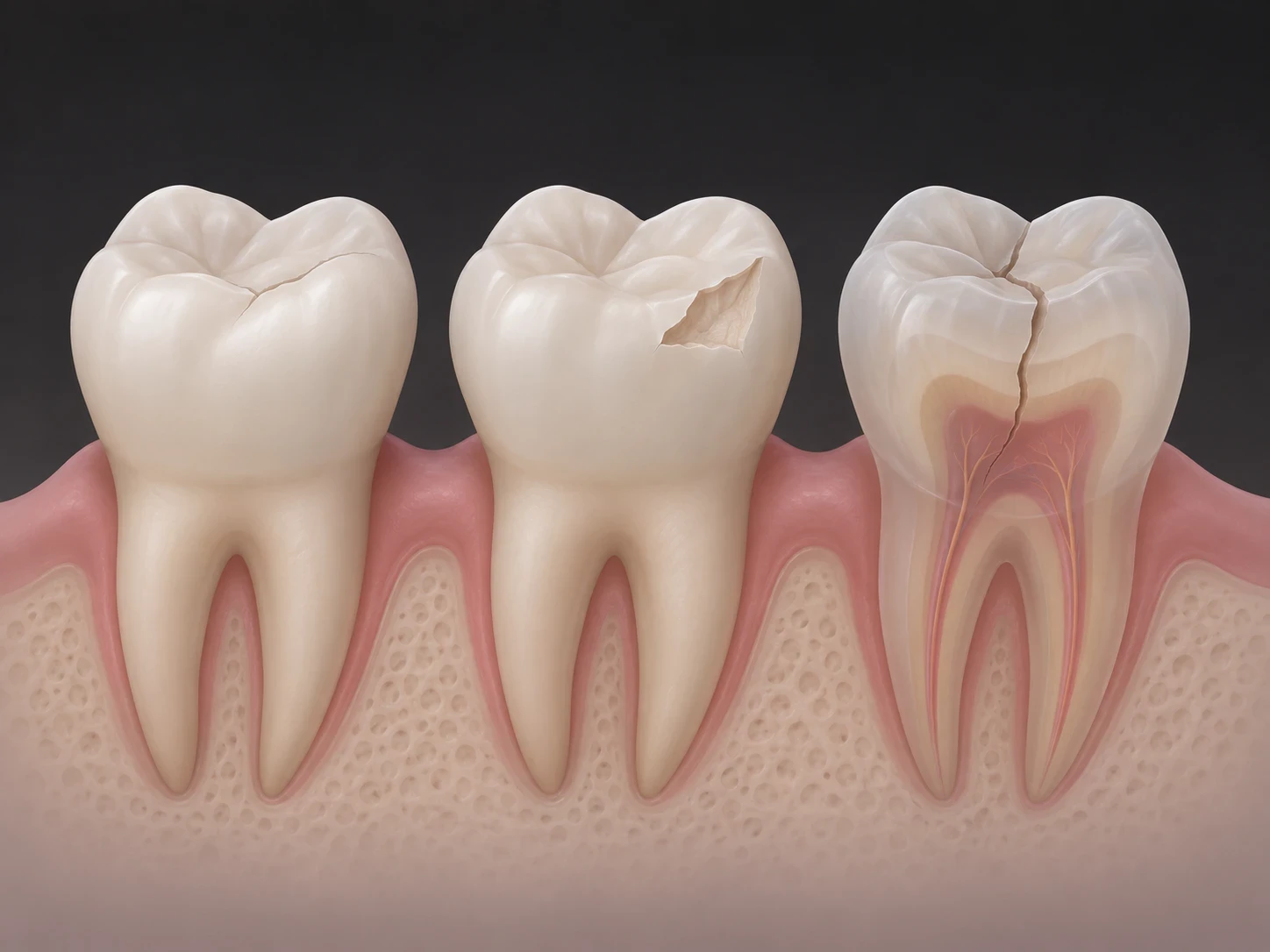
Craze lines in particular are limited to the enamel, the outermost layer of the tooth, and some people live with them without any symptoms.
On the other hand, if a crack has progressed inward from the chewing surface of a molar, the story is different.
As biting force is applied repeatedly, stress builds up at the crack and can affect the tissues inside the tooth.
What I want to emphasize here is that the scope of treatment is not decided simply because a crack is visible.
Even a short line on the surface may extend deep inside, while a noticeable craze line may be monitored without treatment.
3. If a molar breaks, which is needed: composite resin, inlay, onlay, overlay or crown?
Treatment for a fractured molar is not decided by the size of the broken piece alone. We also need to look at whether the remaining tooth walls can withstand biting force and which parts need to be covered and protected.
There is one thing I always think about when I see a tooth that is broken or needs reinforcement.
"How much do we need to cover, and how much can we keep?"
A small broken area can be restored with composite resin, and depending on the extent of damage inside the tooth, an inlay may also be considered.
If the cusps, the raised points of the chewing surface, have become weak, we consider options that cover and protect the cusps, such as an onlay or overlay.
On the other hand, if the tooth walls are badly damaged or a wide area needs protection, a crown that covers the entire tooth may be needed.
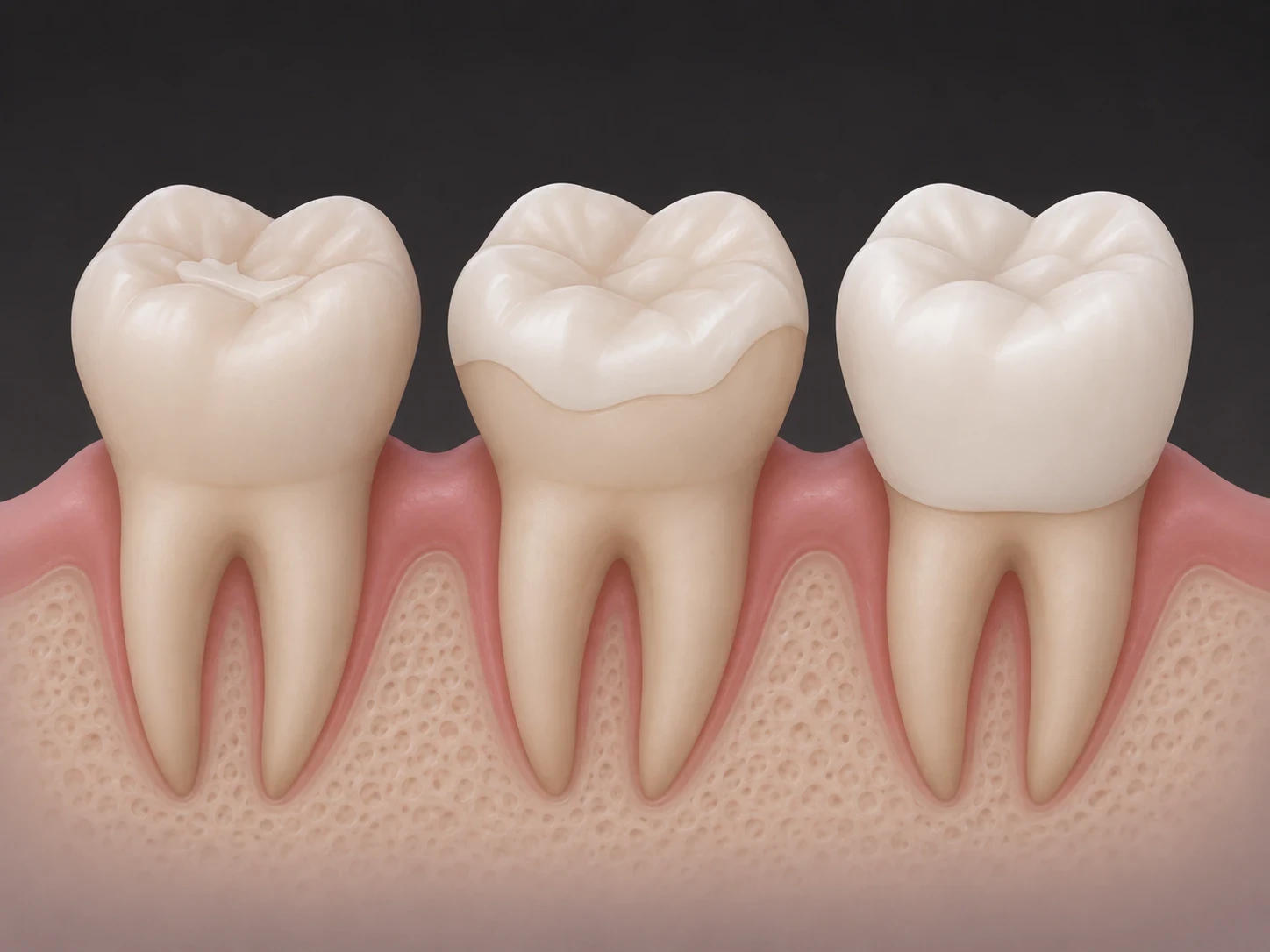
Especially when considering a treatment like an overlay, which keeps part of the healthy tooth structure, I look at the following.
- Are enough healthy tooth walls remaining?
- Can the necessary thickness be secured in the areas that take biting force?
- Is the tooth free of cracks, or has any crack not progressed deeply?
- Have decay or existing fillings not caused extensive damage around the tooth?
- Is the tooth not repeatedly subjected to heavy forces, such as from teeth grinding?
Molars are teeth that take a lot of biting force. Even a wall that looks intact can break again if only a thin layer remains.
That is why I neither recommend a crown in every case nor recommend the least invasive treatment in every case.
Rather than keeping a little more tooth for now, a design that keeps the remaining tooth from breaking again is more important.
You can find more details about the structure and differences of each restoration in Crowns, Inlays and Overlays.
If a front tooth has broken, aesthetics and the forces acting on the front teeth also need to be considered, so please refer to When a Front Tooth Chips.
4. Does a cracked tooth always need root canal treatment?
Not every cracked tooth needs root canal treatment. Whether it is needed depends on how the crack has affected the nerve tissue inside the tooth.
Inside the tooth is a tissue called the dental pulp, which contains nerves and blood vessels.
As a crack deepens, this tissue can become irritated or inflamed. If the pulp is unlikely to recover or has become infected, root canal treatment may be needed.
Whether treatment is needed is determined in the following order.
Step 1. Checking the condition of the nerve inside the tooth
We look at how the tooth responds to cold, whether the pain lingers, and whether it hurts even at rest.
Step 2. Evaluating the crack and the remaining tooth structure
We check how far the crack has progressed, whether there is damage under existing fillings, and whether enough tooth remains to be protected with a restoration.
Step 3. Deciding on root canal treatment and restorative treatment
We determine whether root canal treatment is needed based on pulp damage or infection, and then decide on the restoration that will protect the remaining tooth.
There is a common misunderstanding here.
Many people think that root canal treatment makes a tooth weaker.
Dr. Han Seung-won, the board-certified specialist in conservative dentistry at our clinic, also explains that "root canal treatment does not weaken the tooth; the tooth needs root canal treatment because it has already been weakened."
This means that root canal treatment often becomes necessary when the tooth structure has already been damaged by large cavities, cracks or previous treatment.
When needed, Dr. Han Seung-won uses a dental operating microscope to examine the inside of the tooth under magnification.
However, even with root canal treatment, a crack that has already formed does not join back together. We also need to think about which restoration will protect the tooth after treatment.
You can find details on root canal treatment and root canal retreatment in Microscope Root Canal Treatment.
5. When can a cracked molar not be saved and need to be extracted?
A cracked molar is not extracted right away. However, if it has split vertically into the root or the tooth has split deeply, it may be difficult to save.
A crack limited to the upper part of the tooth may leave room to consider treatment, depending on the remaining structure and the condition of the nerve.
On the other hand, if the crack extends deep below the gum line or into the root and has caused inflammation in the surrounding tissues, treatment options may be limited.
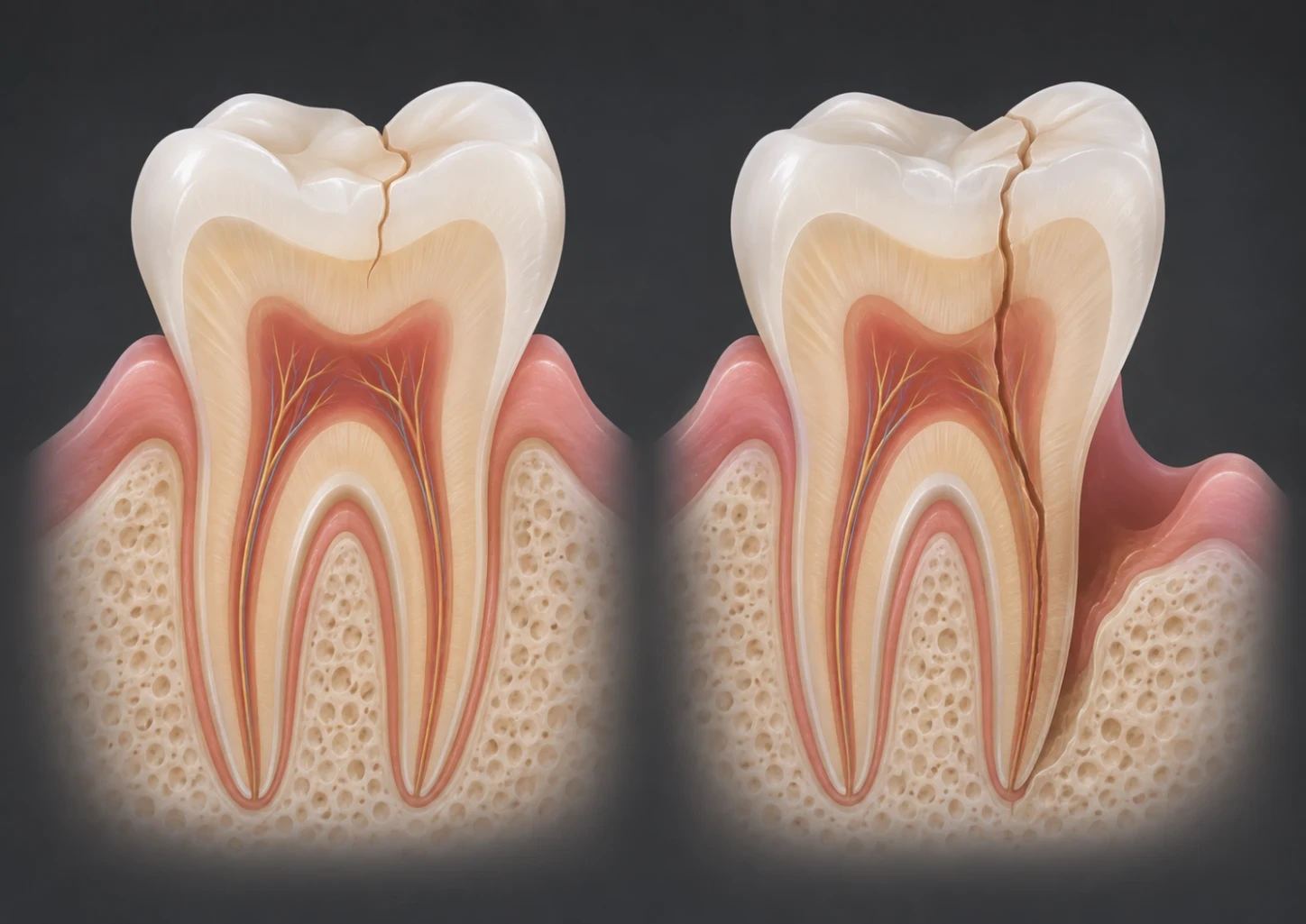
In particular, a tooth with a vertical root fracture is difficult to resolve with root canal treatment alone.
That said, not every tooth is judged the same way just because there is a crack in the root. Depending on the location and extent of the fracture and the condition of the remaining root and alveolar bone (gum bone), part of the tooth can sometimes be saved.
At Yonsei Gunho Dental Clinic, when deciding whether a molar should be extracted, Dr. Han Seung-won, a board-certified specialist in conservative dentistry, I as a board-certified prosthodontist, and Dr. Park Ji-ho, a board-certified oral and maxillofacial surgeon, examine the case together.
Dr. Han Seung-won assesses the inside of the tooth and whether it can be saved, I assess whether the remaining tooth can be protected with a restoration, and Dr. Park Ji-ho checks the condition of the root and surrounding bone from a surgical perspective.
This is because we need to judge not only whether the tooth can be kept, but also whether it can handle biting force after it is kept.
Options to review before deciding on extraction are summarized in Tooth-Saving Options Before Extraction.
If the tooth is difficult to save, treatment options after extraction can be found in Dental Implants.
6. How can you keep a treated molar from breaking again?
Even after a broken tooth has been treated, the possibility of it cracking or fracturing again remains. After treatment, the forces repeatedly applied to the tooth and your chewing habits need to be managed together.
A tooth fracture can happen suddenly when biting something hard, but it can also develop as repeated forces build up.
Typical factors include teeth grinding, clenching, biting ice or hard foods, and chewing only on one side.
If there is a large filling or the remaining tooth walls are thin, the tooth may be vulnerable to damage even under the same force.
In fact, I grind my teeth quite a lot myself.
So when I look at teeth, signs of wear are often the first thing I notice. (My own teeth have those signs too.)
Comparing a cracked tooth to a glass cup makes it easier to understand.
When a glass cup cracks, wrapping the outside does not make the existing crack disappear. The same is true for teeth.
Even if a tooth is protected with a crown or overlay, the crack inside does not return to its original state.
So after treatment, you should cut down on biting hard foods, and if your teeth grinding is severe, it is worth checking whether you need an appliance to protect your teeth.
Regular checkups are also a good way to check the condition of the restoration and whether biting force is concentrated on one side.
Tooth wear caused by teeth grinding and how to manage it are covered in more detail in Teeth Grinding Treatment.
In Closing
When a tooth is cracked, the first thing to look at is not how much has broken, but how far the damage goes and what can be kept.
I think in terms of treatment that conserves rather than treatment that does more, but I consider protecting the remaining tooth from breaking again just as important. Rather than forcing a tooth to stay or rushing to remove it, judging the scope of treatment that fits the current condition of the tooth is the standard of my practice.
This was Dr. Kim Kunmin, board-certified prosthodontist at Yonsei Gunho Dental Clinic in Jamsilsaenae.