
Some of you may have lost several teeth and be torn between a removable partial denture and dental implants, while others may be adult children looking into treatment options for their parents.
Hello. I'm Dr. Kim Kunmin, a board-certified prosthodontist at Yonsei Gunho Dental Clinic in Jamsilsaenae.
Recently, more and more people have been visiting us for denture treatment.
Losing several teeth does not necessarily mean you need several implants. Depending on the condition of your remaining teeth and alveolar bone, a removable partial denture may be suitable, or dental implants or a combination of the two may be the better option.
Let me explain the criteria I actually use to make this decision.
1. When Several Teeth Are Missing, How Do Partial Dentures and Dental Implants Differ?
A removable partial denture is a removable prosthesis supported by the remaining teeth and the gums. A dental implant involves placing an artificial tooth root in the alveolar bone and connecting a tooth on top of it, and it generally uses a fixed prosthesis.
A partial denture is held in place by metal clasps hooked onto the remaining teeth. A dental implant, by contrast, is anchored in the alveolar bone, so there is no need to hook clasps onto the neighboring natural teeth.
| Comparison | Removable partial denture | Dental implant |
|---|---|---|
| Fixation | Removable; clasps hook onto the remaining teeth and the gums provide support | Fixed; an artificial tooth root is placed in the alveolar bone |
| Chewing feel | The denture may move or press on the gums when you chew | Being fixed, it does not move like a denture, but it feels different from natural teeth |
| Force on the remaining teeth | Part of the chewing force is transmitted to the clasped teeth | Does not lean directly on neighboring teeth; the implant and surrounding bone bear the force |
| Care | Remove it for cleaning and care for the remaining teeth as well | Careful cleaning of the gums around the implant and the areas around the prosthesis |
| Trade-offs | Foreign-body sensation, visible clasps, taking it in and out, ongoing adjustments | Surgery, bone requirements, healing period, possible inflammation around the implant |
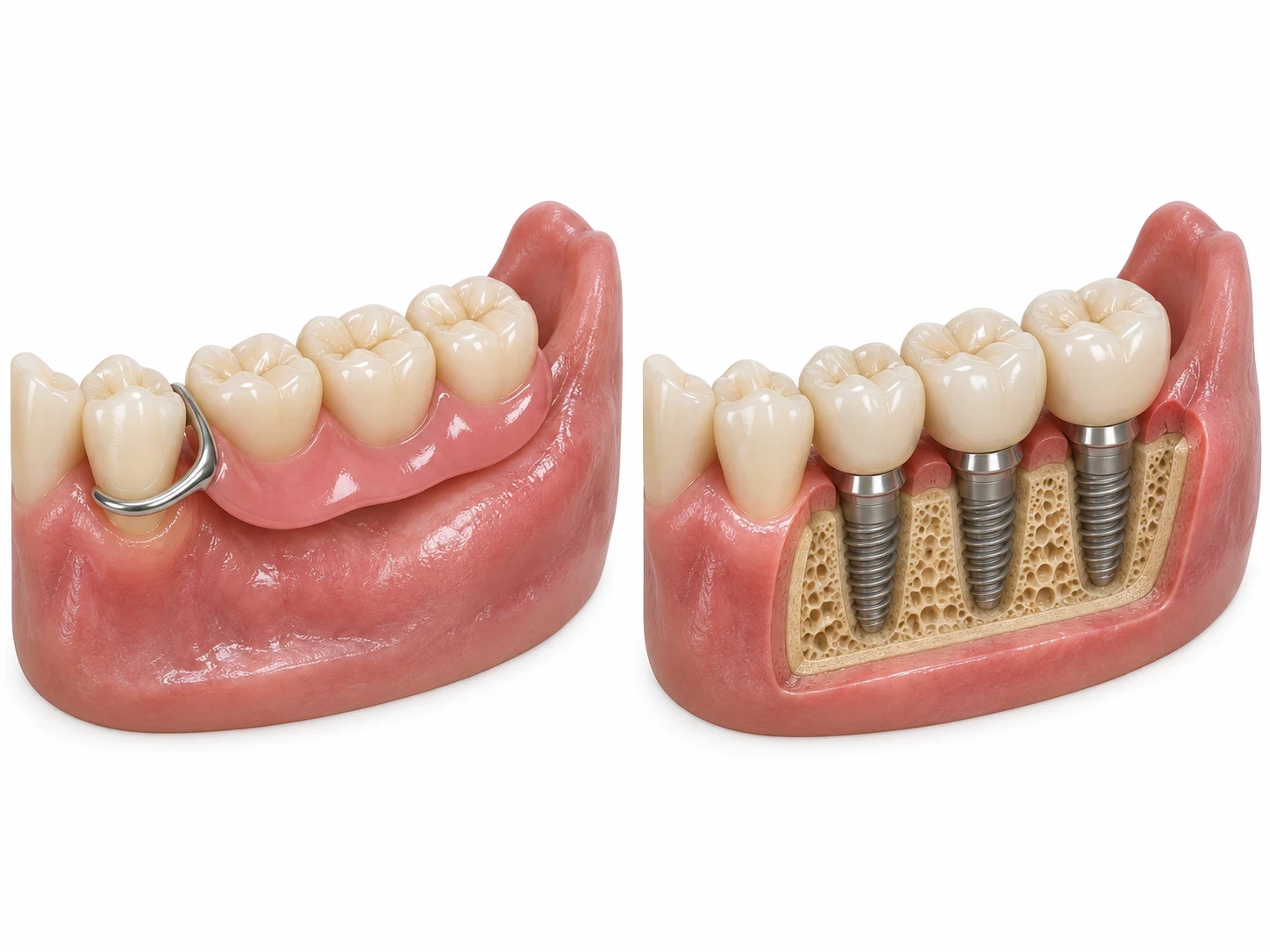
With a front-tooth partial denture, the clasps may show when you smile, and with a molar partial denture, how the chewing force is distributed is important.
When designing a prosthesis, I look not only at the gap but also at how much force the remaining teeth can withstand. Whether it is a partial denture or an implant, for long-term use the chewing force must not be overly concentrated on any one area.
2. What Examinations Determine the Choice Between a Partial Denture and Dental Implants?
The treatment method is not decided by the number of missing teeth alone. We need to check whether the remaining teeth are healthy, whether the alveolar bone can support implants, and how the upper and lower teeth bite together.
There are five main criteria I use.
- Condition of the remaining teeth: I look at the number and position of the teeth, any looseness, and the condition of the roots and alveolar bone.
- Alveolar bone at the missing sites: I check whether there is enough bone for implants, as well as the shape of the bone and the surrounding anatomical structures.
- Opposing teeth: I examine where the upper and lower teeth meet and the direction in which chewing force is transmitted.
- General health: I check how well diabetes is controlled, what medications you take, and any conditions that could affect surgery.
- What you want in daily life: I consider whether you want fixed teeth, whether you can manage a removable appliance, and whether you are concerned about anything being visible.
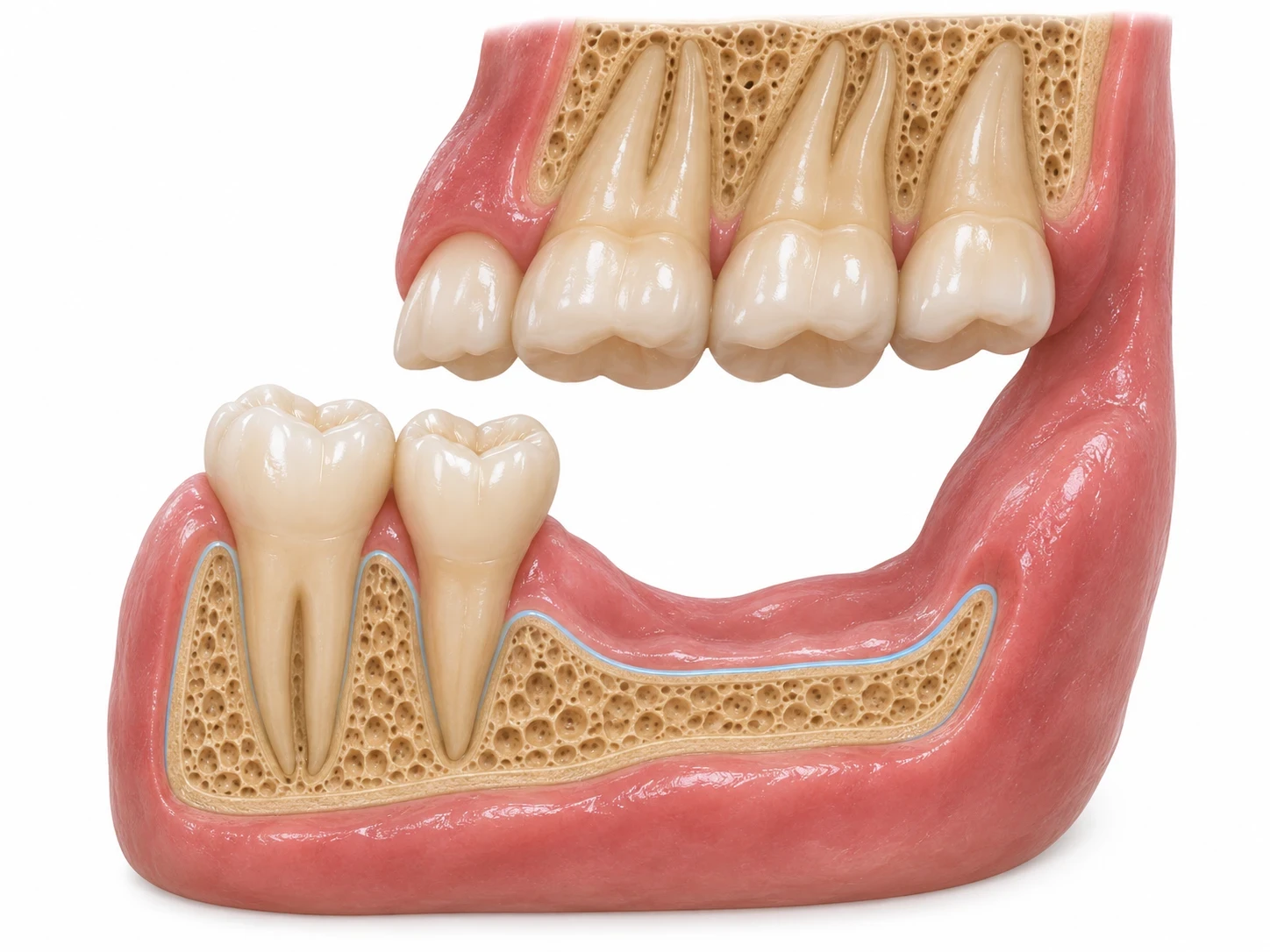
Loose teeth in particular are difficult to judge by appearance alone.
Even if a tooth still looks usable, an X-ray may show that much of the alveolar bone around its root has been lost. Conversely, even a slightly loose tooth may still have the potential to serve as an abutment tooth after treatment.
That is why I do not decide in advance either to give up on the remaining teeth right away or to save them no matter what.
When implants are needed, Dr. Park Ji-ho, a board-certified oral and maxillofacial surgeon, first checks whether extraction is necessary and the condition of the alveolar bone. Based on those results, I design the shape of the prosthesis and the bite.
The condition of the alveolar bone and general health are more important criteria than age itself. Even among people of the same age, the suitable treatment differs depending on the condition of the teeth and bone.
3. What Are the Advantages of Choosing a Partial Denture, and What Must You Accept?
A removable partial denture replaces missing teeth by making use of the remaining natural teeth, without implant surgery. However, because force is placed on the teeth that support the denture, keeping those teeth healthy is important.
There is a reason I care so much about denture treatment.
My maternal grandmother wore dentures for many years. In my final year of dental school, while providing denture care, I keenly felt how much my knowledge and experience fell short. That is also what led me to choose prosthodontic residency training at Severance.
The advantage of a partial denture is that it uses the remaining teeth to fill the gaps and can be done without surgery.
However, if the clasped teeth weaken, the denture's stability can also decline. In some cases, crown treatment is planned alongside it to protect the abutment teeth or to create a shape the clasps can hold onto.
Also, at first there may be a foreign-body sensation, and it may take some time to adjust to speaking and eating.
Above all, a denture is not a prosthesis that is finished once it is made.
Where a tooth has been lost, the functional stimulation once transmitted through the root disappears, and the alveolar bone can shrink over time. As the shape of the gums changes, even a denture that fit well at first can become loose.
In that case, the fit can sometimes be improved by relining, which refills the inside of the denture to match the current shape of the gums, or by adjusting the bite. Of course, if wear or damage is severe, remaking may be necessary.
Denture types, the fabrication process, and how to clean and care for dentures are covered in detail on the Dentures page.
4. What Are the Advantages and Burdens of Choosing Dental Implants?
Dental implants can replace missing teeth with a fixed prosthesis without hooking clasps onto neighboring teeth. However, surgery is required, and the scope of treatment varies with the condition of the alveolar bone and general health.
Especially when several molars are missing, implants can be considered to restore chewing force.
Unlike a partial denture, there is no need to take them out for cleaning every time, and no clasps need to be hooked onto the remaining teeth.
That said, implants are not the better choice for everyone.
If the alveolar bone has shrunk after tooth loss, placing implants may be difficult. In such cases, an implant bone graft may be considered at the necessary site, but a bone graft does not make implant placement possible in every case.
In addition, after surgery a healing period is needed for the implant to integrate with the alveolar bone. The treatment period varies from person to person depending on factors such as bone condition and whether additional surgery is needed, and even after treatment, inflammation around the implant and problems with the prosthesis need to be monitored.
When Dr. Park Ji-ho and I plan implants, we look not only at the surgical position but also at what kind of teeth ultimately need to be made.
Rather than forcing an implant into a position that cannot easily bear chewing force, we first think about the shape of the prosthesis that is needed.
The specific surgical and prosthetic stages can be found in Implant Treatment Process.
5. Can Partial Dentures and Dental Implants Be Used Together?
You do not necessarily have to choose only one or the other. When the remaining teeth alone cannot adequately support a denture, a few implants can be added to reinforce the support and retention of the partial denture.
This is called an implant-assisted removable partial denture (IA-RPD).
For example, consider a case where the front teeth remain but many of the molars on both sides are missing.
If the denture is held only by clasps on the front teeth, the back part of the denture may press on the gums or move when you chew.
In this case, one option is to place implants in the molar area and create a structure on top of them that supports the denture, so the force is shared.
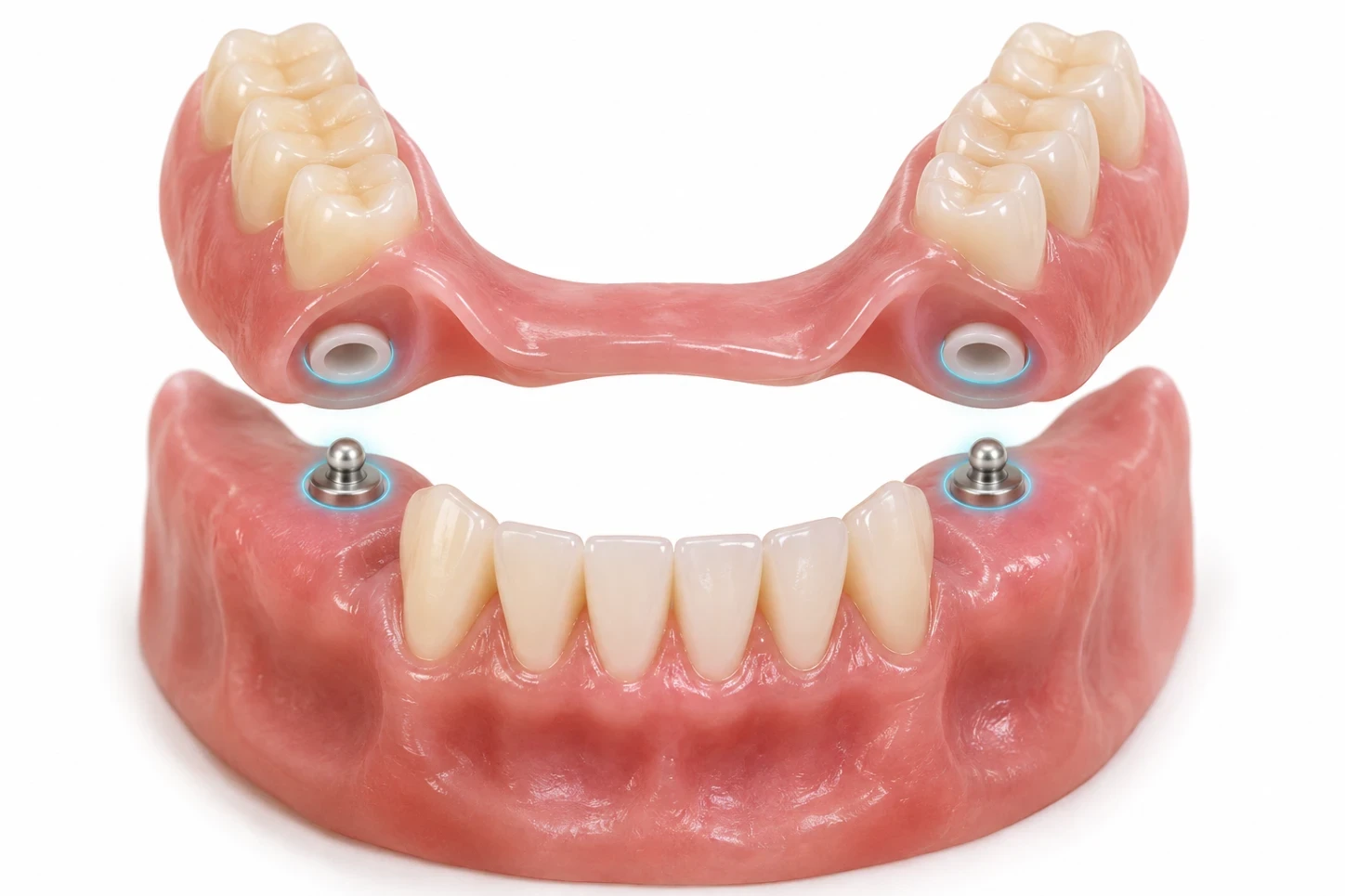
Sometimes a prosthesis that clasps can hook onto is made on top of the implants, and sometimes attachments that snap together like buttons are used.
Related studies have reported that this approach may improve wearer satisfaction and quality of life compared with a conventional partial denture. However, wear or breakage of the attachments and inflammation around the implants require ongoing care.
When considering this approach, I do not just decide where to place the implants. I also design how much force the remaining teeth and the implants will each bear, and how the denture will be put in, taken out, and cared for.
This is also why Dr. Park Ji-ho, who performs the surgery, and I, who design the prosthesis, review the plan together.
Adding implants does not automatically make a partial denture better. If the existing natural teeth and gums can function well enough on their own, making a partial denture without implants is also considered.
6. How Do Partial Denture Prices, Implant Costs, and Health Insurance Coverage Differ?
The cost of partial dentures and implants depends not only on materials but also on the condition of the remaining teeth, the prosthesis design, and the scope of preliminary treatment. For those aged 65 or older, Korean National Health Insurance coverage can be considered for both treatments if set conditions are met, but the scope of coverage differs between them.
The design of a partial denture varies depending on how the remaining teeth are used.
If the teeth to be clasped need treatment, or if special attachments are used, the scope of treatment can change.
For implants as well, differences arise depending on placement position, prosthetic materials, and whether additional surgery such as a bone graft is needed.
Health insurance coverage can be understood as follows.
- Partial dentures: For those aged 65 or older, a clasp-retained metal-framework (cast) partial denture made using the remaining teeth is covered under set criteria. Partial dentures that use special attachments, among others, are excluded from coverage.
- Dental implants: For those aged 65 or older who still have some natural teeth, Korean National Health Insurance may apply if set conditions for implant materials and prostheses are met. Coverage is subject to a lifetime limit on the number of implants.
- Denture remaking: After a denture is made under insurance, coverage for remaking is restricted for a certain period. However, exception criteria may be considered in cases such as a major change in oral condition.
In some cases, coverage for both a partial denture and implants is allowed, but this does not mean that every implant-connected denture is covered.
One more thing I would like to mention is the problem of leaving the gap from a missing tooth empty for a long time.
The alveolar bone in an area without teeth can gradually resorb, and neighboring teeth may tilt toward the empty space or the bite may change.
As a result, more conditions may need to be considered later when designing a prosthesis.
That is why, rather than deciding on cost or treatment method first, I tend to look at what treatment is possible with the remaining teeth and alveolar bone you have now.
In Closing
I first check whether the remaining natural teeth can be preserved, and then decide how to make up for what those teeth cannot handle.
Even when implants are needed, I review the surgical conditions and prosthetic design together with Dr. Park Ji-ho, a board-certified oral and maxillofacial surgeon, and I do not decide in advance that any one treatment is the right answer.
This was Dr. Kim Kunmin, a board-certified prosthodontist at Yonsei Gunho Dental Clinic in Jamsilsaenae.