
If the teeth near your gums have worn into a V-shaped notch and sting with cold water, you may be wondering whether they need to be filled with resin.
Hello. I'm Kim Kunmin, a board-certified prosthodontist at Yonsei Gunho Dental Clinic in Jamsilsaenae.
Not every case of cervical abrasion needs a resin filling. First, we need to check how deep the notch is, what is causing the sensitivity, and whether the wear is progressing.
1. What is cervical abrasion, and why do my teeth sting with cold water?
Cervical abrasion is a condition in which the area where the tooth meets the gum wears into a V-shaped or wedge-shaped notch. When dentin is exposed in the notch, the tooth can become sensitive to cold water or brushing.
The outer surface of a tooth is protected by hard enamel. But when the area near the gum wears down and the dentin underneath is exposed, external stimuli are more easily transmitted to the inside of the tooth.
That is why you may feel a zing when drinking cold water, or a sharp twinge when your toothbrush brushes past. The notched area may also catch your fingernail or look more yellow than the surrounding teeth.
On the other hand, some people have clearly visible notches and still feel little or no sensitivity.
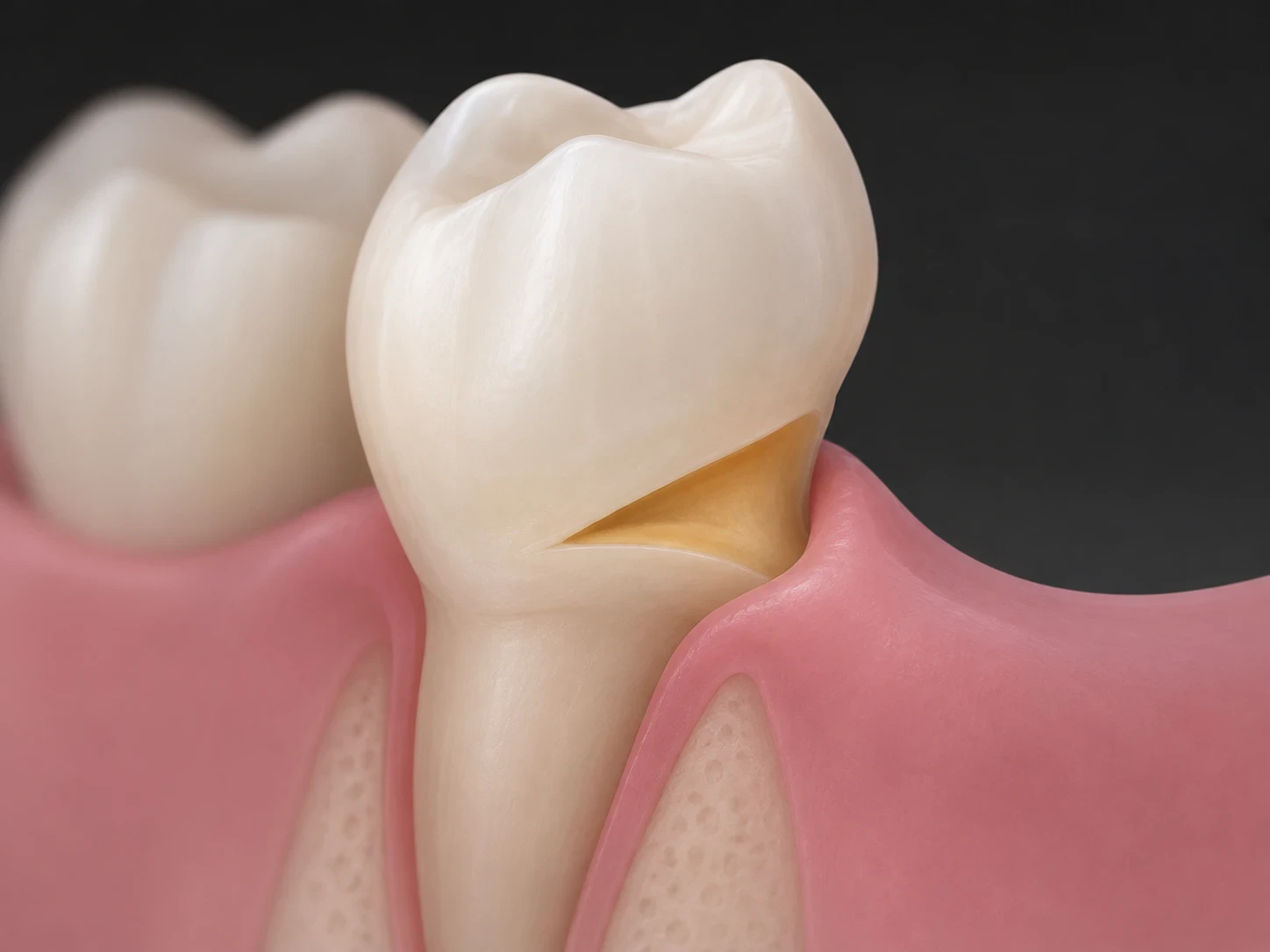
However, not all tooth sensitivity is cervical abrasion. Similar symptoms can appear with cavities, cracked teeth, or when the gums recede and expose the root.
In particular, when the gum itself recedes, the cause and treatment may be different. I explain this separately in Gum Recession.
In such cases, I don't just look at the shape of the notch; I also examine the surrounding teeth and gums and the situations in which the sensitivity occurs.
2. What causes cervical abrasion? Is it from brushing or teeth grinding?
Cervical abrasion can involve several factors acting together, not only friction from brushing but also an acidic environment and chewing forces. However, there is not enough evidence to conclude that teeth grinding alone causes the neck of the tooth to wear away.
Many people think of it as a condition caused simply by brushing too hard, but in reality it is a little more complicated.
If you repeatedly press hard with your toothbrush and scrub side to side, the tooth surface can gradually wear down. A stiff toothbrush or a highly abrasive toothpaste can also play a role.
If you often drink acidic drinks or have acid reflux, the tooth surface can weaken and become more vulnerable to wear.
There is also a hypothesis that forces from teeth grinding or clenching affect the neck of the tooth. However, studies differ on whether these forces directly cause cervical abrasion.
To be honest, I grind my teeth quite a lot myself. My canines have become almost flat, and the tops of my molars are quite worn too. (I have even woken myself up with the sound of my own grinding.)
So I naturally became interested in the lifespan of teeth and in occlusion, that is, how the upper and lower teeth bite together, and I went on to become a prosthodontist.
Of course, my own worn teeth do not prove what directly causes cervical abrasion. But the idea that we should look not only at the worn area but also at what forces and habits are acting on the teeth has stayed with me ever since.
The symptoms and management of teeth grinding itself are covered in detail in Teeth Grinding Treatment.
3. Does cervical abrasion always need to be filled with resin?
Having cervical abrasion does not automatically mean it needs a resin filling. If the notch is shallow and there are no symptoms, we start with observation and lifestyle changes; if sensitivity persists or damage to the tooth progresses, we consider a filling.
I don't recommend treatment just because a tooth has a small notch.
First, I distinguish whether it is at a stage where we can watch it or at a stage where it needs attention now.
| Tooth condition | Approach to consider first |
|---|---|
| Shallow notch with no sensitivity | Observation and correcting brushing habits |
| Shallow notch with sensitivity to cold water | Managing tooth sensitivity, e.g. toothpaste for sensitive teeth, fluoride application |
| Notch progressing or sensitivity persisting | Evaluate the cause, then consider a resin or GI filling |
| Deep notch or food often getting trapped | Check the tooth structure and surrounding condition before deciding whether a filling is needed |
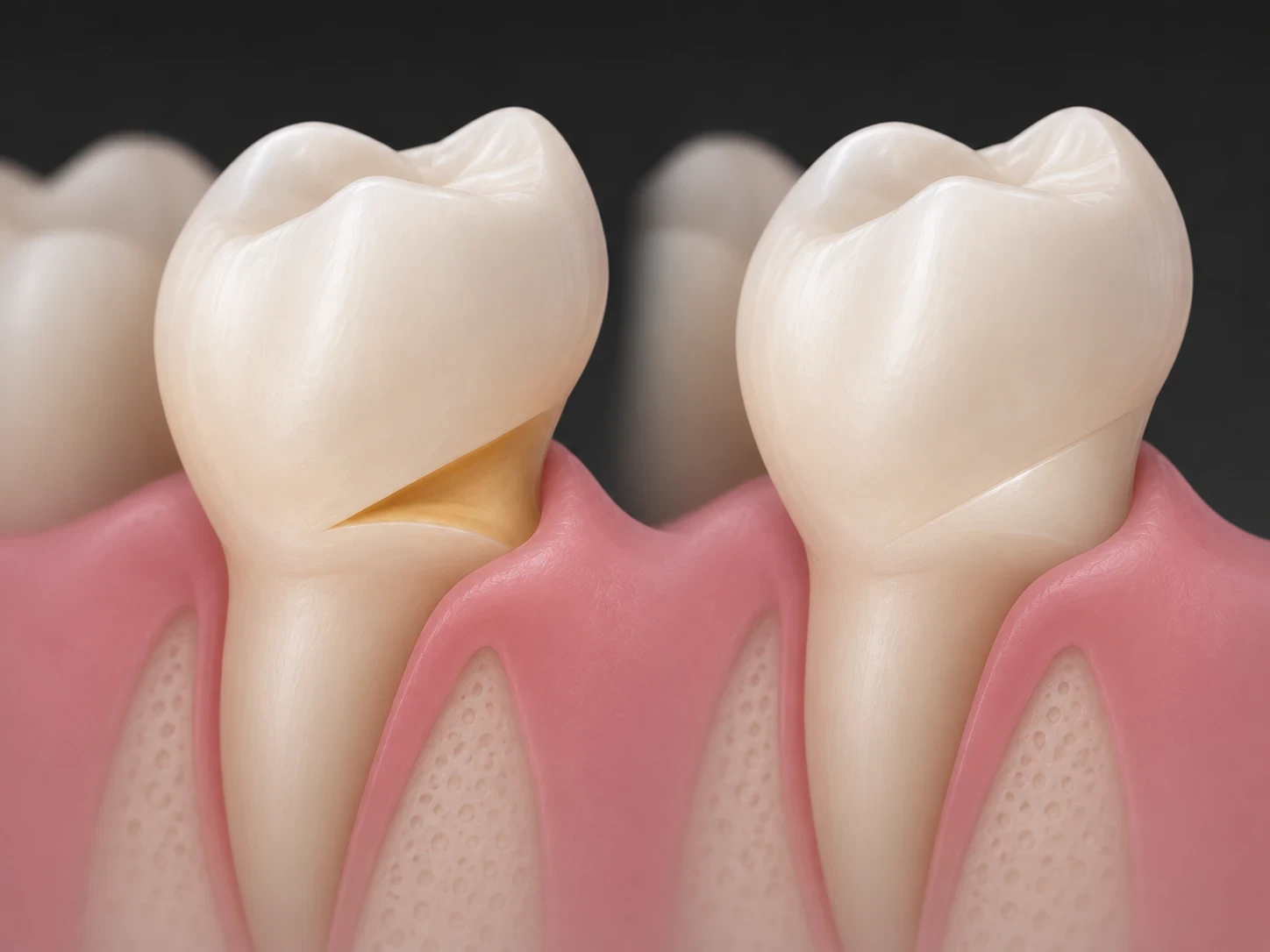
Toothpaste for sensitive teeth can help reduce the sensitivity of exposed dentin. However, it does not restore tooth structure that has already worn away.
I decide whether treatment is needed in the following order.
Step 1. Check the location and depth of the notch
I check how deeply the neck of the tooth has worn and the condition of the surrounding gums.
Step 2. Check the cause of the sensitivity and whether the wear is progressing
I look at whether the tooth reacts only to cold or also hurts when chewing. If needed, I also rule out other causes such as cavities or cracks.
Step 3. Choose observation or a filling
If the tooth does not need to be filled right away, we manage the cause and monitor its progress. If a filling is needed, I choose the material to suit the shape of the notch and the bonding conditions.
Treatment lasts longer when it is done precisely as needed, rather than doing more of it. That said, the outcome after treatment depends on the condition of the tooth and your care habits.
4. How do resin and GI differ for cervical abrasion, and which material is chosen?
Resin and glass ionomer (GI) are both materials used to fill worn teeth, but they have different properties. Rather than assuming one material is always better, the choice depends on where the notch is, the condition of the gums, and whether moisture can be controlled.
Resin can be matched to tooth color in relatively fine detail, and it is a material that bonds to the tooth to restore its shape.
GI bonds chemically with tooth tissue and releases fluoride. It is sometimes considered for areas close to the gum where moisture control is difficult.
| Category | Composite resin | Glass ionomer (GI) |
|---|---|---|
| Material features | Good for reproducing tooth color and bonded restoration | Bonds chemically with the tooth and releases fluoride |
| Advantages | Easy to match color and shape in fine detail | Can be used even where moisture control is somewhat difficult |
| Considerations | Moisture control is important during bonding | Depending on the type, limited in color matching and wear resistance |
| When chosen | Areas where esthetics and good bonding conditions can be secured | Areas such as a low gumline or where keeping the area dry is difficult |
There are different types of GI, and how well resin holds up also depends on the bonding conditions. So it is hard to say for certain that resin always lasts longer or that GI wears down easily.
As a prosthodontist, I first look at where the material will go and what shape it needs to take. When the tooth color needs to be matched in fine detail, I sometimes use a professional DSLR camera and a polarizing filter.
If the notch extends below the gumline or the gums are inflamed, the surrounding tissue also needs to be evaluated. Problems with the gums themselves are explained separately in Gum Treatment.
As of November 2026, according to the Health Insurance Review and Assessment Service (HIRA), light-cured composite resin fillings are covered by Korea's National Health Insurance for treating cavities in permanent teeth without pulp lesions in children aged 5 to 12, and they are not covered when performed to treat wear.
5. Why does a resin filling for cervical abrasion fall out, or why does the tooth still feel sensitive after treatment?
A cervical resin filling can come off for various reasons, including the bonding condition, the shape of the notch, moisture control, and repeated external stress. If the tooth becomes sensitive again after treatment, the cause should be identified first rather than simply refilling the resin.
Because the cervical area is close to the gum, moisture control during bonding can be tricky.
Also, dentin that has been exposed and worn for a long time has different surface properties from ordinary dentin, which can affect bonding.
If the habit of brushing hard side to side continues after the filling, or if repeated forces act on the tooth from grinding or clenching, this can make it harder for the filling to stay in place.
However, a resin filling falling out does not necessarily mean grinding is the cause. The shape of the notch and the bonding conditions at the time of filling also need to be considered.
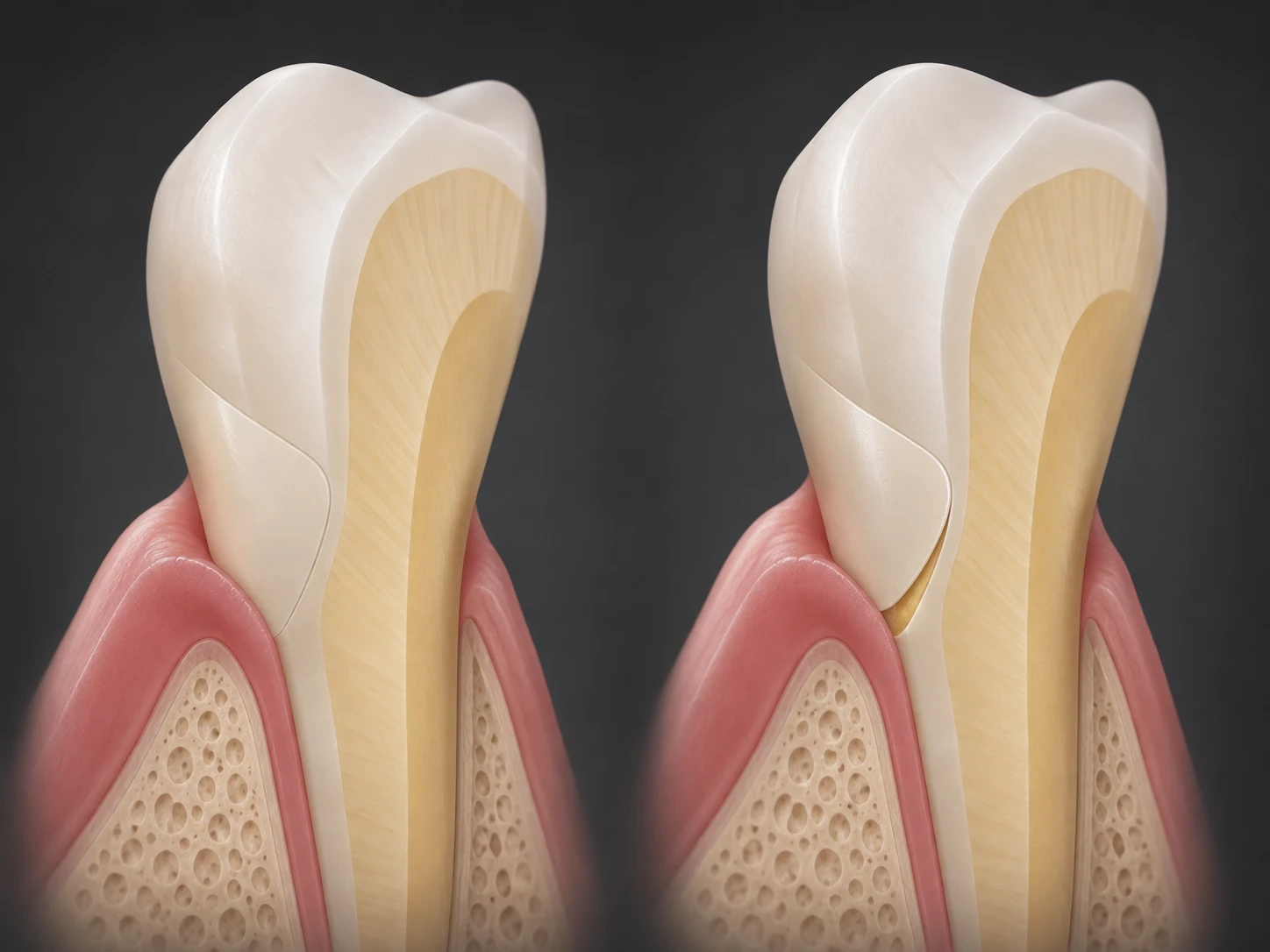
"Before patching up the worn spot, I first look at why it is wearing."
This is something I often emphasize when explaining tooth wear.
If a tooth is sensitive again even after being filled with resin, we need to check for gaps at the filling margin, exposed dentin, or other dental problems.
Temporary sensitivity can occur right after treatment, but if it keeps getting worse or the tooth hurts even when you're doing nothing, it should not be dismissed as simple post-treatment irritation.
In particular, if it hurts when you chew or a crack in the tooth is suspected, it needs to be distinguished from Tooth Fracture.
If one spot keeps feeling sensitive or hurts even at rest, it is best not to put it off and to have the cause checked.
6. How should I care for my teeth so cervical abrasion does not progress again?
Areas already worn by cervical abrasion do not repair themselves naturally, but it is possible to take care to reduce further damage. It is good to look at the force and direction of your brushing, your habits with acidic foods, and whether you grind your teeth.
The first thing to look at is how you usually brush.
It is best to use a soft toothbrush and avoid scrubbing hard side to side along the gumline. You can place the bristles gently where the gum meets the tooth and brush with small movements, or sweep toward the tooth.
Pressing harder does not make your teeth any cleaner.
After drinking acidic drinks, rinse your mouth with water, and it is better to wait a little while rather than brushing hard right away.
Also, if you have a habit of clenching or grinding your teeth at night, the forces on your teeth need to be looked at as well.
At Yonsei Gunho Dental Clinic, when teeth grinding comes with jaw muscle problems, I work together with Dr. Park Ji-ho, a board-certified oral and maxillofacial surgeon. Dr. Park focuses on the jaw joint and muscles, while I focus on the occlusion, how the teeth bite together.
An occlusal appliance or similar may be considered when needed, but not every case of cervical abrasion requires one.
Even teeth that have already been filled with resin still need care. It is good to check regularly for changes such as the filling margin opening up or the area wearing again.
In the end, filling with resin and managing the causes of wear need to be considered together.
In Closing
To me, good treatment is not about doing more but about conserving what you have. With cervical abrasion too, rather than deciding on treatment just because a tooth is notched, we should first look at why it wore away and whether it needs attention now. I believe that treating only as much as needed and thinking ahead to aftercare is the way to make your natural teeth last.
This has been Kim Kunmin, board-certified prosthodontist at Yonsei Gunho Dental Clinic in Jamsilsaenae.