
You may have heard that with navigation implant surgery, implants can be placed without cutting the gums and that it might hurt less after surgery.
Hello. I'm Dr. Park Ji-ho, a board-certified oral and maxillofacial surgeon at Yonsei Gunho Dental Clinic in Jamsilsaenae.
Navigation implant surgery and flapless implant surgery do not mean the same thing. Even when the surgical position is planned digitally in advance, an incision may be needed depending on the condition of the alveolar bone (gum bone) and the surrounding tissues.
Today I'll explain how the two approaches differ, under what conditions flapless surgery is considered, and the actual order in which treatment proceeds.
1. What is navigation implant surgery, and how is it different from conventional implant surgery?
Navigation implant surgery (computer-guided implant surgery) is a method in which the implant position is planned in advance using CT and an intraoral scan, and that plan is then transferred to the surgery. What sets it apart from conventional implant surgery is the use of digital planning and a surgical guide.
Because of the name, it is easy to mistake it for surgery in which a robot places the implant on its own.
However, navigation implant surgery usually means transferring the position and angle designed on a computer to the surgery using a device called a surgical guide. The surgery itself is performed by the dentist.
Terms such as digital implant, computer-guided implant, and guided implant are used with a similar meaning.
When I review a CT scan before surgery, I follow a certain order.
First I look at the bone, then the nerves, and finally where the implant will be placed.
For the bone, its height, thickness, and condition all need to be examined. A single panoramic X-ray is not enough to check bone thickness adequately, so I use CT.
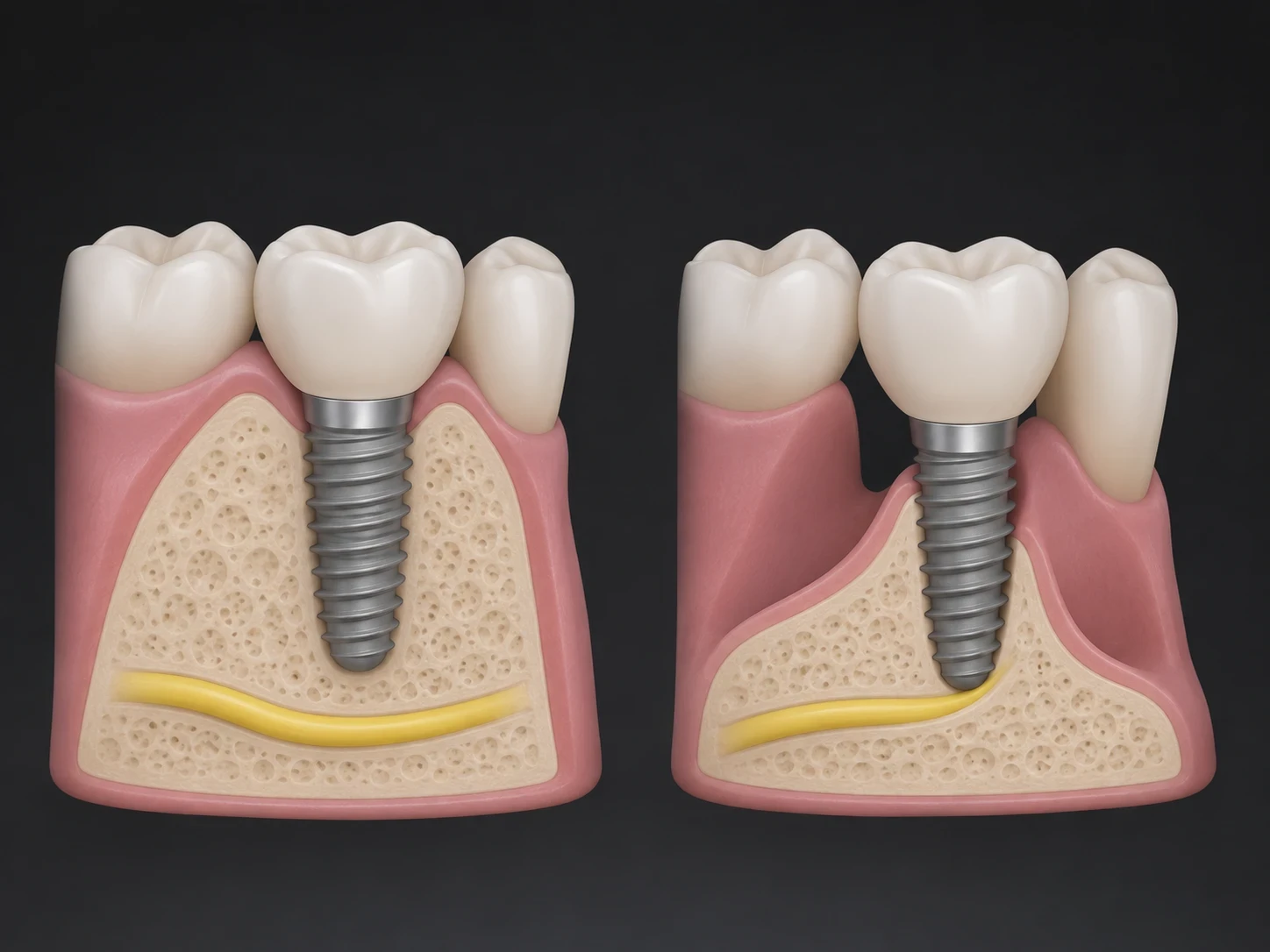
In the lower jaw, I check the inferior alveolar nerve canal, which is responsible for sensation, and in the upper jaw, the relationship with the maxillary sinus. If the depth is set without considering the distance to the nerve canal, abnormal sensation can develop in the lower lip or chin.
An implant is, after all, surgery. I believe the risks that can come with surgery should be explained in advance.
Finally, I decide where the implant will go. At this point, it is not just about the bone; the position of the tooth that will later sit on top and the spacing between the neighboring teeth must also be considered.
Where to place an implant is decided starting from what kind of tooth ultimately needs to be made.
2. Does flapless implant surgery mean the same thing as navigation implant surgery?
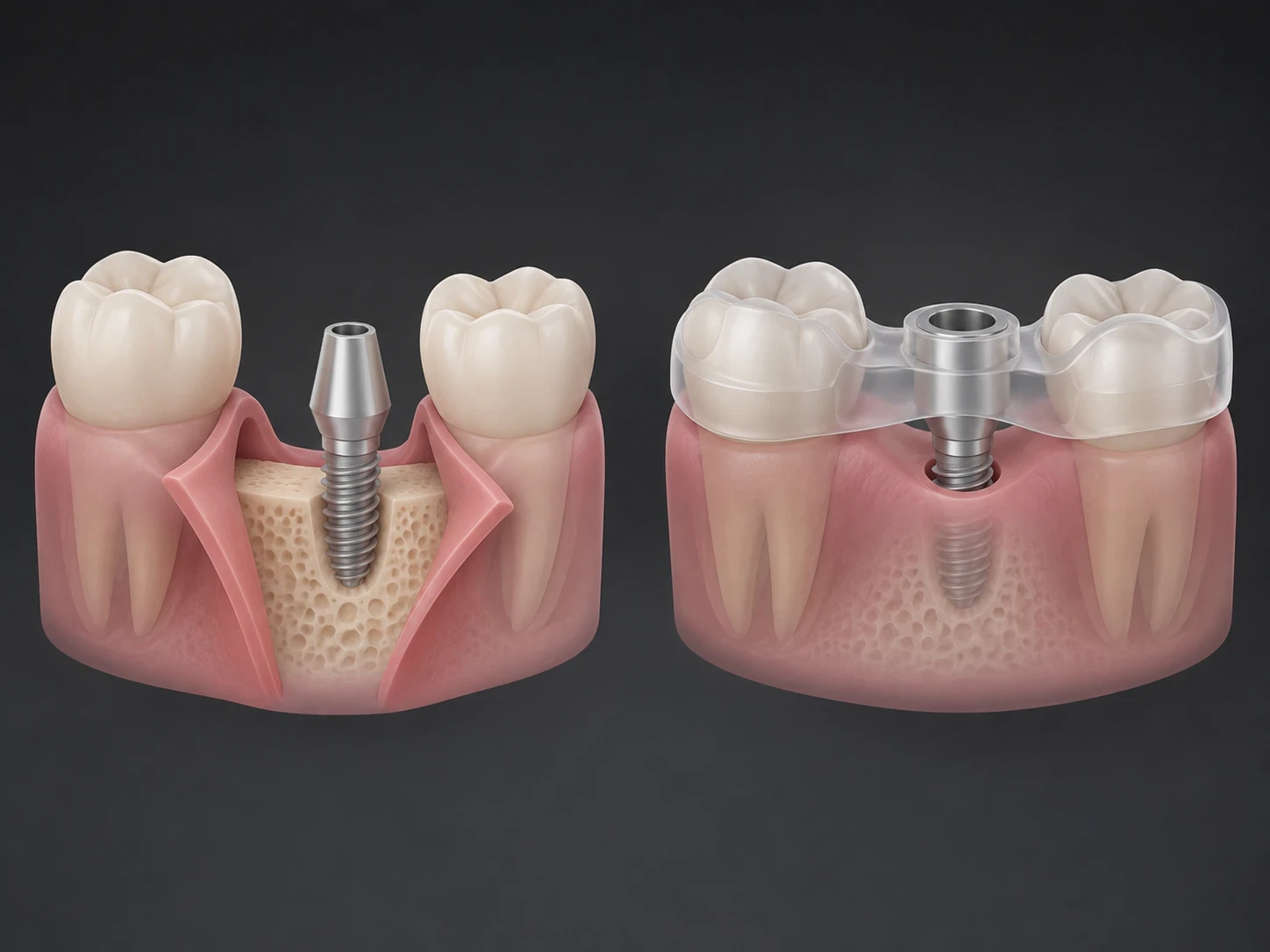
Flapless implant surgery is a surgical method in which the implant is placed through a small opening without widely opening the gums. Navigation is a technique for planning the surgical position and transferring it to surgery, so although the two are sometimes used together, they are not the same concept.
Generally, when the alveolar bone needs to be checked directly, the gums are incised and opened for surgery.
The flapless approach, on the other hand, does not widely open the gums. The implant is placed based on the bone shape and surgical plan confirmed in advance.
A navigation guide can direct the surgical instruments in the planned direction, so it is sometimes used together with the flapless approach.
However, using a guide does not necessarily mean the surgery is flapless.
Not widely opening the gums may reduce discomfort or swelling after surgery. However, research has not confirmed a consistent benefit in pain or recovery for every patient.
I don't insist on the flapless approach alone either.
This is because when the alveolar bone needs to be checked directly or a bone graft is needed, surgery with an incision may be more appropriate.
3. Who can have flapless navigation implant surgery, and when is it difficult?
Flapless surgery can be considered when there is enough alveolar bone to place the implant and the surrounding gums are in suitable condition. If the bone is insufficient or the site is close to the nerve or the maxillary sinus, an incision or additional procedures may be needed.
The first thing I check is whether there is enough bone to fully surround the planned implant.
Even if the bone height seems sufficient, if the width is narrow, part of the implant may be exposed outside the bone.
I also need to look at the thickness of the gums and the extent of the firmly attached gum. This is because in flapless surgery, there are limits to directly checking and adjusting these tissues.
| Item checked | Conditions for considering flapless surgery | Conditions for considering an incision or another approach |
|---|---|---|
| Alveolar bone | Sufficient bone at the planned placement site | Bone is thin or lacks height |
| Attached gingiva | Soft tissue around the implant is in suitable condition | Keratinized gingiva is insufficient or a soft tissue procedure is needed |
| Nerve and maxillary sinus | There is the necessary clearance between the anatomical structures and the planned position | The nerve canal or maxillary sinus is close, so the surgical plan must be changed |
| Bone graft | Placement is possible without an additional bone graft | A bone graft or maxillary sinus procedure is needed |
| Immediate placement after extraction | The extraction site and primary stability conditions are suitable | A separate approach is needed due to bone defects or infection at the extraction site |
The conditions in the table are general criteria. Being close to the nerve canal or maxillary sinus does not by itself mean flapless surgery is impossible.
The actual surgical method is decided by considering together the bone shape seen on CT, the soft tissue condition, and any additional procedures needed.
The same applies when an implant is placed right after extraction. Whether to use a guide and which surgical method to use are decided based on the bone condition at the extraction site and the likelihood of achieving primary stability.
Options for when bone is insufficient are covered in more detail in Implant Bone Graft, and the relationship between the upper back teeth and the maxillary sinus in Sinus Lift.
4. In what order does navigation implant surgery proceed, from CT scan to surgery?
Navigation implant surgery proceeds in this order: a surgical plan is made with CT and an intraoral scan, a guide is fabricated, and the guide is used to place the implant. At Yonsei Gunho Dental Clinic, two doctors, one from surgery and one from prosthodontics, plan together, and the guide is made in-house.
In particular, I consider the position of the final restoration first when planning surgery.
This is because even if the implant goes into the bone well, problems can arise during the prosthetic stage if the position or chewing direction of the tooth placed on top is not appropriate.
Step 1. CT and intraoral scan
CT is used to check the height and thickness of the alveolar bone and the positions of the nerve canal and maxillary sinus.
The intraoral scan records the shape of the teeth and gum surface, and the two sets of information are used together to review where the implant will be placed.
Step 2. Surgical and prosthodontic collaboration and virtual surgery
I examine the bone, the nerves, and the surgical difficulty. Dr. Kim Kunmin, a board-certified prosthodontist, checks the position of the final restoration and how the upper and lower teeth bite together.
The two doctors virtually position the implant in front of the screen.
During this process, sites where the bone is thin and the implant surface is expected to be exposed are sometimes identified in advance.
Step 3. In-house fabrication of the surgical guide
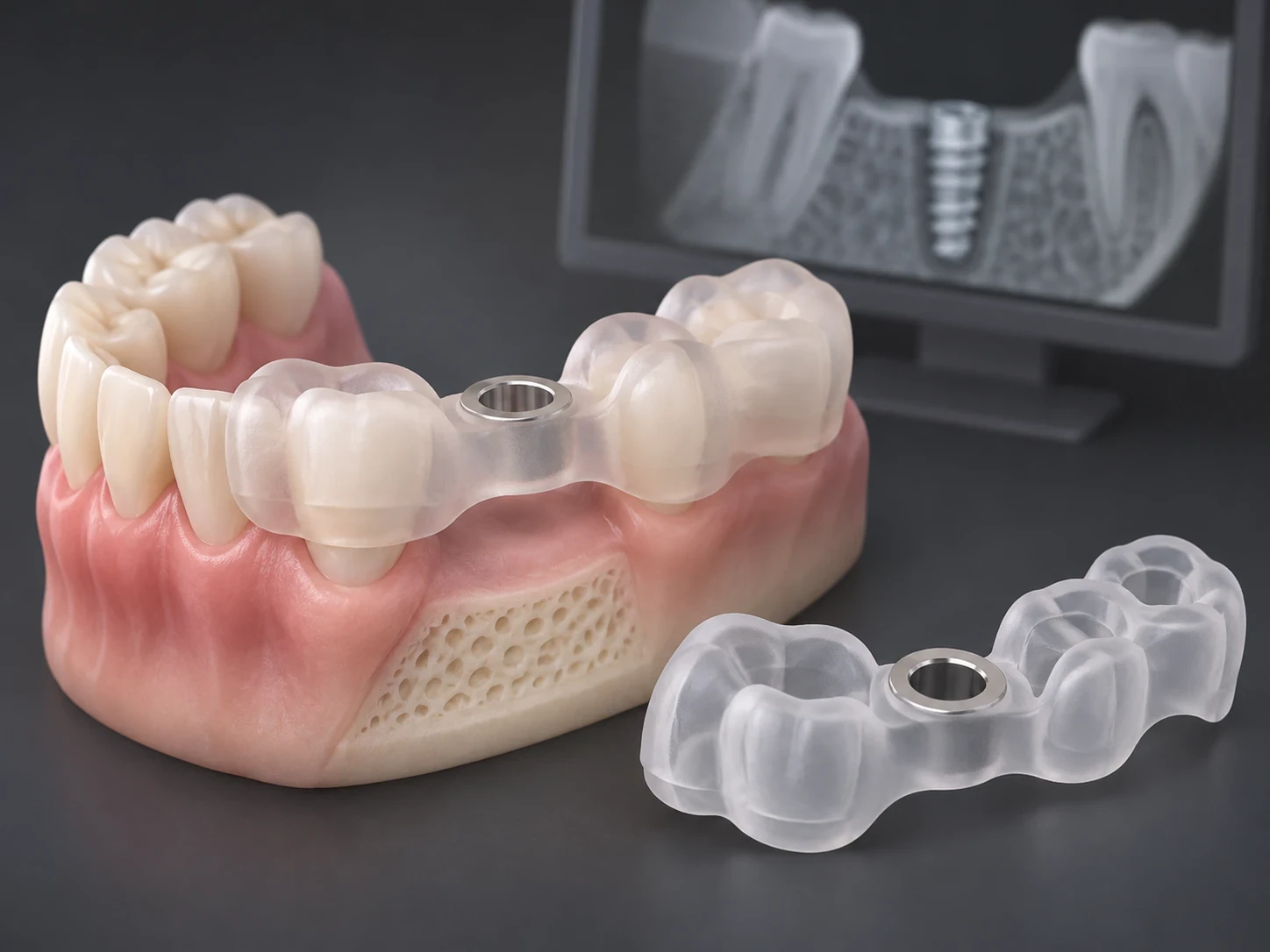
Once the plan is complete, a surgical guide is made based on that information.
At Yonsei Gunho Dental Clinic, the guide design is not outsourced; the two doctors review it themselves, and the guide is made with an in-house 3D printer.
The fabricated guide must be checked to make sure it fits properly on the teeth or gums. If the guide does not sit stably, the actual placement position may differ from the planned direction.
Step 4. Implant surgery
The implant is placed using the surgical guide, with reference to the planned position and direction.
If the conditions allow a flapless approach, a small opening is used; if the bone needs to be checked directly or additional procedures are needed, an incision approach is chosen.
If the condition found during surgery differs from what was expected, it is also important not to force the original plan.
Step 5. Post-operative check
At Yonsei Gunho Dental Clinic, swelling, bleeding, mouth opening, and similar points are checked the day after surgery.
Subsequent care and the timing of the prosthetic stage depend on the bone condition, primary stability, and whether a bone graft was done. The specific check-up schedule follows the clinic's protocol and varies from person to person.
5. What are the advantages, disadvantages, and side effects of navigation implant surgery?
The advantage of navigation implant surgery is that it helps transfer the position and angle planned before surgery to the actual surgery. However, errors can occur when the guide is fabricated and seated, and the risks of conventional implant surgery do not disappear.
Being able to check the positions of the nerve canal and maxillary sinus before surgery and to plan the placement direction to match the final restoration is a clear advantage.
However, there are also limitations you should be aware of.
- Difference between the plan and the actual position: If the CT and intraoral scan data do not match or the guide is not seated properly, the implant may be placed in a position different from the plan.
- Preparation process: Digital planning, guide fabrication, and fit checks are added to the process.
- Mouth opening and surgical space: If it is hard to open the mouth wide or there is not enough room for instruments in the back molar area, using a guide may be difficult.
- Risks of the surgery itself: The possibility of bleeding, infection, abnormal sensation from nerve damage, maxillary sinus complications, and similar problems remains.
One thing to keep in mind in particular is that if there is a problem with the original plan, the guide can transfer that plan to the surgery just as it is.
That is why I look at pre-surgical planning and diagnosis more carefully than at the guide itself.
When considering implant removal and revision surgery, I also start by checking where and at what angle the implant was originally placed.
This is because the next treatment direction can only be decided after examining how the implant's position is affecting the surrounding bone, nerves, and restoration.
Situations that require revision surgery and the criteria for that decision can be found on the Implant Revision Surgery page.
6. What does the cost of navigation implant surgery depend on?
The cost of navigation implant surgery can vary depending not only on whether a surgical guide is made but also on bone grafting, maxillary sinus procedures, the material of the final restoration, and the scope of treatment. Even with the same navigation approach, the steps required differ depending on the condition of the patient's alveolar bone and teeth.
For example, the scope of treatment differs between placing an implant where there is enough bone and a case that also requires a bone graft or maxillary sinus surgery.
The material and method used to make the restoration also need to be considered.
Also, since fabricating the navigation guide is itself an added step, the first thing is to determine whether the situation actually calls for a guide.
When deciding on a surgical method, I don't make flapless surgery or the use of a guide a goal in itself.
The priority is choosing the treatment needed to match the current bone condition and the final prosthetic plan.
I've summarized the overall implant treatment process, the factors that determine cost, and the Korean National Health Insurance coverage criteria in Implant Treatment Process and Costs.
In Closing
Navigation implant surgery is a tool that helps transfer a plan made before surgery to the actual surgery, and the key lies in how that plan is made.
Flapless surgery, which does not widely open the gums, has its advantages, but it is not a suitable method for every patient.
I try to first judge which treatment is appropriate rather than which treatment is merely possible, and to choose the surgical method considering the bone, the nerves, and the final restoration.
This has been Dr. Park Ji-ho, a board-certified oral and maxillofacial surgeon at Yonsei Gunho Dental Clinic in Jamsilsaenae.