
The gum around your wisdom tooth has suddenly become swollen and painful, it is nighttime so you are not sure what to do, and you are probably worried that if you go to the dentist, the tooth will have to come out right away.
Hello. I am Park Ji-ho, a board-certified oral and maxillofacial surgeon at Jamsilsaenae Yonsei Gunho Dental Clinic.
A swollen gum around a wisdom tooth does not automatically mean the tooth has to be extracted right away. First, we need to check how severe the inflammation is and decide whether to calm the infection or proceed with extraction.
Today I will explain why the gum around a wisdom tooth swells, what you can do right now, and the criteria for deciding whether to extract.
1. Why does the gum around a wisdom tooth swell and hurt?
A common cause of a swollen gum around a wisdom tooth is pericoronitis. Especially when a wisdom tooth has only partially come in, food and bacteria easily build up under the gum.
When a wisdom tooth cannot fully emerge through the gum, part of the tooth may remain covered by gum tissue. If food gets under this gum flap (operculum), it is hard to keep the area clean with a toothbrush.
This inflamed condition is called pericoronitis.
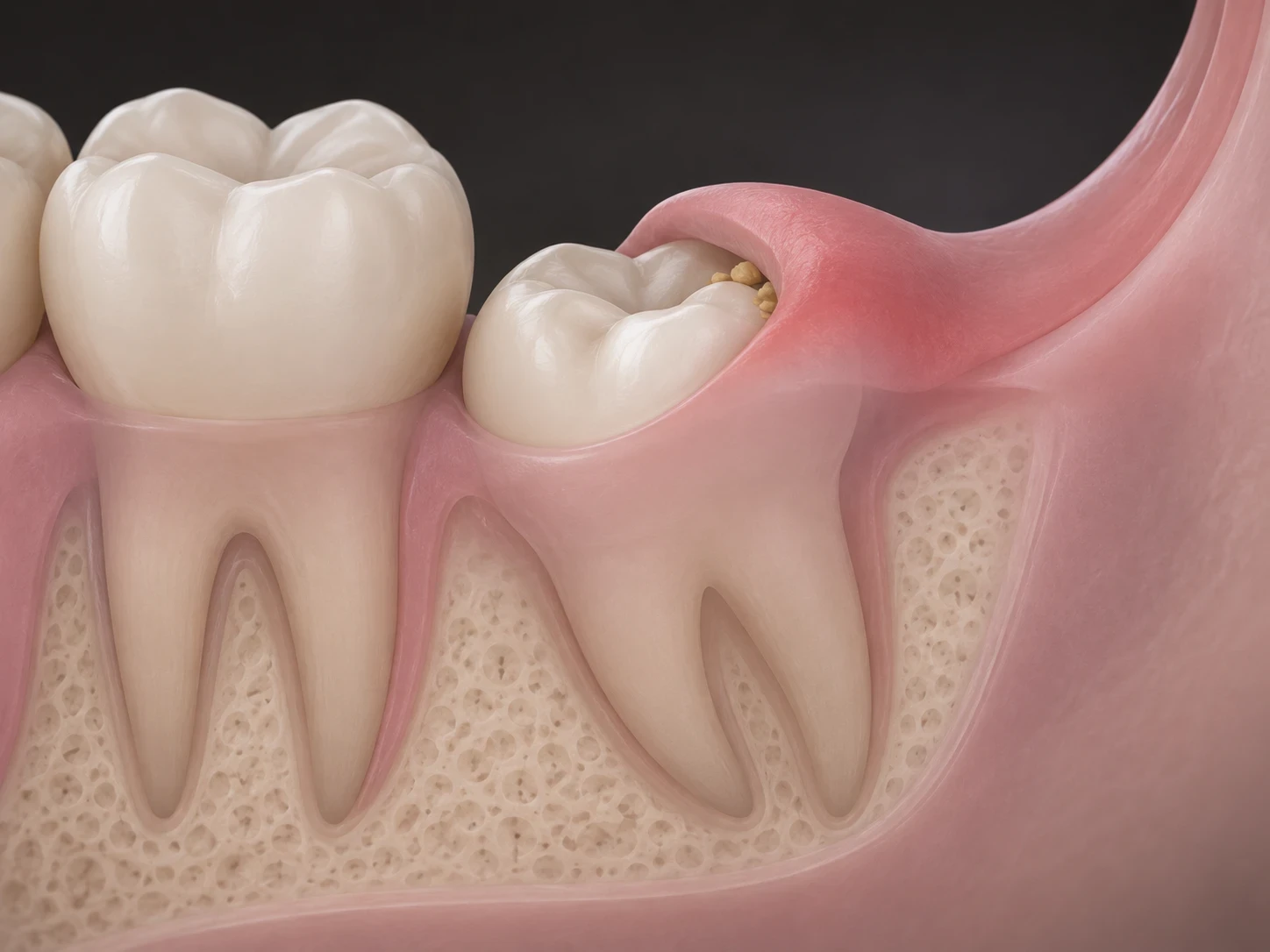
At first, the gum behind the wisdom tooth may be only slightly swollen and uncomfortable when you chew. As the inflammation worsens, you may notice bad breath or an unpleasant taste, and it may hurt to open your mouth or swallow food.
Some people also describe pain spreading toward the ear or neck.
In particular, with a partially erupted (partially impacted) wisdom tooth, the gum may swell and settle down repeatedly. Symptoms may stand out when you are tired, but rather than fatigue itself being the cause, in many cases a structure that easily traps food is still there.
When these symptoms keep recurring, rather than simply noting that the gum is swollen, I first look at which direction the wisdom tooth has come in and how it is affecting the surrounding tissues.
2. What should I do at home tonight if the gum around my wisdom tooth is swollen?
For mild swelling of the gum around a wisdom tooth, keeping your mouth clean and managing the pain can help. However, home care is only a temporary measure and does not resolve the cause of the inflammation.
If it is nighttime and you cannot see a dentist right away, try the following.
| What you can do | What to avoid |
|---|---|
| Rinse gently with lukewarm salt water | Squeezing or poking the swollen gum with your fingers or a needle |
| Brush around the wisdom tooth with a soft toothbrush | Rubbing the painful area hard |
| Check an over-the-counter pain reliever with a pharmacist and take it as directed on the label | Taking leftover prescription medication on your own |
| Briefly apply a cold compress wrapped in a towel to the outside of your cheek | Applying a hot compress for a long time |
| Chew soft foods on the other side | Chewing hard foods on the painful side |
A pain reliever may not be suitable depending on any conditions you have or medications you are taking, so you need to check first. It is also best to avoid alcohol.
Even if the gum is swollen, you should not press on it or try to drain pus yourself. This can irritate the tissue and make the infection worse.
What I want to emphasize is that less pain does not mean the cause of the inflammation is gone.
If the gum covering the wisdom tooth and the structure that traps food remain as they are, the symptoms can come back.
3. If the swelling around a wisdom tooth is severe, which symptoms call for prompt care?
If inflammation around a wisdom tooth spreads to the face or below the jaw, or comes with a fever, you need prompt care. In particular, if swallowing or breathing becomes difficult, it may be an emergency.
If you have any of the following symptoms, do not treat it as simple gum swelling.
- Your jaw is so stiff that you can barely open your mouth
- Swelling spreads to your cheek, face, or below your jaw
- You have a fever and feel generally unwell, as if you have the flu
- Pus comes out of the gum or the pain is getting worse
- It becomes hard to swallow saliva or food
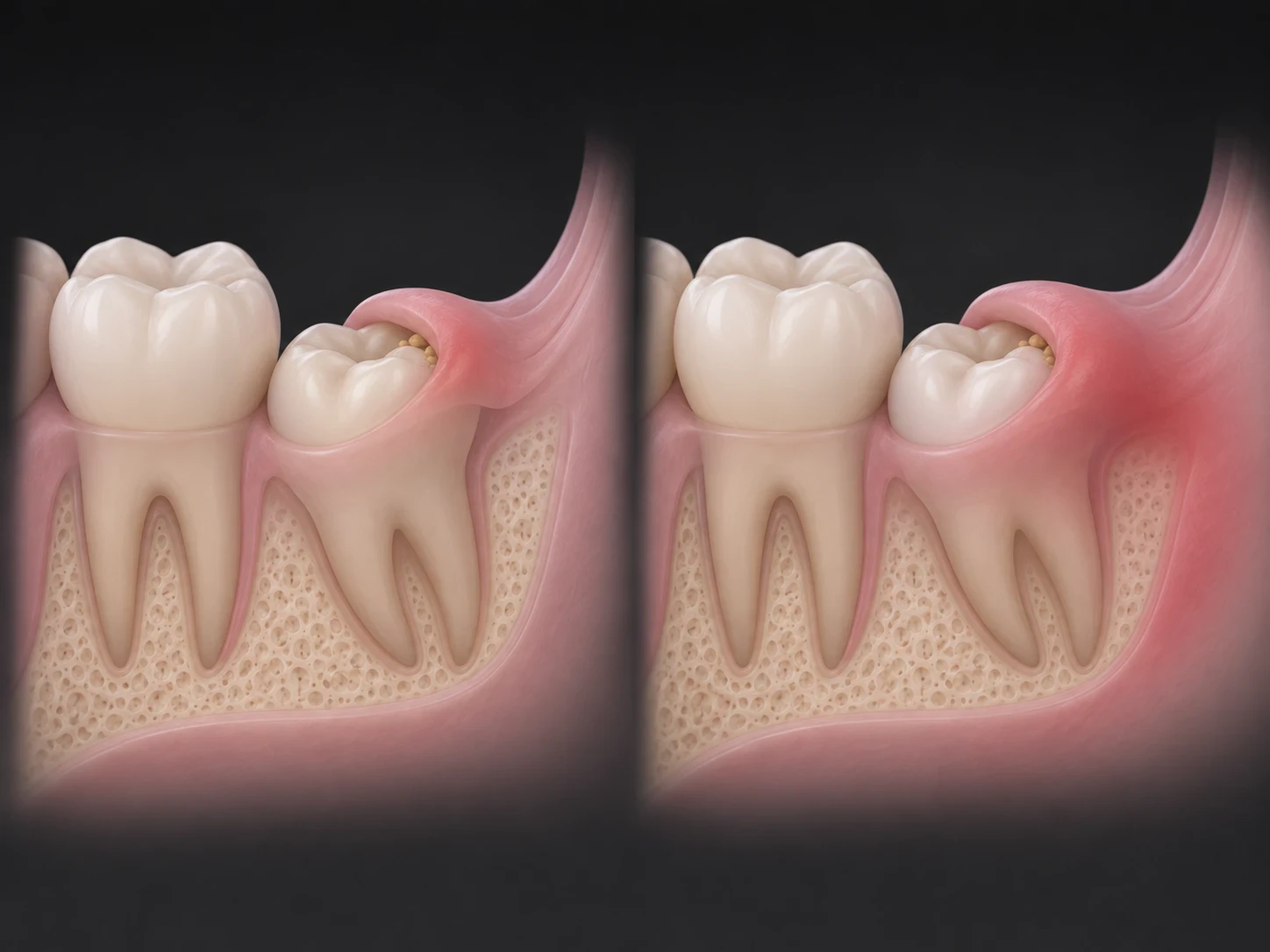
In some cases, an infection around a wisdom tooth can spread to the soft tissues around the jaw and neck.
There are situations I pay particular attention to in my practice.
If you suddenly can barely open your mouth, your face is swollen, and you have a fever, do not put it off; get examined quickly.
If pus is suspected or facial swelling is worsening quickly, a prompt evaluation is also needed.
If you have difficulty breathing or can hardly even swallow saliva, do not wait for a dental appointment; go to the emergency room immediately.
With these symptoms, it is not appropriate to tough it out at home with pain relievers alone.
4. If a wisdom tooth is inflamed, will the dentist extract it right away?
Inflammation around a wisdom tooth does not necessarily mean same-day extraction. We look at the extent of the inflammation, how well you can open your mouth, and the position of the wisdom tooth, and then decide on the treatment sequence needed.
In some cases the inflammation is controlled first and the tooth is extracted afterward; depending on the condition, extraction may also be done right away.
Step 1. Checking the current state of inflammation
First, we check how swollen the gum is, whether there is pus, and whether you have any difficulty opening your mouth.
We confirm the position of the wisdom tooth with a panoramic X-ray, and when we need to look more closely at its relationship to the inferior alveolar nerve canal in the lower jaw, we consider a CT scan.
Step 2. Managing the infection as needed
If the inflammation is severe, we may first clean around the wisdom tooth and carry out treatment to reduce food and other irritants that trigger inflammation.
If the infection has spread or there are whole-body symptoms, we prescribe medication when needed. Not every case of wisdom tooth inflammation requires antibiotics.
In severely inflamed areas, anesthesia may not work well enough, and if it is hard to open the mouth, this also affects the extraction. With these points in mind, we sometimes calm the inflammation first.
Step 3. Deciding when to extract
The extraction may be done after the inflammation is under control, or we may judge that extracting in the current state is more appropriate.
Before making a treatment plan, I ask myself:
Is this treatment needed now? How will it affect the surrounding tissues? Is this a condition that can wait?
That is because being able to extract a tooth and needing to extract it now are two different questions.
You can find details on the extraction process and aftercare on the Wisdom Tooth Extraction page.
5. If the gum swelling around my wisdom tooth goes down, can I skip extraction?
Even if the swelling has gone down, extraction should be considered if inflammation around the wisdom tooth keeps coming back. On the other hand, a wisdom tooth that has come in normally and is well maintained may be monitored without extraction.
Not every wisdom tooth has to be removed just because it is a wisdom tooth.
These are the criteria I look at when deciding whether to extract.
- Whether the gum around the wisdom tooth repeatedly swells and hurts
- Whether food keeps getting trapped around a partially erupted wisdom tooth
- Whether the molar in front has developed decay or external root resorption
- Whether the wisdom tooth has come in normally so that brushing and care are possible
In particular, if the molar directly in front of the wisdom tooth is also being affected, the decision needs to be made more carefully.
I have seen many people who put off extraction out of fear, only to come in after repeated inflammation had damaged the molar in front as well.
On the other hand, if the wisdom tooth has fully come in, fits well with the upper and lower teeth, and is easy to keep clean, there is no need to extract it.
"Rather than asking whether a wisdom tooth can be removed, I first ask whether it really needs to be removed now."
This is the standard I try to keep when explaining whether a wisdom tooth should be extracted.
Localized inflammation around a wisdom tooth and gum disease affecting the gums as a whole can differ in cause and treatment approach. General gum disease is explained separately on the Gum Treatment page.
6. If fear of extraction is making you put off a wisdom tooth, what should you check first?
If you are afraid of extraction, it is a good idea to first check the position of the wisdom tooth roots and the nerve canal, as well as the condition of the surrounding tissues. The need for extraction, the expected discomfort, and risks such as nerve injury should be considered together.
I trained at Yonsei University College of Dentistry and Severance Hospital in Sinchon, and I have experience supervising students' wisdom tooth extractions at a university hospital.
When explaining wisdom tooth extraction, I often compare a panoramic X-ray and a CT scan using the image of a tree.
If a panoramic X-ray is like the shadow of a tree cast on a wall, a CT scan is more like examining the tree in three dimensions.
Especially with lower wisdom teeth, the nerve canal carrying the nerve responsible for sensation may run close to the roots.
Even if they appear to overlap on a panoramic X-ray, a CT scan lets us see in more detail whether the nerve canal lies in front of or behind the roots, or on their inner or outer side.
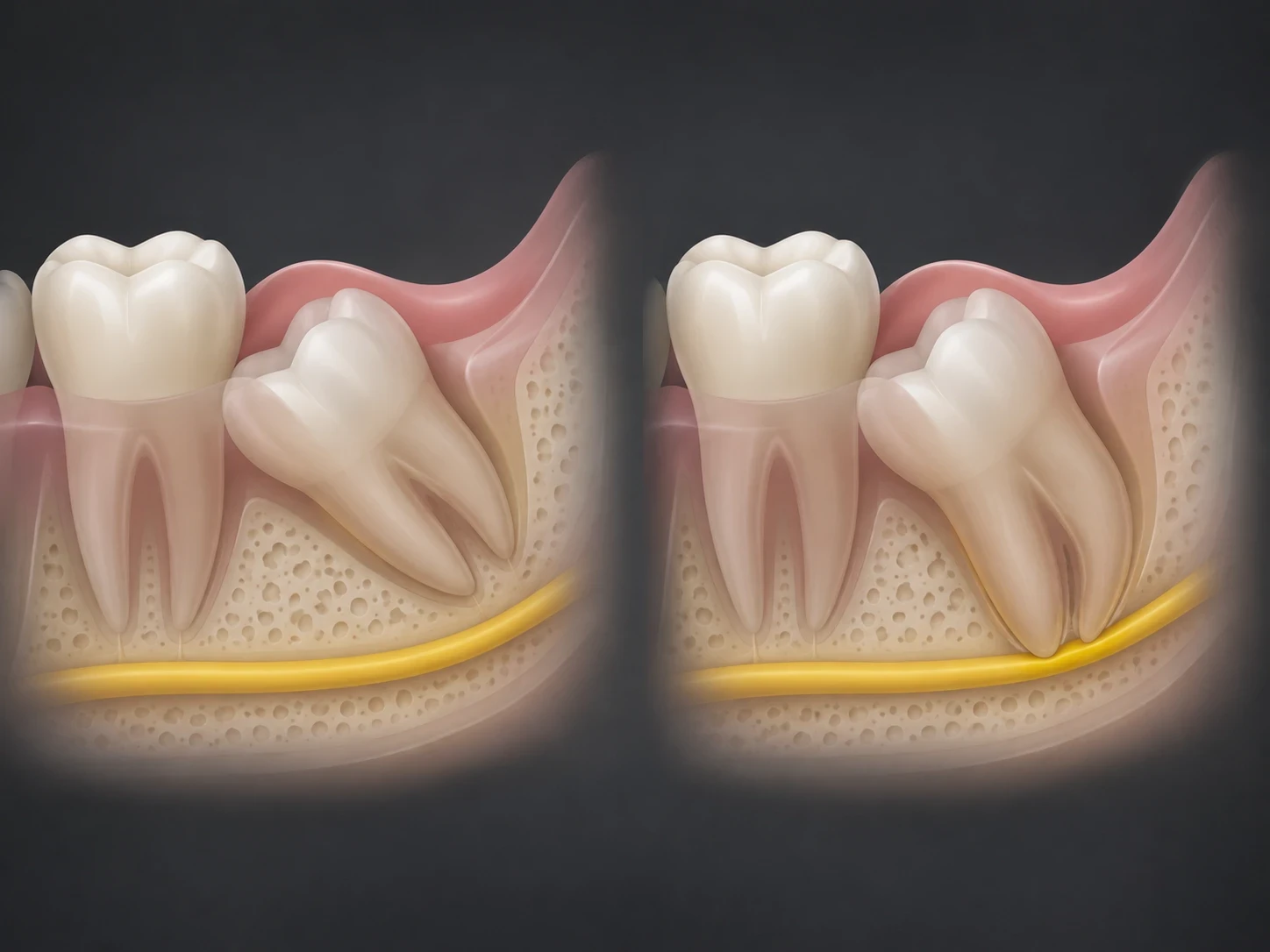
At Yonsei Gunho Dental Clinic, when necessary, we confirm the position with a low-dose CT and carry out treatment in a separate surgical room according to the extraction plan.
Discomfort after extraction is not determined simply by whether the wisdom tooth is lying on its side.
It depends on how much the gum was opened, how much of the surrounding bone was trimmed, how much force was applied during the extraction, how long the surgery took, and what the existing state of inflammation was.
That is why, when inflammation is severe, it is sometimes more appropriate to control the inflammation first rather than pushing ahead.
After the extraction, I see you again the next day and personally check the swelling and sensation. I look at how you are recovering, and if all is well, I tell you face to face, "It's healing well."
Of course, besides swelling and pain, bleeding, infection, altered sensation, and other issues can occur after extraction, so an explanation tailored to each person's condition is needed.
If your fear of extraction is strong, conscious sedation is also an option to consider. However, it is not suitable for everyone, and your overall health and the medications you take need to be checked.
You can find more details in Conscious Sedation and When the Dentist Feels Too Scary.
In Closing
A swollen, painful gum around a wisdom tooth does not necessarily mean it has to be extracted on the spot. However, if the inflammation keeps coming back or is affecting nearby teeth, it is not good to put things off for a long time just because the symptoms have settled down.
Rather than what treatment can be done, I first think about whether a treatment is appropriate to do now and whether it is truly necessary.
This was Park Ji-ho, board-certified oral and maxillofacial surgeon at Jamsilsaenae Yonsei Gunho Dental Clinic.